







You probably use ChatGPT for some things, Google for others, and a separate coding tool for others still.
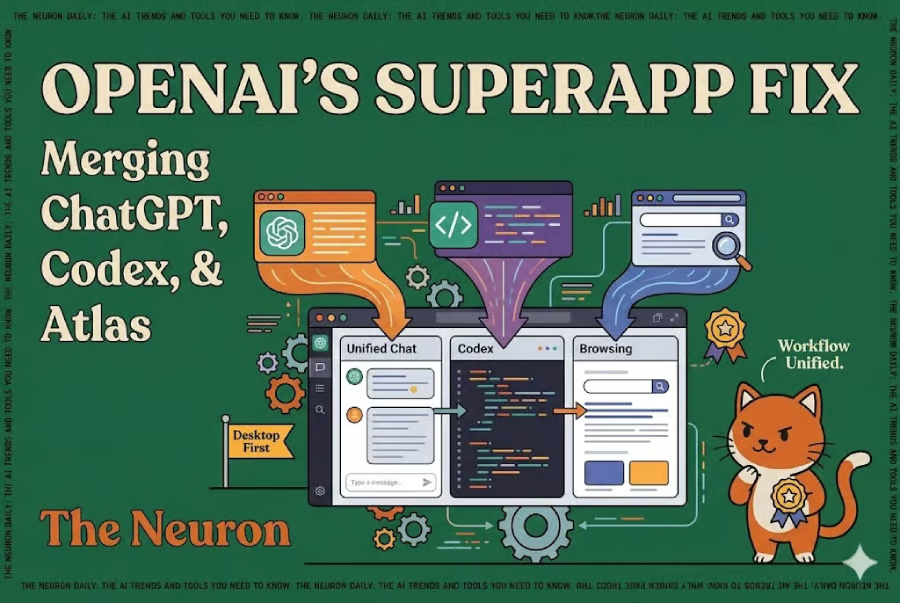
OpenAI built products that way too: ChatGPT over here, Codex (their AI coding platform) over there, and an AI browser called Atlas somewhere else. By late 2025, Sam Altman had seen enough. He declared an internal "code red" and told the company to stop the sprawl.
The result will be on your desktop soon.
Here's what happened
- OpenAI confirmed it is merging ChatGPT, Codex, and its Atlas browser into a single desktop "superapp," first reported by the Wall Street Journal in March and now entering its rollout phase
- The Financial Times report added the commercial layer: the redesign will steer users toward partner services like Canva and Booking.com, with coding tools, AI agents, and third-party integrations baked in
- Greg Brockman, OpenAI's co-founder and president, is permanently leading product strategy for the unified platform; Fidji Simo (OpenAI's CEO of Applications) is leading the commercial push
- Simo's internal memo was blunt: "Fragmentation has been slowing us down and making it harder to hit the quality bar we want"
- The mobile app is not changing; this is a desktop-first overhaul targeting professional and enterprise users
- OpenAI filed a confidential S-1 (the document companies submit before going public) with the SEC days after the restructuring was announced, at a reported valuation above $300 billion
Why this matters
The "superapp" model, popularized by WeChat in China and Grab in Southeast Asia, means a single platform handles everything: chat, search, productivity, payments, and commerce. OpenAI is betting that the AI equivalent is possible, and that ChatGPT is the right container for it.
This is also a direct shot at Anthropic. Claude Code hit $2.5 billion in annualized revenue by February 2026 and has been eating into OpenAI's lead with developers. Merging ChatGPT and Codex into one platform, with enterprise sales led by Simo, is OpenAI's answer: stop competing product-by-product and just own the whole workflow.
The IPO angle sharpens everything. Two million businesses already account for 40% of OpenAI's revenue. Getting that to 50% before listing is the goal. A superapp that keeps enterprise users within a single ecosystem is how you get there.
Our take
The clearest way to understand what OpenAI is building is to look at Google.
Think about how Google works. Gemini is embedded across Docs, Sheets, Slides, and Meet. Firebase and AI Studio handle developer-specific needs. NotebookLM got folded into the Gemini ecosystem. Everything Google builds lives within one interconnected platform, and Gemini is the thread running through it all.
That's exactly what OpenAI is attempting here.
ChatGPT is the chat layer. Codex handles code. Atlas handles browsing. One company, one ecosystem, one model family powering it all. The superapp is less a product launch and more an ecosystem declaration: we are done being a single chatbot, and we are building the Google Workspace of AI.
The open question is whether OpenAI can pull off what took Google two decades to build, before its IPO window closes and before Anthropic, Microsoft, and Google itself lock up the enterprise deals that make an ecosystem sticky in the first place.
Editor’s note: This article originally appeared on our sister publication, The Neuron.