







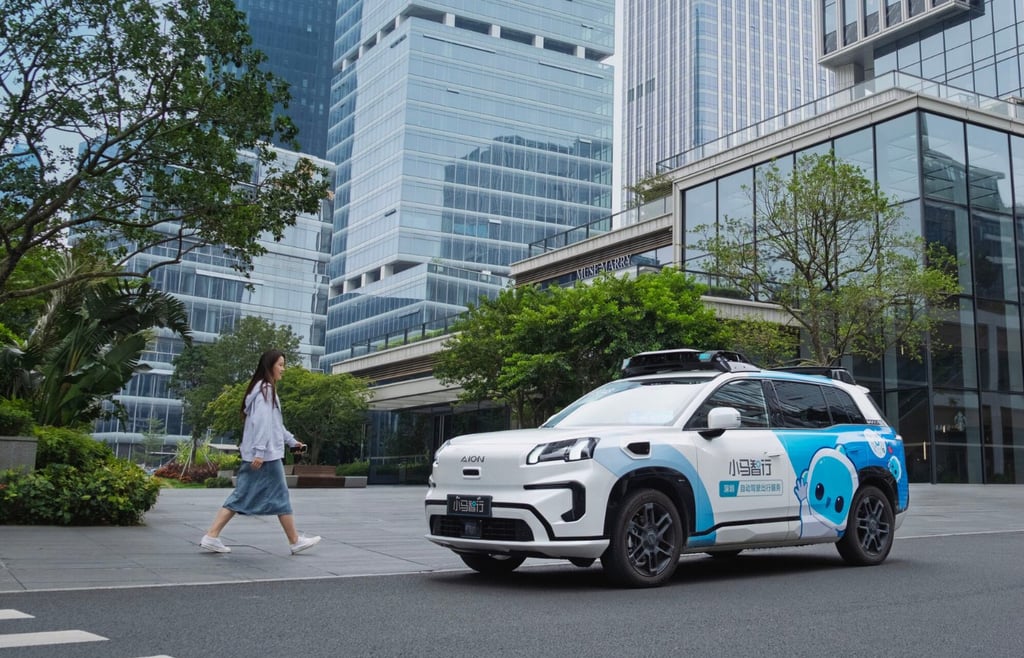
Pony.ai says its Gen-7 robotaxis now pay for themselves in one of China’s biggest mobility labs, Guangzhou. And it plans to more than triple its fleet in the next year as autonomous driving moves from showcase to business.
Backed by over US$800 million in fresh capital from a recent Hong Kong listing, the company is pushing harder on mass production, asset-light fleet partnerships, and international expansion.
Gen-7 breakeven shifts the robotaxi conversation
Pony.ai framed citywide breakeven in Guangzhou as proof that its Gen-7 architecture can support a sustainable robotaxi business model, not just a showcase project. It said each Gen-7 vehicle now handles an average of 232 daily orders in the city, supported by improved fleet utilization and remote assistance tools.
The company also noted it has 961 robotaxis in service, 667 of which are Gen-7. Management added that it remains on track to exceed a 1,000-vehicle fleet by the end of 2025 and aims to expand the fleet to more than 3,000 vehicles by the end of 2026, helped by a further 20% reduction in bill of materials costs for its autonomous driving kits in 2026 production.
The milestone comes just weeks after Pony.ai’s Gen-7 robotaxis formally entered fully driverless commercial operation across Guangzhou, Shenzhen, and Beijing, following extensive 24/7 testing across those cities earlier in the year.
Asset-light fleets and new geographies
To avoid owning every car on its balance sheet, Pony.ai is leaning into an asset-light model built on partners. According to the robotaxi developer, its collaboration with taxi operator Xihu Group in Shenzhen and a newer alliance with Sunlight Mobility are examples of third parties funding vehicle procurement. Meanwhile, Pony.ai provides the autonomous stack and operations.
This approach aligns with regulatory momentum in key Chinese cities. In October, local authorities in Shenzhen granted Pony.ai and Xihu Group the city’s first permit for fully driverless commercial robotaxi operations across the entire city, after an initial rollout in districts such as Nanshan and Qianhai. Pony.ai said the number of pickup and drop-off stops in Shenzhen now exceeds 10,000, up more than 300% since late June.
The company also reported global reach to eight countries via partnerships, including a new collaboration with Qatar’s Mowasalat, as well as expanded work in Singapore, Luxembourg, and South Korea. It is also working with global ride-hailing platforms, including shareholders Uber and Bolt, to explore additional markets.
Bigger picture: jobs, regulation, and autonomy at scale
China has become a proving ground for driverless mobility, with robotaxi pilots now active in roughly 20 cities. Local governments have encouraged deployments as part of smart-city strategies, while also using permitting regimes, such as Shenzhen’s citywide license for Pony.ai, to manage risk.
At the same time, economists and labor advocates have warned that large-scale adoption of robotaxis and autonomous delivery systems could threaten millions of driving and courier jobs over time, even if the transition is gradual.
For the broader autonomous vehicle ecosystem, Pony.ai’s trajectory offers a reference point alongside efforts from US players such as GM’s Cruise, which has long relied on cloud-native infrastructure and Kubernetes-based tooling to operate and update fleets.
While their regulatory and competitive environments differ, both sets of players are effectively building real-time, safety-critical distributed systems on wheels.
Amazon’s Zoox is also beginning to surface in San Francisco, where early riders are now testing its driverless shuttles.