







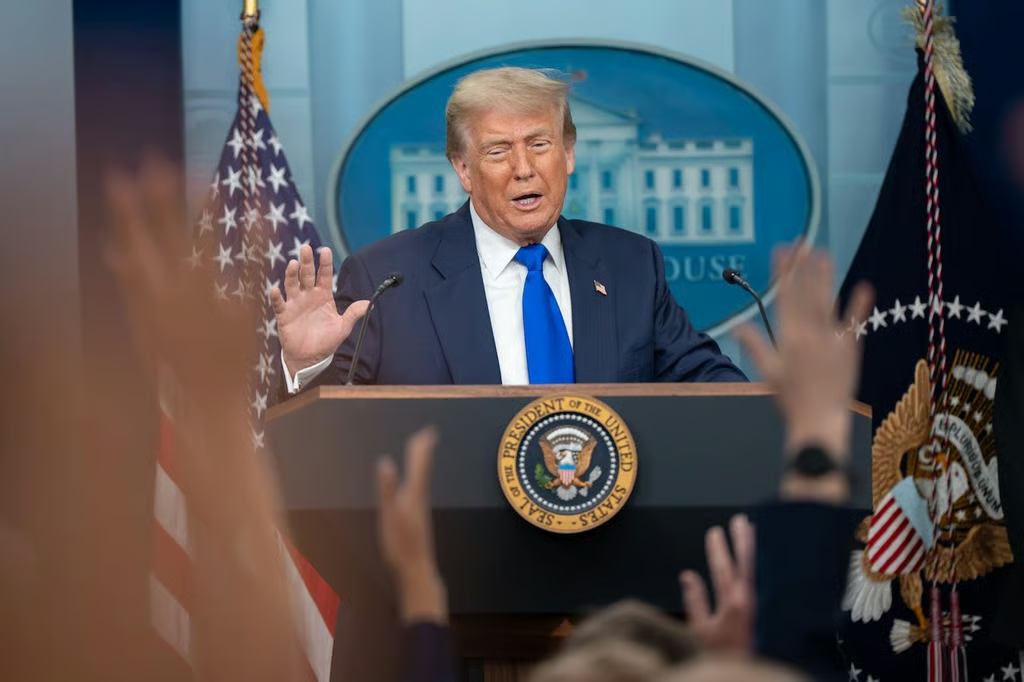
President Donald Trump has signed an executive order calling for federal review of advanced AI models before they reach the public, marking a notable shift from his administration’s earlier hands-off posture.
The order asks AI developers to voluntarily work with federal agencies on a benchmarking process meant to assess whether new systems have “advanced cyber capabilities” and should be treated as “covered frontier models.” The review is designed to evaluate potential risks to national security, financial systems, critical infrastructure, and other sensitive networks.
The policy stops short of mandatory regulation, but it still signals that the White House wants a closer look at the most powerful AI systems before they are widely deployed.
How federal AI benchmarking would work
Among the provisions of the order, the president is calling for a voluntary framework to be designed with AI developers through which developers would be able to:
- Engage the federal government to determine whether model(s) under development meet the designation of “covered frontier model.”
- Collaborate with the federal government to select trusted partners that will have early access to covered frontier models to promote secure innovation and strengthen the cybersecurity of critical infrastructure.
The classified benchmarking process will assess the national security implications of advanced AI models and determine which are covered by the policy. A determination will be made by the director of the National Security Agency, in collaboration with cybersecurity and technology leaders from the White House, the Cybersecurity and Infrastructure Security Agency (CISA), and the Pentagon.
How the policy shift happened
Last month’s executive order on AI came after months of debate in the administration about how to handle the technology and its impact on cybersecurity and national security. It would have created a 90-day window during which government officials would review new AI models before their release.
But former AI czar David Sacks warned Trump hours before the planned signing that the order would slow innovation, and the president pulled it just hours before he was due to sign.
Tuesday’s signing reportedly followed a meeting at the White House on Monday that Trump convened with Treasury Secretary Scott Bessent, Defense Secretary Pete Hegseth, and Sacks, who sanctioned the revised version after the review timeline was cut to 30 days from 90 days. That influenced Trump to move ahead with signing the revised order.
The 30-day pause would give federal agencies time to assess what threats the AI systems might pose to sensitive financial, national security, and other computer systems.
The executive order is the Trump administration’s biggest step toward regulating AI. Taking a more active role in monitoring the technology’s capabilities is a shift in strategy for the president, who had a laissez-faire attitude toward AI during his first term.
Trump also tried to discourage states from adopting AI regulations that he opposes. The president's decision to adopt voluntary testing could negatively affect industry profits if it delays the deployment of new models or leads companies to alter their development and evaluation processes to address security concerns.
Yet, Trump said government oversight is important to protect against threats to national security.
“Advanced AI capabilities make our nation stronger, but also introduce new national security considerations that require coordinated action across executive departments and agencies (agencies), and components,’’ the order stated in part. As these capabilities evolve, Trump said his administration “will continue to work closely with industry to ensure that the best and most secure technology is deployed rapidly to confront any and all threats to our country.”
The order leaves major questions unanswered, including how many AI companies will participate, how federal agencies will define “covered frontier model,” and whether voluntary benchmarking could eventually become a more formal review process. For now, the policy gives the Trump administration a clearer role in scrutinizing the next generation of AI systems before they reach the market.
The order follows other recent signs that the administration is taking a closer look at frontier AI risks. Anthropic, for example, recently briefed Trump officials on its AI safety framework, Mythos, as policymakers weigh how closely the government should monitor the most advanced systems.