






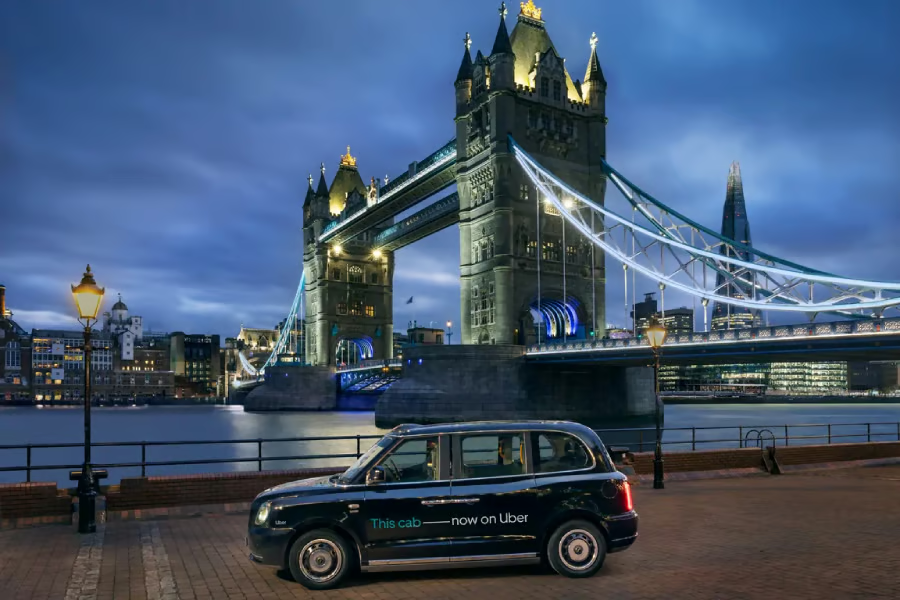


London’s robotaxi race is starting with a waitlist.
Uber has launched a London waitlist for riders interested in trying its first self-driving vehicles, powered by autonomous tech from Wayve. Customers who join the interest list will be more likely to be matched with a Wayve car when the self-driving service rolls out later this year.
As it has done in Austin and Atlanta with Waymo, Las Vegas with Motional, Dallas with Avride, and Dubai with WeRide, Uber will provide the ride-hailing platform for self-driving vendors to connect with passengers. It has not been disclosed what percentage Uber and Wayve will take from each ride.
Currently, Uber has a take rate of about 25% in mobility, but it could seek a much higher rate given the lower cost per ride without a human driver.
Uber and Lyft have both partnered with Baidu's Apollo driverless program, which aims to launch in London around the same time as Waymo and Wayve.
Like Waymo, Wayve is currently mapping the city, with dozens of cars being driven around London as radar, lidar, and cameras capture its many complexities and challenges. When they get the green light, it will be for autonomous rides with a safety driver in the front seat, ready to take control if intervention is required.
The Department for Transport and the UK government have said they aim to achieve fully driverless operations by 2027.
Wayve: the UK's answer to Waymo
According to Reuters, Wayve will deploy a fleet of Ford Mustang Mach-E SUVs on the Uber app, marking the company's first commercial launch. It is still far behind Waymo, which has said it plans to expand to more than 20 cities in 2026, including its first two outside the US: London and Tokyo.
The UK company received $1.2 billion in fresh funding in February to accelerate its robotaxi program, with major automakers Mercedes-Benz, Stellantis, and Nissan all involved in the round. It also wants to supply automakers with self-driving technology for production cars, rather than operating strictly as a robotaxi firm.
Is 2026 the year of the robotaxi?
Initial predictions had 2020 as the year of the self-driving vehicle, with executives from Ford, General Motors, and Tesla making similar claims in 2014 and 2015. An early wave of consolidation and closures tempered expectations, with Waymo for a time being the only operator still conducting millions of miles of self-driving tests.
There was renewed life in the market after the pandemic, as Waymo started its first commercial tests. Uber, which sold its autonomous operations in 2020 after costs spiraled, returned in 2022 with its Motional autonomous agreement and a partnership with Waymo. It accelerated investment in 2024 with financial agreements with WeRide, Avride, Nuro, Lucid, and others.
Uber is now pitching itself as the network or marketplace layer for these vehicles, with customers potentially able to order rides from several different vendors, similar to how users can currently choose between an Uber ride, a Lime bike, or car hire.
But robotaxis being available outside of a few locations is still unlikely, at least in 2026. Waymo has accelerated its expansion, and Uber has made significant investments, but there will still be a few years of ramping up this technology and making sure the public is on board.
For now, London’s robotaxi future is still arriving with a safety driver and a long list of caveats. But the bigger test is no longer whether autonomous vehicles can work in controlled pockets. It is whether companies like Uber and Wayve can make them reliable, regulated, and ordinary enough for riders to trust.
Also read: Baidu’s robotaxi failure in Wuhan raised fresh questions about autonomous-vehicle reliability and public safety.