







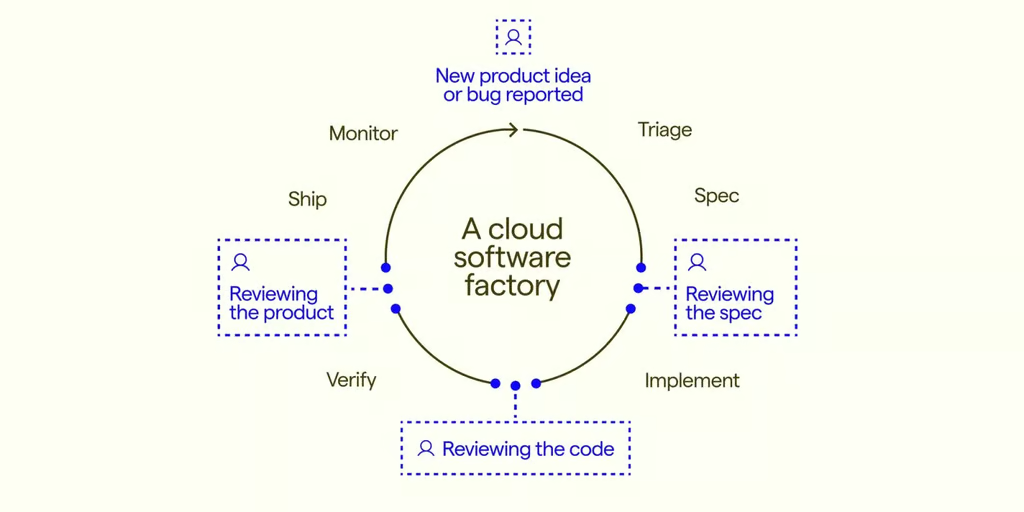
Warp launched Warp Factories on Aug. 18, moving its AI coding business toward centrally managed fleets of agents that can handle work across the software development lifecycle. The platform routes tasks through specialized agents for triage, specifications, implementation, and review while keeping humans involved at approval points.
Teams can mix models and coding harnesses within one workflow, track costs and results, and decide how much autonomy agents receive. The approach targets organizations trying to scale AI-assisted development without surrendering control over models, infrastructure, permissions, or code changes.
How Warp Factories orchestrates and controls coding agents
A coordinating “foreman” decides which agents should handle each work item and skips stages that are not needed. Warp’s Factories documentation says teams can customize agents and automations and manage factory definitions as version-controlled code, creating a review history and rollback path for configuration changes.
Work can enter Factories through GitHub, GitLab, Slack, Linear, and Jira. Agents can run different supported models and harnesses, including Warp Agent, Anthropic’s Claude Code, and OpenAI Codex.
That flexibility lets engineering teams match tools to particular jobs instead of standardizing an entire workflow on one provider. Cost is also becoming part of that decision as vendors compete on coding-agent pricing and capabilities.
Warp CEO Zach Lloyd told TechCrunch that the company automates roughly 30% to 35% of its own tasks in a typical week. The figure reflects Warp’s internal use rather than an independently verified customer benchmark.
Factories also tracks agent runs, costs, automations, and benchmarks. Its self-improvement system can identify recurring failures and propose configuration changes for review rather than applying them automatically.
Warp’s infrastructure and security documentation says teams can limit credentials by agent, connect supported inference providers, and use Warp-hosted infrastructure or, for eligible Enterprise customers, self-hosted workers. Specifications can require human approval, and pull requests still require a person to merge them.
The controls address risks already emerging around AI-generated code. Recent research into AI coding tools found security and quality results vary with task complexity, programming language, and oversight, increasing the importance of testing, code review, and tightly scoped permissions.
Early Access puts cost and ROI to the test
Warp Factories remains in Early Access and is available to a limited set of teams. Warp’s pricing information lists pay-as-you-go factory usage at a 20% markup over API rates. Build includes factory usage within plan credits and prices additional usage at API rates, while Enterprise offers self-hosted workers and bring-your-own-LLM inference at no Warp credit cost.
The infrastructure burden extends beyond coding. A recent Google Cloud survey on agentic AI infrastructure found 83% of surveyed organizations said their infrastructure needed upgrades to support production-grade agentic AI, with costs, governance, and operational complexity among the pressures.
Warp has not yet demonstrated Factories’ production impact through independent customer data. Organizations evaluating it should track pull-request acceptance and rollback rates, review time, total costs, agent permissions, and the amount of human intervention required. Those measurements will show whether coordinated coding agents reduce engineering overhead or shift that work into supervision, governance, and infrastructure management.
Read more: As autonomous systems gain access to more business tools and data, enterprise AI governance gaps are creating wider security and visibility challenges for organizations moving agents into production.