






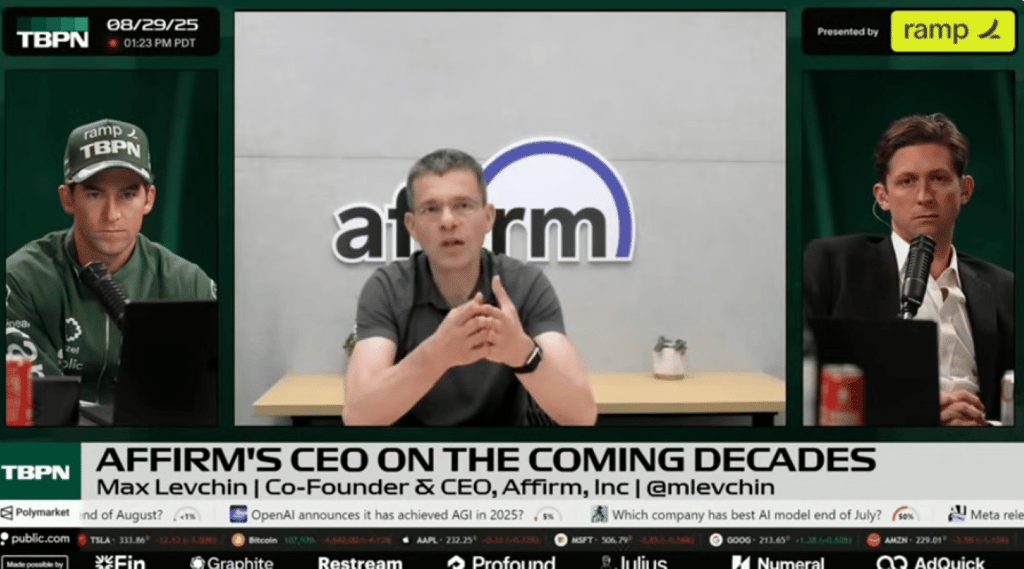


Affirm CEO Max Levchin says artificial intelligence is boosting humanity’s brainpower. Speaking on TBPN last Friday, the PayPal mafia alum argued that AI is effectively raising the universe’s average IQ — or at least the IQ of anyone online.
This tracks with what Ethan Mollick just wrote about “mass intelligence,” or the idea that nearly a billion people now have access to near-genius-level AI models.
Say what you will about economic bubbles or whether AI makes us lazy, but one thing’s undeniable: These tools are dramatically raising the floor of what average users can accomplish.
Here’s where it gets wild
This might solve one of humanity’s oldest problems.
- Ever notice how every major platform eventually turns to garbage? Google drowning in SEO spam; Airbnb becoming a minefield of fees; social media optimizing for outrage?
- 12 Grams of Carbon recently wrote about the newly coined (and highly scientific) term for this phenomena:“enshittification” — and how it works.
- See, services getting worse over time is not just the platforms’ fault, but ours as users, too. We’re all stuck in a prisoner’s dilemma where competitive incentives force everyone— platforms and users alike — to make choices that destroy value over time.
- Back in 2014, Scott Alexander called this force “Moloch” — the demon of competition that makes us sacrifice everything good on the altar of staying competitive, and how it’s actually plagued us for as long as humans have been around (long before the internet or ChatGPT slop).
- His proposed solution at the time? Only a benevolent artificial superintelligence could coordinate humanity out of this mess. (Ironically, he later co-authored AI 2027, predicting that the race to build that very superintelligence might destroy us all. Whoops.)
Well, the conventional wisdom says AI is about to make Moloch — or “enshittification” — exponentially worse: more spam, more manipulation, more races to the bottom.
But what if we’re thinking about this backward? Let’s revisit Max’s point: What if AI is actually raising humanity’s average IQ? Not through some sci-fi brain implant, but by making everyone who touches these tools dramatically smarter at navigating the world.
Max’s point was simple but profound. When AI helps us evaluate products in real-time, bad actors can’t hide behind complexity anymore. His example: AI-powered search helps people understand that Affirm’s transparent loans actually cost less than credit cards with compound interest traps.
Now multiply this by every decision we make daily:
- Google’s SEO slop problem? Now your AI assistant pre-filters search results, giving you just the information you ask for. Suddenly, spending millions on SEO manipulation becomes pointless — only genuine value surfaces.
- Airbnb’s bait-and-switch economy? Your AI agent spots patterns across thousands of reviews, calculates real total costs including those “surprise” cleaning fees, and warns you about hosts who mysteriously always find “damage.” The scammers lose their camouflage.
- AI-generated slop flooding your feeds? As AI assistants get better at detecting synthetic content, they can flag it before it wastes your time. And the attention economy’s race to the bottom hits a wall when fake engagement can’t fool anyone anymore.
You can basically call this the “unshittification” hypothesis!
Here’s the catch
This only works if AI can reliably distinguish truth from fiction, and if humans keep creating genuinely valuable products, content, and services. Otherwise, we’re just automating — and accelerating — Moloch’s race to the bottom.
But here’s the thing — we don’t need perfect detection. We just need to raise the cost of deception high enough that creating value becomes more profitable than gaming the system.
This is exactly what Meta’s betting $72 billion on: so called ”personal superintelligence” that helps you navigate life better. Though ironically, if we all get smart enough to stop doomscrolling, Meta’s current business model evaporates.
Now apply this to education
Joe Liemandt and MacKenzie Price at Alpha School aren’t waiting for superintelligence. Their AI tutor helps kids master entire grade levels in only 20-30 hours right now. The results are almost unbelievable.
- High schoolers who loved learning so much they canceled summer break.
- A student jumping 50 SAT points after AI identified she needed third-grade multiplication practice.
- Liemandt predicts that within 5-10 years, a sub-$1K tablet will teach any child everything they need academically in two hours daily.
- The rest of their day? Building real businesses, developing actual skills, becoming genuinely capable humans (and Alpha School has a plan to take this national).
Now scale this up. When a billion kids get 10x better at learning, they become adults who are 10x better at evaluating products, spotting scams, and creating valuable products and services. The enshittification cycle breaks because the marks get too clever to con.
This might be AI’s ultimate twist: Instead of building artificial general intelligence to govern us from above, we’re scaling human general intelligence from below. Every kid who learns to think critically, evaluate evidence, and solve real problems becomes another node in humanity’s distributed intelligence network — making us all better for it.
So maybe we don’t need a benevolent AI overlord to solve Moloch. We just need everyone informed enough to stop feeding the beast.
Editor’s note: This content originally ran in our sister publication, The Neuron. To read more from The Neuron, sign up for its newsletter here.