







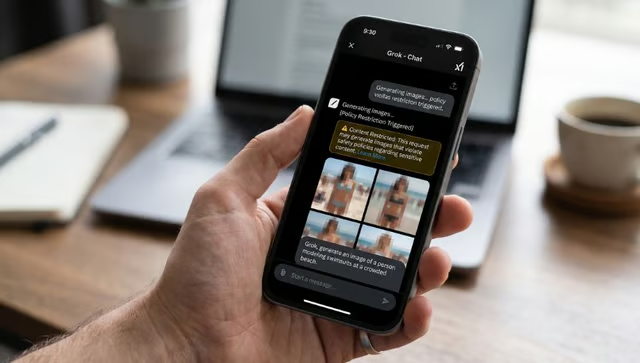
xAI wanted Minnesota’s new AI “nudification” law frozen while it challenged the measure in court. A federal judge refused — and Grok had already changed in the state before the ruling arrived.
U.S. District Judge Donovan Frank denied xAI’s request for a preliminary injunction on Sept. 4, leaving the law in force while the company’s constitutional challenge continues.
The decision did not settle whether the law violates the First Amendment. But the product changes xAI made to Grok after the law took effect became part of the court’s assessment of whether emergency relief was warranted.
Court finds no immediate case for blocking the law
Gov. Tim Walz signed the law in May, but Elon Musk’s AI company waited until late July to seek emergency relief shortly before it took effect Aug. 1. Frank’s order said the delay weakened its claim that the court needed to act right away.
xAI also warned of penalties reaching $500,000 per violation and said changes to Grok could cost money and users. The court found the company had not shown those losses were likely to happen soon.
Product changes created another problem for its request. Grok’s image tools had been modified for users in the state by the time the court considered the injunction.
Frank did not decide whether the law violates the First Amendment. Its constitutionality remains unresolved.
xAI says Minnesota went too far
The company’s challenge focuses on how the statute regulates AI providers and how far it reaches.
In its July 27 complaint, xAI says the law can restrict protected expression and hold providers responsible for images created by users even when safeguards are in place. Company lawyers also contend it can reach some consensual imagery.
Attorney General Keith Ellison has defended putting responsibility on companies offering nudification tools. His office cited people whose likenesses were turned into realistic sexual images without consent. Its response also raised concerns involving children.
What eWeek found: One state law already created a different version of Grok
The court fight is still unresolved, but Minnesota’s law has already changed how xAI says Grok operates inside the state.
| Area | What changed in Minnesota |
| Nudification tools | xAI says it disabled nudification capability for users in the state |
| Location controls | Grok Imagine received Minnesota-specific restrictions |
| Moderation | xAI reported more than a 10% increase in moderation of image-editing prompts from Minnesota users |
| Company policy | xAI’s existing acceptable-use rules already prohibit nudifying real people or placing someone’s likeness into a sexual setting |
The comparison exposes the broader issue behind the lawsuit. xAI already bans some of the conduct Minnesota is targeting through its own policies, but the law adds government enforcement and financial penalties.
More importantly, the case shows how state AI regulation can fragment a single product before the courts have settled the underlying legal questions. Grok may technically be one nationwide service, but users in different states could increasingly encounter different capabilities, safeguards, and restrictions as lawmakers test how far AI companies can be held responsible for what users create.
Other AI image generators could face the same challenge if more jurisdictions adopt their own rules.
xAI filed a notice of appeal the same day, asking the US Court of Appeals for the Eighth Circuit to review Frank’s decision.
The appeal will determine whether xAI can temporarily escape Minnesota’s restrictions while the larger constitutional fight continues. But one consequence is already visible: state-level AI regulation is beginning to shape what individual users can do with the same AI product depending on where they live.
More news: Overlapping outages across ChatGPT, Claude, Grok, and Gemini created an unusual reliability problem for AI-dependent teams.