






.webp "Dell Logo")
- Key takeaways
- AI Factory vs Traditional Data Center: What Changes?
- Transforming data centers into AI infrastructure platforms
- Validated infrastructure architecture for AI fine-tuning and inference
- Designing scalable AI infrastructure
- Networking and GPU factors that affect AI performance
- Scalability challenges in enterprise AI deployments
- Redundancy strategies for resilient AI systems
- Scaling AI infrastructure across global organizations
- Modernizing AI infrastructure for global enterprise environments
- AI data center modernization checklist
Key takeaways
- Traditional enterprise data centers built for CPU-based applications often struggle to support modern AI workloads.
- Modern AI data center infrastructure combines GPU clusters, high-speed networking, and distributed storage systems.
- Effective AI infrastructure architecture supports distributed computing and scalable machine learning environments.
- GPU capability, networking performance, and data pipelines influence AI workload performance.
- Enterprises must design infrastructure that supports scalability, resiliency, and global deployment.
Artificial intelligence has become a core capability for enterprises. Organizations are applying machine learning to software development, analytics, customer service automation, and operational decision-making. McKinsey’s State of AI survey reports that 88% of organizations now use AI in at least one business function, though many remain in early deployment stages.
As adoption expands, enterprises are discovering that traditional data centers were not designed to support modern AI data center infrastructure requirements. Training and running machine learning models require large datasets, parallel processing, and fast communication between systems. These requirements are pushing enterprises to redesign AI data center infrastructure with GPU computing, high-speed networking, and scalable storage.
AI Factory vs Traditional Data Center: What Changes?
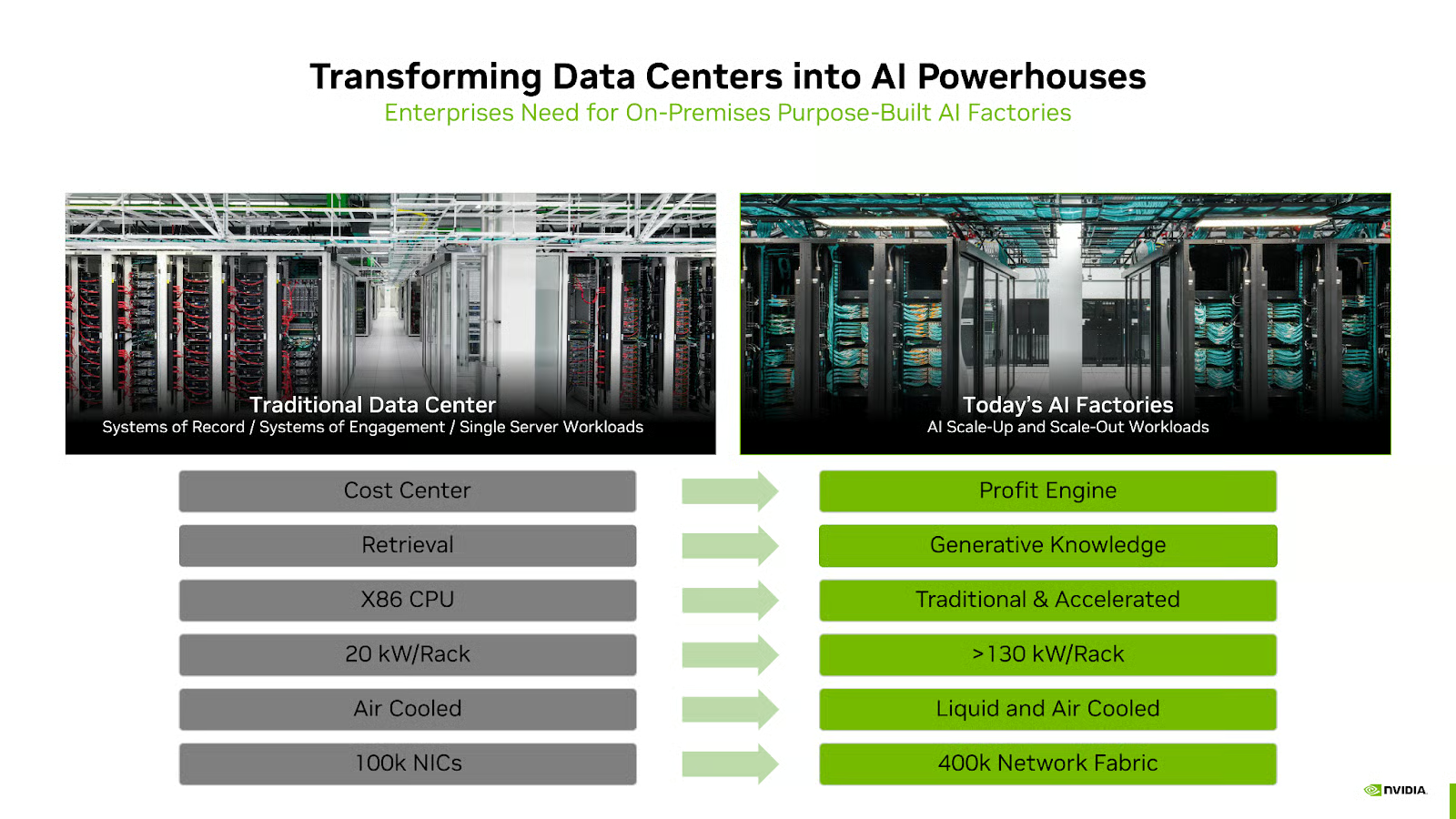
AI is transforming the data center from a system designed for efficiency into one designed for intelligence and value creation.
Business model shift
- From a cost center to a profit-generating engine
- From retrieval-based systems to knowledge-generating AI systems
Infrastructure shift
- From CPU-based (x86) architectures to accelerated GPU computing
- From ~20 kW per rack to 100+ kW high-density environments
- From air-cooled systems to hybrid liquid and air cooling
- From limited networking to high-scale network fabric supporting east–west traffic
| Capability | Traditional data center | AI factory |
|---|---|---|
| Primary workload | CPU-based enterprise applications | AI training, fine-tuning, inference, and agentic workloads |
| Compute architecture | General-purpose CPU systems | Accelerated GPU clusters and specialized AI infrastructure |
| Storage | Capacity-focused enterprise storage | Distributed, high-performance storage for large datasets and model pipelines |
| Networking | North–south traffic for application access | High-bandwidth, low-latency fabrics for east–west GPU and node communication |
| Cooling and power | Lower-density racks and traditional air cooling | High-density racks, liquid or hybrid cooling, and higher power requirements |
| Operations | Static application hosting and infrastructure management | Orchestrated, scalable AI workload management |
| Business role | Cost center for IT services | Platform for generating intelligence, automation, and business value |
Transforming data centers into AI infrastructure platforms
Enterprises modernize data centers for AI workloads by upgrading compute systems, networking infrastructure, storage platforms, and operational tools that support distributed machine learning environments.
According to Dell Technologies research, 87% of surveyed business and IT leaders say AI and generative AI will significantly transform their industries, while 89% agree that data will be the key differentiator in generative AI strategies.
Traditional x86 CPU environments are being augmented or replaced by accelerated computing architectures. GPUs and specialized accelerators enable the parallel processing required for large-scale AI training and inference.
Modern AI data center infrastructure typically includes:
- Accelerated compute clusters for model training and inference
- High-bandwidth networking fabrics that allow compute nodes to exchange data quickly
- Distributed storage platforms that store and manage large training datasets
- Containerized development environments that support model experimentation and deployment
- Workload orchestration tools that coordinate distributed training pipelines
Together, these changes redefine the data center not as a static environment for running applications, but as a dynamic platform for generating intelligence, insights, and business value.
Validated infrastructure architecture for AI fine-tuning and inference
AI infrastructure architecture describes the compute systems, networking platforms, storage resources, and orchestration layers used to train and deploy machine learning models at scale. Large-scale AI workloads require distributed infrastructure that coordinates these components across systems.
A typical enterprise AI environment includes several key components:
AI infrastructure component | Role in AI workloads |
|---|---|
Accelerated compute clusters | Provide parallel processing for model fine-tuning and inference workloads |
High-performance, scalable storage | Store and manage training datasets |
High-speed networking | Enable communication between compute nodes |
AI frameworks | Support model development and training |
Orchestration platforms | Manage distributed workloads |
These components support distributed machine learning workflows. During training, models exchange parameters between compute nodes, making high-speed networking essential for efficient updates.
Building infrastructure that supports AI workloads at scale remains a challenge. The IBM Institute for Business Value’s 2025 CEO Study found that only about 16% of AI initiatives have successfully scaled across the enterprise, highlighting operational and data barriers that can prevent AI projects from moving from experimentation to production.
Using validated AI architectures: Many enterprises are adopting integrated AI platforms to simplify this architecture. Dell AI Factory with NVIDIA, for example, provides a validated infrastructure stack that combines accelerated compute, high-performance networking, scalable storage, and AI software tools into a single platform. By delivering a pre-engineered environment for AI training and inference workloads, these architectures can reduce deployment complexity and help organizations move from AI pilots to production environments more quickly.
Designing scalable AI infrastructure
Scalable AI infrastructure allows organizations to expand computing capacity as workloads grow. AI projects often begin as pilot initiatives but later require systems that support multiple teams and production deployments.
Distributed GPU clusters and hybrid infrastructure provide two common approaches to scaling AI environments. These architectures combine on-premises data centers with cloud platforms while orchestration tools coordinate training pipelines and allocate resources across clusters.
Platforms like the previously mentioned Dell AI Factory with NVIDIA build on this approach by integrating accelerated compute, high-speed networking, and distributed storage within a unified architecture. These integrated environments allow organizations to expand AI capacity, support new workloads, and scale deployments without continuously redesigning their infrastructure.
Networking and GPU factors that affect AI performance
AI performance depends heavily on GPU capability and networking design.
GPU infrastructure considerations
Several GPU characteristics influence how efficiently AI models can train:
- Memory capacity, which determines how much training data can be processed at once
- Interconnect speeds, which allow GPUs within a cluster to exchange data efficiently
- Cluster configuration, which affects how workloads are distributed across compute nodes
Networking considerations
Networking infrastructure is equally important in distributed AI environments. Unlike traditional data centers that primarily rely on north–south traffic, AI workloads depend heavily on east–west communication between distributed compute nodes. Key networking factors include:
- Bandwidth, which determines how quickly data moves between compute nodes
- Latency, which affects synchronization during distributed training
- RDMA networking, which enables faster communication between servers
- Network topology, which influences how efficiently clusters exchange model updates
In large distributed environments, even small communication delays can slow both training and inference performance, particularly for large models that span multiple GPUs or nodes and require frequent coordination during execution.
Scalability challenges in enterprise AI deployments
Scaling AI deployments introduces several infrastructure and operational challenges. AI projects often begin as pilot initiatives but encounter difficulties expanding them across production environments and teams.
Infrastructure constraints can be one major barrier, particularly when organizations need large numbers of GPUs or high-performance networking to support distributed training. AI infrastructure dramatically increases power density, with racks scaling from ~20 kW to well over 100 kW, driving the adoption of liquid cooling alongside traditional air-cooled systems.
Data management adds another layer of complexity. Training large AI models requires extensive datasets that must be stored, processed, and accessed efficiently across multiple systems. Operational complexity can also increase as organizations deploy multiple models across teams and environments.
Redundancy strategies for resilient AI systems
Reliable AI systems require infrastructure that continues operating when individual components fail. Distributed environments often use redundant compute nodes and storage systems so workloads can shift automatically during disruptions.
Storage replication and model checkpointing help protect training progress and datasets if hardware disruptions occur. Monitoring systems and automated failover mechanisms also support reliability by detecting issues and rerouting workloads to healthy systems.
Scaling AI infrastructure across global organizations
Global enterprises support AI workloads across multiple regions, creating additional infrastructure and governance considerations. Deploying AI systems globally requires coordination between data centers, cloud platforms, and regional computing resources.
Distributing infrastructure across multiple locations can reduce latency and improve performance for regional teams and users. It can also help organizations address regulatory requirements related to data residency and privacy.
Modernizing AI infrastructure for global enterprise environments
Modernizing AI infrastructure in global organizations often involves hybrid architectures that combine on-premises data centers, cloud platforms, and edge computing resources. This allows organizations to run workloads where performance, cost, and regulatory requirements can be balanced effectively.
Hybrid environments also provide flexibility as AI workloads evolve. Enterprises can scale computing capacity through cloud platforms while maintaining control over sensitive data and critical infrastructure.
AI data center modernization checklist
| Infrastructure layer | What must change for AI |
|---|---|
| Compute | Move from CPU-centric systems to accelerated GPU clusters that support training, fine-tuning, and inference |
| Networking | Support high-bandwidth, low-latency east–west traffic between distributed compute nodes |
| Cooling and power | Plan for higher rack density, liquid or hybrid cooling, and increased power requirements |
| Storage | Use scalable, high-performance storage that can feed large datasets and support AI pipelines |
| Data | Ensure large AI datasets can be stored, processed, and accessed efficiently across systems |
| Orchestration | Coordinate distributed workloads, model development, deployment, monitoring, and scaling |
FAQs
What is an AI factory and how does it differ from a traditional data center?
An AI factory is an infrastructure environment designed to turn enterprise data into AI outcomes at scale. A traditional data center is usually optimized for CPU-based business applications, predictable traffic, and general-purpose storage. An AI factory is optimized for AI training, fine-tuning, inference, and agentic workloads using accelerated compute, high-speed networking, scalable storage, orchestration, and advanced power and cooling systems.
How do enterprises modernize data centers for AI workloads?
Enterprises modernize data centers by adopting GPU computing, high-speed networking, distributed storage, and orchestration platforms for machine learning workloads.
What is AI data center infrastructure architecture?
AI data center infrastructure architecture refers to the computing, networking, storage, and software systems used to train and deploy machine learning models. In modern environments, this architecture typically includes GPU clusters, high-speed networking, distributed storage systems, and orchestration platforms that support large-scale AI training and inference.
Why do AI workloads require specialized infrastructure?
AI workloads require specialized infrastructure because they process large datasets, rely on parallel computing, and require fast communication between systems.
How do organizations scale AI computing environments?
Organizations scale AI environments by expanding GPU clusters, adopting hybrid infrastructure, and using orchestration tools to manage distributed workloads.
Ready to move AI from experimentation to enterprise impact? Explore TechRepublic’s Enterprise Guide to Scalable AI for practical guidance on strategy, data, infrastructure, use cases, and ROI.