









- 15 Ways Python Is a Powerful Force on the Web
- Python: A Dynamic Programming Language
- Python Runs Nearly Anywhere
- Python Has Deep Roots
- Python 2.0
- Python 3.0
- Python Is Used on a Website Near You
- Popular Yahoo Software
- Python Was Not Named After the Snake
- Python Runs on .NET and Java Virtual Machine (JVM)
- Python Supports Multiple Integration Technologies
- Python Comes with Batteries Included
- With Python, Its a Wrap
- Python Ranks 7th as Most Popular Programming Language
- Google App Engine Launched with Python
- Popular Python Integrated Development Environments
15 Ways Python Is a Powerful Force on the Web
by Darryl Taft
Python: A Dynamic Programming Language
Python is an interpreted, interactive, object-oriented programming language. It incorporates modules, exceptions, dynamic typing, very high-level dynamic data types and classes.
Python Runs Nearly Anywhere
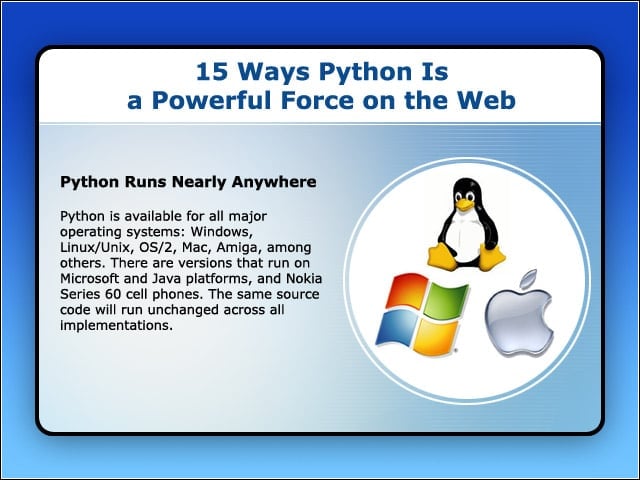
Python is available for all major operating systems: Windows, Linux/Unix, OS/2, Mac, Amiga, among others. There are versions that run on Microsoft and Java platforms, and Nokia Series 60 cell phones. The same source code will run unchanged across all implementations.
Python Has Deep Roots
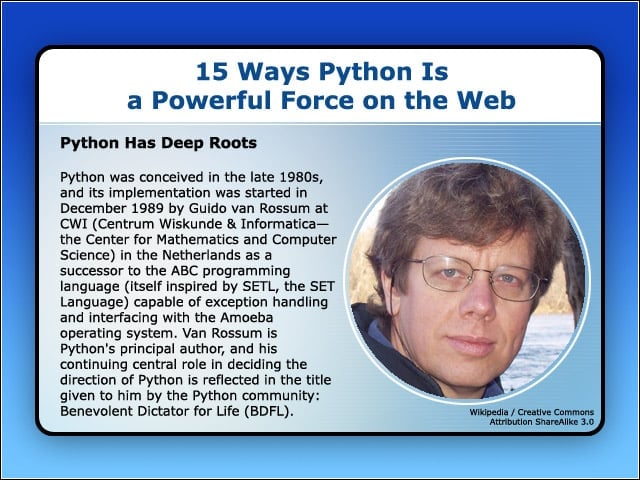
Python was conceived in the late 1980s, and its implementation was started in December 1989 by Guido van Rossum at CWI (Centrum Wiskunde & Informatica—the Center for Mathematics and Computer Science) in the Netherlands as a successor to the ABC programming language (itself inspired by SETL, the SET Language) capable of exception handling and interfacing with the Amoeba operating system. Van Rossum is Python’s principal author, and his continuing central role in deciding the direction of Python is reflected in the title given to him by the Python community: Benevolent Dictator for Life (BDFL).
Python 2.0
Python 2.0 was released on Oct. 16, 2000, with many major new features, including a full garbage collector and support for Unicode. However, the most important change was to the development process itself, with a shift to a more transparent and community-backed process.
Python 3.0
Python 3.0, a major, backward-incompatible release, was released on Dec. 3, 2008, after a long period of testing. Many of its major features have been backported to the backward-compatible Python 2.6.
Python Is Used on a Website Near You
Big users of Python include YouTube, Yahoo, Google, Industrial Light & Magic, NASA, the University of Maryland and Thawte Consulting, among others, for a variety of types of applications.
Popular Yahoo Software
Popular software written in Python include the Django and TurboGears Web development frameworks, and the Zope Web application server.
Python Was Not Named After the Snake
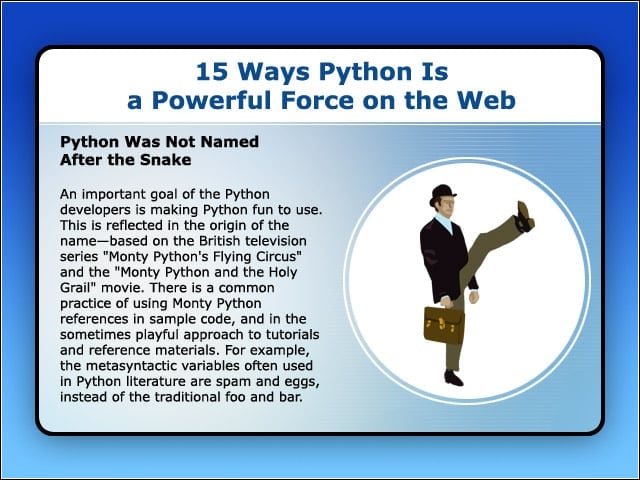
An important goal of the Python developers is making Python fun to use. This is reflected in the origin of the name—based on the British television series “Monty Python’s Flying Circus” and the “Monty Python and the Holy Grail” movie. There is a common practice of using Monty Python references in sample code, and in the sometimes playful approach to tutorials and reference materials. For example, the metasyntactic variables often used in Python literature are spam and eggs, instead of the traditional foo and bar.
Python Runs on .NET and Java Virtual Machine (JVM)
Developers can integrate Python with COM (Component Object Model), Microsoft’s .NET and CORBA (Common Object Request Broker Architecture) objects. For Java libraries, developers can use Jython, an implementation of Python for the JVM. For .NET, developers can use IronPython, Microsoft’s implementation of Python for .NET, or Python for .NET.
Python Supports Multiple Integration Technologies
Python also supports ICE (Internet Communications Engine) and many other integration technologies.
Python Comes with Batteries Included
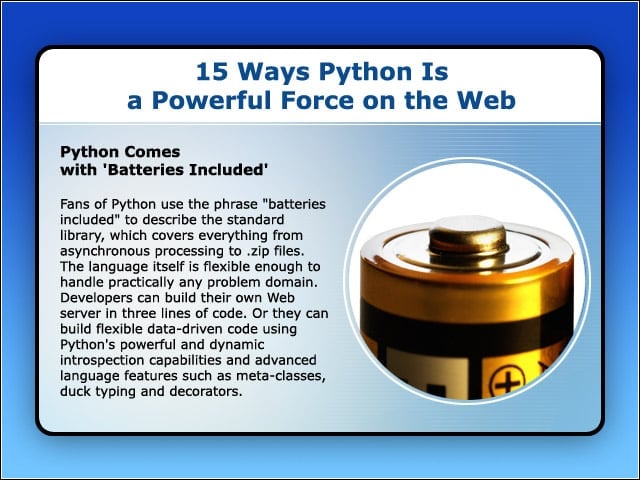
Fans of Python use the phrase “batteries included” to describe the standard library, which covers everything from asynchronous processing to .zip files. The language itself is flexible enough to handle practically any problem domain. Developers can build their own Web server in three lines of code. Or they can build flexible data-driven code using Python’s powerful and dynamic introspection capabilities and advanced language features such as meta-classes, duck typing and decorators.
With Python, Its a Wrap
If you find something that Python cannot do, or if you need the performance advantage of low-level code, you can write extension modules in C or C++, or wrap existing code with SWIG (Simplified Wrapper and Interface Generator) or Boost.Python. Wrapped modules appear to your program exactly like native Python code. That’s language integration made easy. You can also go the opposite route and embed Python in your own application, providing your users with a language they’ll enjoy using.
Python Ranks 7th as Most Popular Programming Language
According to the Tiobe Programming Community Index for March 2010, Python ranks as the seventh most popular programming language, after Java, C, PHP, C++, Visual Basic and C#. The Tiobe Programming Community Index is maintained by Tiobe Software. Tiobe stands for “The Importance of Being Earnest.”
Google App Engine Launched with Python
When Google launched its Google App Engine cloud development platform in April 2008, the first and only language supported was Python.
Popular Python Integrated Development Environments
Some of the known Python IDEs (integrated development environments) include Boa Constructor, a cross-platform IDE for Python development; EasyEclipse, an open-source IDE for Python and other languages; Eric, an IDE for Python and Ruby; PIDA (Python Integrated Development Application), an open-source IDE written in Python capable of embedding other text editors, such as Vim; SPE (Stani’s Python Editor), a cross-platform IDE for Python development; Webware for Python, a suite of programming tools for constructing Web-based applications in Python; and Wing IDE, an IDE for Python development.