






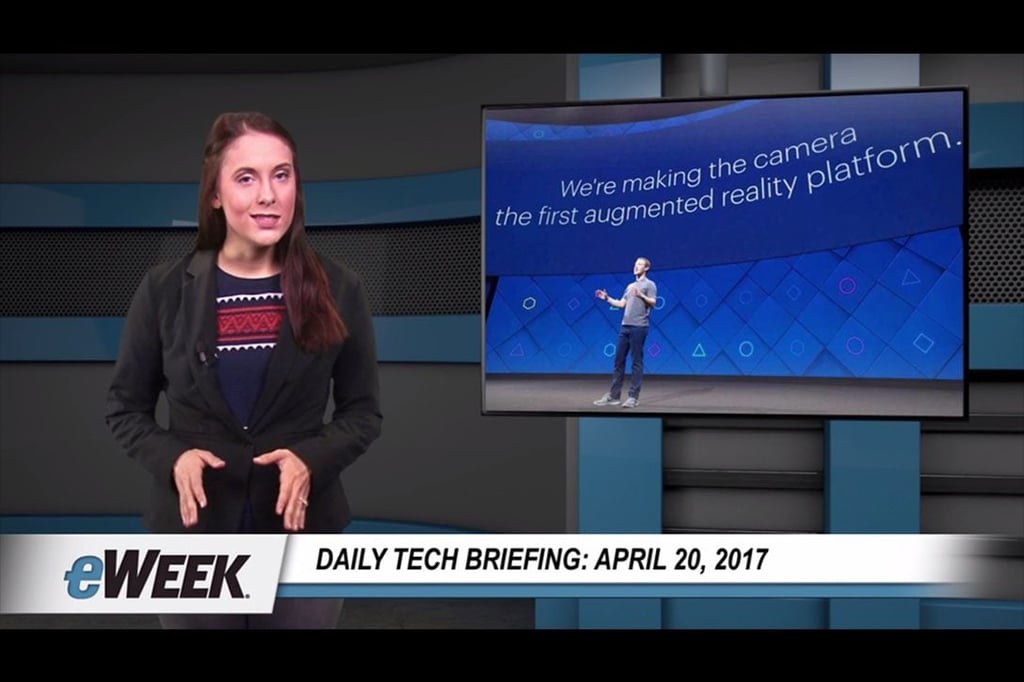


Today’s topics include Facebook targeting virtual worlds and augmented reality, Google’s acquisition of 1,210 acres in Nevada, Uber expanding its business services with Uber Central and cloud security risks associated with Amazon Web Services misconfiguration.
Facebook CEO and founder Mark Zuckerberg thinks experiencing augmented reality through glasses is still a few years away, but that’s not stopping his company from exploring it.
Rather than glasses though, Facebook will focus on a camera platform. “In the last few years we’ve seen primitive use cases on phones and cameras. Today we start together and make the camera the first augmented reality platform,” Zuckerberg explained at Facebook’s F8 developer conference.
Facebook’s Camera Effects Platform software for developers includes advanced computer vision technology that recognizes objects in the real world and provides the means for developers to augment them with overlays.
When Google acquired 1,210 acres of land at an industrial park in northern Nevada for $29.1 million, reports speculated that the property would be used for autonomous-car testing and development. However, the company recently slapped down those reports.
Instead, Google asserts that the land is the future site of another U.S. data center. Right now there is no timeline or definite plans for when development would begin or end, a spokesman said.
If and when Google eventually builds a data center on the newly acquired Nevada site, it will be the company’s ninth in the U.S. Six are currently operational, while the other two are under construction.
Uber’s lesser known Uber for Business service is expanding with the introduction of Uber Central. Through the ride-hailing app’s new service, users can request, manage and pay monthly for rides for others at scale.
Uber Central is the company’s first global “one-to-many” ride service. It allows enterprises to manage multiple rides at the same time and from the same dashboard.
Customers who receive rides via Central do not need to have an Uber account or the app on their phones to take a ride; the organization handles everything. More than 8,000 companies participated in the Uber Central pilot program, the company stated.
Security vendor Threat Stack on April 18 released a study revealing a host of common security misconfigurations by users that expose their cloud instances to security risks.
The goal of the study was to identify potential security concerns for the 200 companies using Amazon Web Services that Threat Stack analyzed.
The research results, presented at the AWS Summit, found that 73 percent of AWS users were leaving the Secure SHell service open to the public internet on their cloud instances.
SSH is commonly used to remotely administer a server instance. The vulnerability is not within SSH, Sam Bisbee, CTO at Threat Stack, explained, but in poor firewall configuration.