







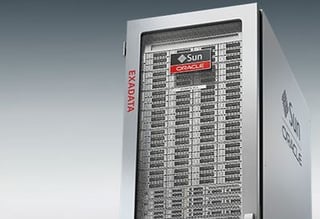
Oracle, doing everything in its power to transition its on-premises customers–which comprise the vast majority of them–into buying cloud services, has moved its physical Exadata analytics server into the Oracle Cloud.
Oracle users now have a couple of other options to deploy Oracle Exadata Cloud Machine, which handles big data workloads at scale off-premises. This includes deploying it as a cloud service inside a private data center cloud, in the Oracle Cloud or in a conventional on-premises environment.
The Redwood City, Calif.-based database giant is calling its user-facing cloud the Oracle Cloud at Customer, a rather unusual name for a cloud service. It is aiming the Exadata service, released Feb. 27, at organizations that want to move enterprise workloads into the public cloud as soon as possible to avoid continuous capital expense costs.
However, many of these enterprises have been constrained by business, legislative and regulatory requirements that have prevented them from moving their data and applications outside their own data centers.
Highly Regulated Industries Making the Switch
Oracle’s user base includes a high number of government, military, financial services, health care and other highly regulated business sectors.
The Oracle Cloud features nearly 1,000 SaaS applications and 50 enterprise-class PaaS and IaaS services to users in more than 195 countries around the world and supports 55 billion transactions each day.
With Oracle Exadata Cloud Machine, customers have subscription access to Oracle’s latest database with all options and features, such as Real Application Clusters, Database In-Memory, Active Data Guard and Advanced Security, offering high levels of performance, availability and security features for mission-critical workloads.
As one might imagine, Oracle also claims that the Exadata Cloud Machine is compatible with all on-premises and Oracle Cloud applications and databases, ensuring that any existing application can be migrated to the cloud without requiring coding changes.
The Oracle Cloud and Exadata Cloud Machine provide functionality that includes:
—mission-critical database for OLTP, analytics, mixed workloads, and consolidation, and all options are included;
—production-proven database hardware platform with NVMe Flash, InfiniBand networking, and fast servers;
—intelligent database platform with Smart Database Algorithms in storage, networking and compute;
—advanced database cloud platform with subscription based pricing and real-time online capacity bursting;
—simple and straightforward migration to the cloud; software and hardware are identical and 100 percent compatible.
The Oracle Cloud at Customer has Oracle experts monitoring and managing the infrastructure; and the same tools used in Oracle’s public cloud are used to provision resources on the Cloud Machine, the company said.
Users can run Cloud Machine for a number of use cases, including disaster recovery, elastic bursting, dev/test, lift-and-shift workload migration, using a single API and scripting toolkit for DevOps.
For more information, go here.