







10 Things You Might Not Know About Google
1) Sergey at Wolfram Research
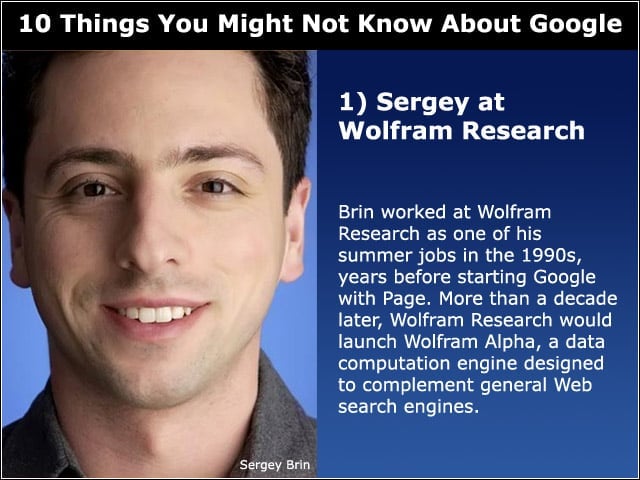
Brin worked at Wolfram Research as one of his summer jobs in the 1990s, years before starting Google with Page. More than a decade later, Wolfram Research would launch Wolfram Alpha, a data computation engine designed to complement general Web search engines.
2) Stanford Rewarded
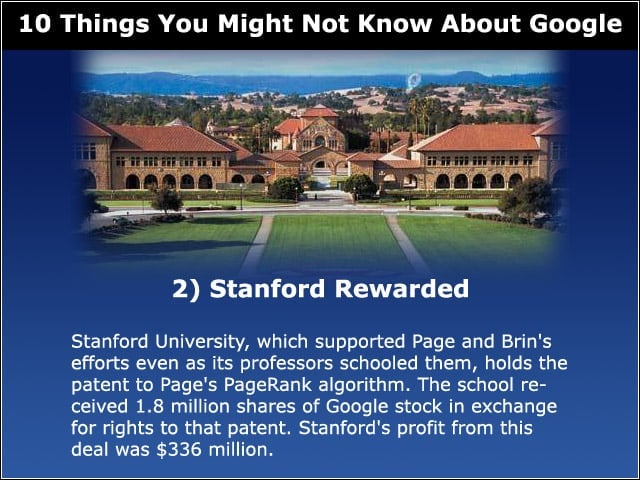
Stanford University, which supported Page and Brin’s efforts even as its professors schooled them, holds the patent to Page’s PageRank algorithm. The school received 1.8 million shares of Google stock in exchange for rights to that patent. Stanford’s profit from this deal was $336 million.
3) Hiring Hell
Google’s engineering group has hundreds of hiring committees locking horns weekly over potential hires to weed out biases managers might have in the interview process. There is no one person presiding over this effort, but a Borg-like group think.
4) Googley Daycare
Google subsidized daycare at its Mountain View, Calif., headquarters to the tune of $37,000 per year, before dropping it to $20,000 per year in 2008.
5) Fun with Numbers
How much are Google employees worth? $1 million each. No, but seriously, Google does $20 billion in sales a year and has roughly 20,000 employees. The ratio of employees to revenue, at $1 million a head, is one of the highest in high tech.
6) One Threat to Rule Them All
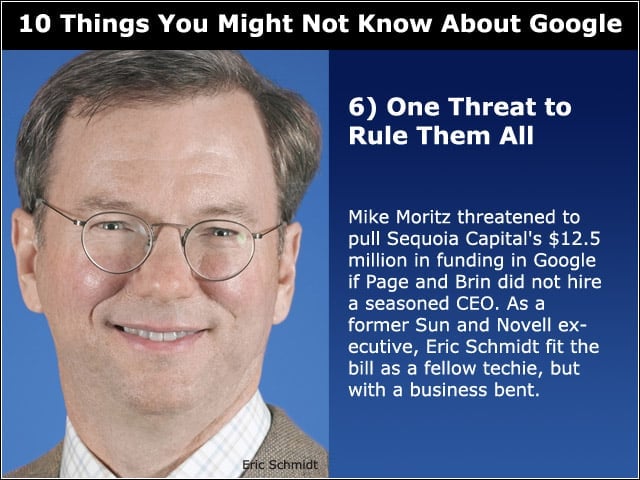
Mike Moritz threatened to pull Sequoia Capital’s $12.5 million in funding in Google if Page and Brin did not hire a seasoned CEO. As a former Sun and Novell executive, Eric Schmidt fit the bill as a fellow techie, but with a business bent.
7) Paid Placement Drama
After hearing from AOL executives that Google was “stupidly” missing out on revenue by not accepting paid placements, Brin left the room screaming that he needed to set himself on fire “to get rid of the scum of those people.”
8) Microsoft Had A Shot
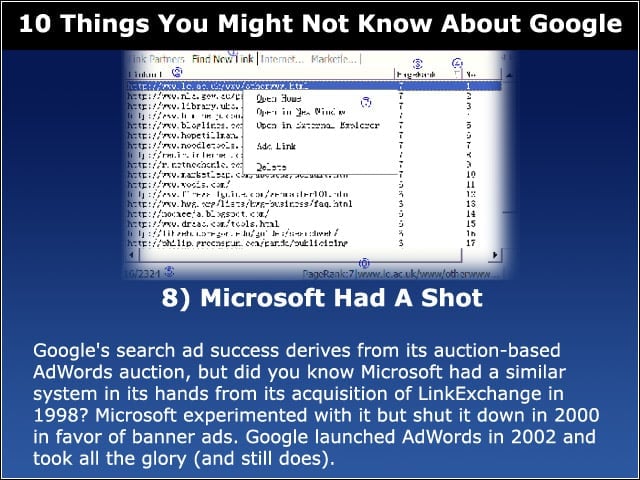
Google’s search ad success derives from its auction-based AdWords auction, but did you know Microsoft had a similar system in its hands from its acquisition of LinkExchange in 1998? Microsoft experimented with it but shut it down in 2000 in favor of banner ads. Google launched AdWords in 2002 and took all the glory (and still does).
9) On Privacy Violations
What privacy violations? Despite all of the saber rattling from the Electronic Frontier Foundation and other watchdogs, Brandt wrote that there has never been a documented case of Google violating its users’ privacy rights. Could be a good tool for Google in its Google Book Search argument.
10) Google Book Search Begins
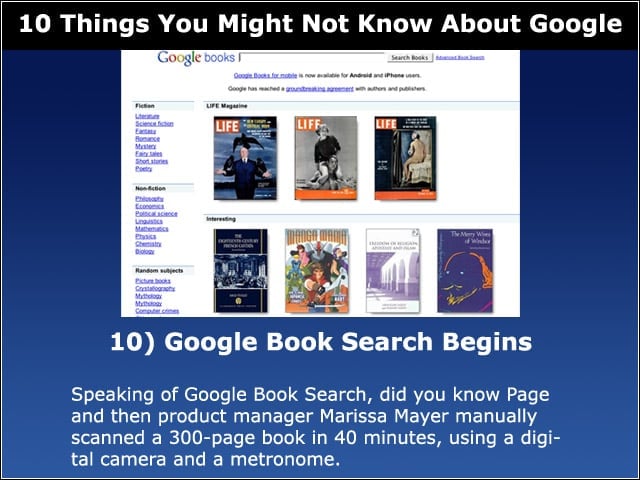
Speaking of Google Book Search, did you know Page and then product manager Marissa Mayer manually scanned a 300-page book in 40 minutes, using a digital camera and a metronome.