






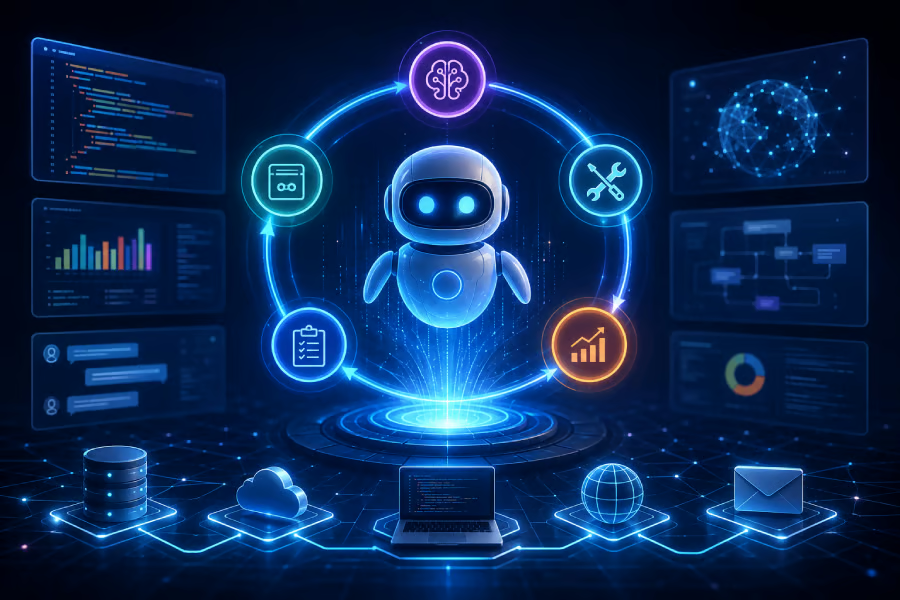


For the better part of this decade, the dominant interaction paradigm with artificial intelligence has been reactive. We asked; it answered. We prompted; it generated.
However, the emergence of Agentic AI marks an inflection point, a structural migration from Large Language Models (LLMs) as mere reasoning engines to LLMs as execution kernels. This transition is not an incremental software update; it is a redefinition of the machine's role in the digital ecosystem, moving it from a consultant to an autonomous delegate.
While a single, universally agreed-upon definition remains elusive, a consensus is forming around the core concept. At its core, Agentic AI refers to artificial intelligence systems capable of pursuing complex goals autonomously. These systems don't just wait for a prompt; they can anticipate, initiate, and act to achieve an objective.
The key to this autonomy is a system's ability to reason, plan, and adapt. Unlike traditional AI, which is constrained by predefined rules and a reactive nature, Agentic AI can break down a complex goal into a multi-step plan, execute those steps, and learn from the outcomes. It can interact with its environment, use external tools, and modify its approach in response to new information.
This represents a shift from AI that helps with "thinking" to AI that helps with "doing."
- Agentic AI vs AI agent vs generative AI vs workflow/automation
- Core terminology and vocabulary
- How agentic AI works: The three-component model
- Architectural components
- Core capabilities of AI agents
- Agent design patterns
- The protocol layer: How agents talk to tools and to each other
- Frameworks and SDKs: What to actually build with
- How agents are benchmarked
- Security and risk: The OWASP top 10 for agentic applications (2026)
- Core mitigation technique
- Where to find agentic AI
- Real products and use cases (What's actually shipping)
- Managing agentic AI
- A practical decision checklist
- Parting words
Agentic AI vs AI agent vs generative AI vs workflow/automation
Not every AI system is an agent; the terms are often used interchangeably, but they describe different levels of capability, autonomy, and decision-making.
- Generative AI: Produces an output (text, image, code) in response to a prompt. No persistent goal, no loop.
- AI agent: One component, a model plus tools/memory, that can act toward a goal.
- Agentic AI: The broader system/approach, often coordinating multiple AI agents toward a larger objective.
- Workflow/automation: A predefined code path that happens to call an LLM.
| Capability | Chatbot | AI assistant | Workflow automation | AI agent | Agentic AI |
| Interaction | Q&A, reactive | Helps users complete tasks | Executes predefined steps | Plans, decides, uses tools | Broad category of action-taking systems |
| Planning | No | Limited | Fixed rules | Breaks goals into steps | Coordinates multiple agents |
| Tool use | No | Some integrations | Predefined | Selects and uses tools | System-wide orchestration |
| Memory | Session only | Session + context | None | Short + long-term | Persistent across agents |
| Autonomy | None | Low | None | Moderate to high | Variable by design |
Core terminology and vocabulary
| Term | Definition |
| Agent | An autonomous AI system that perceives its environment, makes decisions, and takes actions to achieve specific goals. |
| Agentic AI | AI systems designed to act autonomously on behalf of users, making decisions and taking actions without constant human intervention. |
| Autonomy | The degree to which an agent can act independently without human approval. |
| Planning | The process of breaking a goal into smaller steps or decisions. |
| Reasoning | The agent's ability to process information, draw conclusions, and make logical decisions. |
| Tool use/tool calling | An agent's ability to interact with APIs, databases, applications, or external systems. |
| Function calling | A structured way for AI models to trigger tools or software actions. |
| Memory | Stored context that helps an agent maintain continuity across interactions. |
| Orchestration | The coordination layer that manages workflows, tools, models, and agents working together. |
| Human-in-the-Loop (HITL) | A governance pattern where humans review, approve, or intervene before actions are completed. |
| Guardrails | Policies, permissions, and controls that limit what an agent can access or do. |
| Multi-Agent System (MAS) | A collection of multiple AI agents that work together, communicate, and coordinate to solve complex problems. |
| Context window | The amount of text (in tokens) that an AI model can process and remember in a single interaction. |
How agentic AI works: The three-component model
At a high level, Agentic AI has three main components.
- The agent itself: Powered by an LLM or other AI engine that provides reasoning and decision-making capabilities.
- Tools and connectors: Allow the agent to access data, software, or the outside world—including APIs, databases, web search, code execution, and file system operations.
- Protocols and frameworks: Guide how agents interact, collaborate, and stay within human-defined boundaries.
In practice, an agentic AI system doesn't just generate an answer; it can take actions such as scheduling meetings, researching information, managing workflows, optimizing processes, or collaborating with other agents in a network.
Architectural components
According to IBM's guide, an agentic AI system comprises:
- Agent orchestration component: Manages and coordinates the actions of a set of agents.
- Input component: One or more sources of input that trigger the agent to take action.
More detailed architectures include:
- Agent(s) with access to models, tools, and memory to complete tasks.
- Orchestration to coordinate multiple agents.
- Guardrails to keep agent actions bounded and safe.
A unified academic taxonomy decomposes LLM-based agents into six modular dimensions.
- Core Components: Perception, memory, action, profiling
- Cognitive Architecture: Planning, reflection
- Learning
- Multi-Agent Systems
- Environments
- Evaluation
Core capabilities of AI agents
Reasoning and planning
Agents use chain-of-thought reasoning to break complex tasks into manageable steps. Modern agents use techniques like:
- ReAct (Reason + Act): Think > Act > Observe > Repeat
- Plan-and-execute: Create a full plan, then execute the steps.
- Tree of thought: Navigate complex problem spaces.
Memory systems
| Memory type | Description |
| Short-term memory | Conversation history within a session |
| Working memory | Scratchpad for intermediate results |
| Long-term memory | Vector database for persistent knowledge |
| Episodic memory | Records of past task executions for learning |
Tool use
Agents can call external tools, including web search, code execution, database queries, API calls, and file system operations. The model decides which tool to use based on the task.
Multi-agent collaboration
Complex tasks are divided among specialized agents. For instance, a researcher gathers information, a coder writes code, and a reviewer checks quality. A supervisor agent orchestrates the team.
Agent design patterns
| Pattern | How it works | Best for |
| ReAct | Think > Act > Observe > Repeat | General-purpose agents |
| Plan and execute | Create full plan, then execute steps | Structured workflows |
| Reflection | Agent reviews and improves own output | Quality-critical tasks |
| Supervisor | Manager agent delegates to workers | Complex multi-agent |
| Swarm | Peer agents with handoff protocols | Flexible routing |
| Human-in-the-Loop | Agent pauses for human approval | High-stakes decisions |
| Evaluator-optimizer | One agent evaluates, another optimizes | Iterative improvement |
| Prompt-chaining | Sequential prompts building on each other | Multi-step transformations |
| Parallelization | Multiple agents work simultaneously | Speed-critical tasks |
| Routing | Route tasks to specialized agents | Classification/dispatch |
The protocol layer: How agents talk to tools and to each other
Two open protocols now underpin most production multi-agent stacks, and they solve different problems:
Model Context Protocol (MCP) — Anthropic, November 2024
- An open standard for how an AI system connects to external tools and data sources (databases, file systems, Slack, GitHub, etc.) — described by Anthropic as a "USB-C port for AI applications."
- Solves the "N×M" integration problem: before MCP, every model needed a custom connector for each tool.
- Built on JSON-RPC 2.0; reuses ideas from the Language Server Protocol.
- Adopted by OpenAI (March 2025) and Google DeepMind shortly after launch.
- December 2025: Anthropic donated MCP to the Agentic AI Foundation (AAIF), a Linux Foundation-directed fund co-founded by Anthropic, Block, and OpenAI.
- A November 2025 Anthropic engineering post shows that letting agents write code that calls MCP tools (rather than injecting every tool definition into context) can cut token overhead by up to ~98.7% on tool-heavy tasks.
Agent2Agent Protocol (A2A) — Google, April 2025
- An open standard for how one agent discovers and delegates work to another agent, across vendor boundaries, the "horizontal" protocol, complementary to MCP's "vertical" tool-access role.
- Uses HTTP + Server-Sent Events + JSON-RPC 2.0; agents publish an Agent Card describing what they can do and how to be called.
- Launched with 50+ technology partners (Salesforce, MongoDB, LangChain, Accenture); reported to have grown past 150 partner organizations by April 2026.
- Google explicitly frames A2A as complementary to, not competing with, MCP.
Mental model: A2A routes the task to the right agent; MCP gives that agent the tools/data it needs to actually do the work.
Frameworks and SDKs: What to actually build with
There is no single "best" framework. The right choice depends on whether you need fast prototyping, deterministic production control, or tight integration with one model vendor. The field consolidated heavily through 2025–2026.
| Framework | Maker | Orchestration model | Best for | Notable trade-off |
| LangGraph | LangGraph | Directed graph, conditional edges, built-in checkpointing | Production, regulated industries needing audit trails and human-in-the-loop pauses | Steeper learning curve; more boilerplate to first working agent |
| CrewAI | CrewAI | Role-based "crews" (researcher/writer/reviewer-style personas) | Fastest path to a working multi-agent prototype | Weaker built-in checkpointing/observability historically; community reports of friction with non-OpenAI model integrations |
| OpenAI Agents SDK | OpenAI | Explicit "handoffs" between agents | Clean, opinionated single-vendor builds with native MCP, sandboxed tools | Originally OpenAI-model-locked, though the SDK works with 100+ models via compatible endpoints |
| Microsoft Agent Framework | Microsoft | Graph-based workflows; unifies former AutoGen + Semantic Kernel | .NET/Azure-native enterprises wanting one supported SDK | AutoGen itself is now in maintenance mode, superseded by this framework (reached v1.0 GA) |
| Google ADK (Agent Development Kit) | Hierarchical agent tree; native A2A support | Multimodal agents, GCP/Vertex-native deployments | Optimized for Gemini, though it supports other models | |
| Claude Agent SDK | Anthropic | Tool-use chains with spawnable sub-agents (the same architecture behind Claude Code) | Safety-first, MCP-native builds; agents needing extended/long reasoning | Claude-models-only |
| Smolagents | Hugging Face | Minimal single-agent loop | Fastest way to a single-agent system without heavy orchestration | Not designed for complex multi-agent coordination |
| Semantic Kernel | Microsoft | Plugin/skill-based | .NET/enterprise teams (now folding into Microsoft Agent Framework) | Being subsumed by the unified framework above |
| LlamaIndex (Workflows) | LlamaIndex | Event-driven, RAG-first | Document-heavy/data-intensive pipelines | Less general-purpose than LangGraph for arbitrary agent logic |
| Haystack | deepset | Pipeline architecture | RAG-centric retrieval pipelines | Narrower scope than full agent frameworks |
| Dify | Dify | Visual, drag-and-drop | Non-engineers/fastest visual prototyping | Less code-level control |
How agents are benchmarked
No single benchmark captures "how good an agent is." The field uses a cluster of task-specific suites:
| Benchmark | Tests | Scale |
| SWE-bench/SWE-bench Verified | Resolving real GitHub issues with a working patch | 2,294 problems (500 in the human-verified subset) |
| GAIA | General-assistant tasks requiring web browsing, file parsing, multi-step reasoning | 466 real-world questions |
| WebArena | Autonomous web navigation across e-commerce, forums, dev tools, CMS | 812 long-horizon tasks; human baseline ≈78% |
| AgentBench | Cross-domain agent reasoning (OS, DB, knowledge graphs, games, web) | 8 environments, 29 LLMs evaluated originally |
| τ-bench/τ²-bench | Tool-agent-user interaction under real policy constraints (customer service) | Retail and airline domains |
| OSWorld | Real desktop computer control across OS environments | Functional, VM-based tasks |
Security and risk: The OWASP top 10 for agentic applications (2026)
Released December 2025 by the OWASP GenAI Security Project, developed with input from more than 100 security researchers and reviewed by representatives from NIST, the Alan Turing Institute, and Microsoft's AI Red Team, among others. It extends (rather than replaces) the existing OWASP Top 10 for LLM Applications, because autonomy, tool integration, and persistent state introduce genuinely new failure classes.
| ID | Risks | What it is |
| ASI01 | Agent Goal Hijack | An attacker redirects the agent's objective via poisoned input (email, document, web content, calendar invite) — agents can't reliably separate instructions from data |
| ASI02 | Tool Misuse and Exploitation | The agent invokes a legitimate tool in an unauthorized way/sequence, causing harmful side effects |
| ASI03 | Identity and Privilege Abuse | The agent's identity/permissions are misused or escalated |
| ASI04 | Agentic Supply Chain Vulnerabilities | Risk from third-party tools, MCP servers, frameworks, and registries the agent depends on at runtime |
| ASI05 | Unexpected Code Execution (RCE) | The agent's code-execution sandbox boundary fails |
| ASI06 | Memory and Context Poisoning | Persistent memory or retrieved context is manipulated to mislead future steps |
| ASI07 | Insecure Inter-Agent Communication | Messages between agents are spoofed, replayed, or unauthenticated |
| ASI08 | Cascading Failures | One agent's error/compromise propagates across a multi-agent system |
| ASI09 | Human-Agent Trust Exploitation | Humans are deceived by, or over-trust, agent outputs into taking harmful action |
| ASI10 | Rogue Agents | An agent operates outside its intended policy — by drift, design failure, or compromise |
Core mitigation technique
- Treat all natural-language input, including RAG documents and tool outputs, as untrusted.
- Apply least-privilege ("least agency") to what an agent is allowed to do autonomously, not just what it can access.
- Give agents their own scoped, short-lived identity rather than letting them borrow a user's session.
- Put irreversible or high-stakes actions behind human approval gates.
- Red-team specifically for prompt injection, tool misuse, and privilege escalation in agent workflows, not just single-turn jailbreaks.
Where to find agentic AI
Agentic AI appears in two main places:
- Specialized vendors: Platforms built specifically for agent building, orchestration, multi-agent collaboration, and goal-directed workflows, including startups focused on enterprise automation, research assistants, developer agents, and vertical solutions in healthcare, finance, and customer service.
- Mainstream software platforms: Productivity suites, CRM systems, marketing platforms, and IT management software are adding agents that can plan, prioritize, and execute specific tasks, often labeled as copilots, assistants, or workflows.
Real products and use cases (What's actually shipping)
| Category | Examples | Notes |
| Agentic coding | Claude Code, GitHub Copilot agent mode, OpenAI Codex, Cursor, Windsurf, Devin (Cognition) | The most mature agentic category by consensus; measured heavily via SWE-bench |
| Computer-use/GUI agents | Claude Computer Use (Anthropic), Operator/CUA (OpenAI), Gemini Computer Use (Google, evolved from Project Mariner) | Each takes screenshots and issues mouse/keyboard actions; benchmarked on OSWorld and WebArena. |
| Enterprise CRM/workflow agents | Salesforce Agentforce (formerly Einstein Copilot), IBM watsonx, Microsoft Copilot Studio | Geared toward governed, auditable enterprise deployment |
| Customer-support agents | Modeled and benchmarked via Sierra's τ-bench domains (retail, airline, telecom) | Sierra explicitly built τ-bench from production experience with live customer-facing agents |
Managing agentic AI
Best practices for managing agentic AI deployment:
- Start small: Give an agent a clear, limited goal and observe performance.
- Understand strengths and weaknesses before expanding the scope.
- Maintain human oversight through rules, checkpoints, and governance.
- Ensure high-quality data; the biggest deployment risk is poor, stale, or unstructured data feeding the agents.
- Implement observability and safety controls.
A practical decision checklist
- Could a single well-engineered LLM call (with retrieval/examples) solve this? If yes, stop there, don't build an agent.
- Is the task's structure well-defined and repeatable? Use a workflow (chaining, routing, parallelization), not an autonomous agent. You get predictability and lower cost.
- Does the task need open-ended flexibility, multi-step judgment, or recovery from unexpected states? An autonomous agent is justified, but budget for the latency/cost trade-off.
- Do you have a clear, automatable evaluation signal? If yes, an evaluator-optimizer loop or Reflection pattern adds real value; if no, that loop can become circular and unreliable.
- Is this high-stakes or irreversible (payments, deletions, external communications)? Insert a human-approval checkpoint regardless of how capable the agent benchmarks.
- Are you coordinating more than one agent? Make sure writes stay single-threaded, or context is fully shared; don't assume parallel sub-agents will reach compatible conclusions without it.
- Before shipping, run your own evals on your own workload. Public benchmark leaderboards are filters for "worth testing," not predictors of your production performance.
Parting words
Agentic AI marks a pivotal moment in the evolution of technology. It represents a shift from AI systems that are tools to be consulted to AI systems that are partners capable of taking initiative. While the path forward is marked by significant hype, complex challenges, and a necessary market correction, the underlying potential is undeniable.
Agentic AI is not just another trend; it is the next logical step in the journey to create machines that can truly collaborate with us to solve complex, real-world problems. The organizations that successfully navigate the complexities of governance, security, and data readiness will be best positioned to unlock their transformative power.
Also read: AI agents are moving from simple assistants to systems that can plan, use tools, and act across workflows; our AI agents cheat sheet explains the core terms, risks, and business use cases.