







AT&T has announced plans to make its prepaid brand AIO (All In One) Wireless available nationwide, just days after T-Mobile filed a civil action suit against AIO, claiming that its marketing materials aim to confuse consumers into thinking AIO is T-Mobile.
AIO “out of all the colors in the universe … chose magenta to begin promoting no-contract wireless communications services in direct competition with T-Mobile,” T-Mobile said in its Aug. 23 suit. “AT&T’s subsidiary’s use of magenta to attract T-Mobile’s customers is likely to dilute T-Mobile’s famous magenta color trademark and to create initial interest confusion as to the source or affiliation of AT&T’s subsidiary business.”
AT&T introduce AIO (pronounced “A-O”) May 9, making it initially available in Houston, Orlando, Fla., and Tampa, Fla.
On Aug. 29, AT&T announced that the no-annual-contract service will be available to all U.S. customers starting in mid-September. New customers who sign up online or in stores by Sept. 29 will be eligible for a fall promotion to receive their third month of service for free.
“We want to make it easy for consumers almost anywhere in the U.S. to get great value in their wireless service, with the network coverage and experience they deserve, and devices they can be proud to own,” AIO President Jennifer Van Buskirk said in a statement.
AIO offers “three simple plans to choose from,” the statement added. All three include unlimited talk, text and data, with a pre-established limit for high-speed data access (after the cap, the data speed will slow down). The plans range from $40 to $70 per month, including taxes and fees.
T-Mobile, which calls its plans “Simple Choice Plans,” offers three options, from $50 to $70, and is now the only Tier 1 carrier to have done away with two-year contracts.
It’s what T-Mobile calls the “Magenta Mark” that the lawsuit focuses on, though.
T-Mobile and parent company Deutsche Telekom have used magenta in all forms of advertising media since the 1990s, says the suit.
“The other major participants in the telecommunications industry also color code their advertisements and promotional materials—e.g., blue and orange for AT&T, red for Verizon, yellow for Sprint,” it continued. “Consumers have learned to perceive the colors used by these providers as source indicators.”
T-Mobile says that since 2006 it has spent more than $3.75 billion on advertising using the Magenta Mark, from its ads with spokeswoman Carly to replacing the red carpet at the 2011 National Basketball Association All-Star game with a “magenta carpet.”
Already in 2013, it has invested more than $500 million on advertising using magenta.
While AIO’s general coloring is truer to magenta, or a wine color, T-Mobile says AIO “makes prominent use of magenta in its logo and elsewhere in its retail stores.”
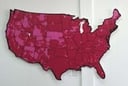
Come mid-September, more U.S. consumers will get to see for themselves. (The coverage map in the attached photo is AIO’s, not T-Mobile’s.)