








Moving Mobile Networks to 4G LTE: 10 Tips for Service Providers
by Chris Preimesberger
The Customer Is Always Right
Carriers must ensure that any upgrades are done with the customer at the forefront of their minds. One of the ultimate goals of migrating to LTE is increasing customer satisfaction; all parts of the network must be upgraded. An LTE upgrade is about more than just a radio.
Show Me the Money

LTE upgrades aren’t cheap. If a mobile carrier isn’t also thinking of value propositions to help monetize their new network (whether it’s a pay-per-feature business model or justifiably charging for HD voice), then an LTE upgrade could prove a giant money pit. Consumers will pay for a quality experience.
Build on Trust
Today, service providers are typically trusted brands by their customers. Adding on new services, such as mobile wallets or electronic keys, requires service providers to value and nurture that trust relationship and open the door on new service opportunities.
Keeping Connectivity
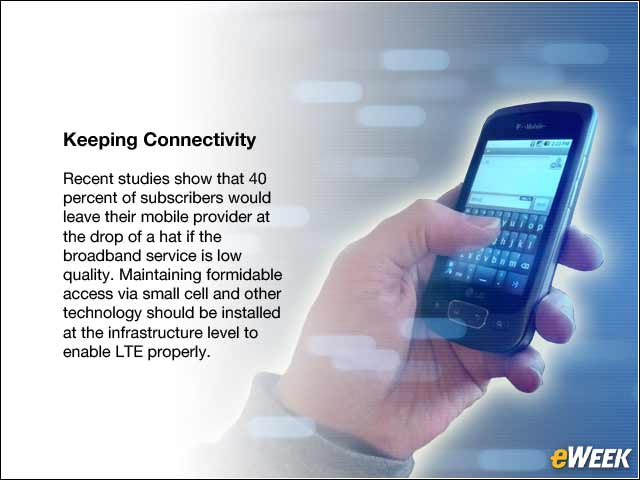
Recent studies show that 40 percent of subscribers would leave their mobile provider at the drop of a hat if the broadband service is low quality. Maintaining formidable access via small cell and other technology should be installed at the infrastructure level to enable LTE properly.
Share the Load
Building out LTE networks take time and money, so don’t exclude IT which can help shoulder some of the burden—namely WiFi. Deployed in the places where people spend most of their time, WiFi is an ideal complement to LTE, so embrace it.
Make It Personal
Contrary to common perception, not all over-the-top (OTT) services are a threat to revenues expected through LTE. OTT providers such as AppleTV, Netflix and Hulu have steadily gained market penetration, causing traditional service providers to rethink their strategies. Through a carefully crafted OTT partner strategy, a rich set of personalized service bundles can be a good source for driving average-revenue-per-user growth. Background: The term “over-the-top” in the media business refers to broadband delivery of video and audio without a multiple system operator being involved in the control or distribution of the content itself.
Security Keeps the Network Running

An LTE network is based on all-IP operation in an inherently less-secure shared infrastructure than dedicated connections, such as legacy mobile networks. High-performance security needs to be installed to protect subscribers and the network from potential threats and outages.
Benefiting From the Data Deluge
Since LTE moves carrier traffic to an IP-based nature, it creates more data. But it also creates opportunities for operators to harness that data and leverage it for analytical and planning purposes. Pairing subscriber information with location, time and service activity can yield valuable insight into the way subscribers use networks, paving the way to monetize subscriber behavior.
Keep an Eye on Things
If carriers deliver on the promise of LTE by deploying a number of new services and giving end users seamless HD video streaming, carriers need heightened levels of network visibility to ensure that everything is running smoothly. Since subscribers access mobile networks through apps, carriers must ensure app-level visibility to easily and securely fix a buffering video stream, choppy voice calls or crashing Angry Birds.
The End, or Only the Beginning?
LTE is not the end of the 2G-3G journey; it’s the beginning of the next-generation mobile network. Rather than trying to extend legacy gear into the new LTE era, carriers need to build new systems and platforms with the latest software-defined networking and virtualization technology as foundations for the new mobile Internet—and turn LTE into the platform for the next decade.