








Seven Notable Challenges of Managing 100G Networks
The move from standard 10- or 40-gigabit-per-second to 100G-bps Ethernet transport networks is on a faster growth ramp than many industry observers expected, and the use cases for transport at 100G bps are multiplying. The timing appears right: As companies continue to scale, and as their data needs become more complex, 100G bps (“100G”) offers the bandwidth and efficiency they require. But 100G also brings with it a new set of challenges; rules that apply to 10G networks don’t apply at networks running 10 times that speed. Companies must build out their networks carefully to adapt to these changing needs. This eWEEK slide show, using industry information from real-time performance monitoring provider cPacket Networks, points out the key challenges of making this switch.
Bottlenecks
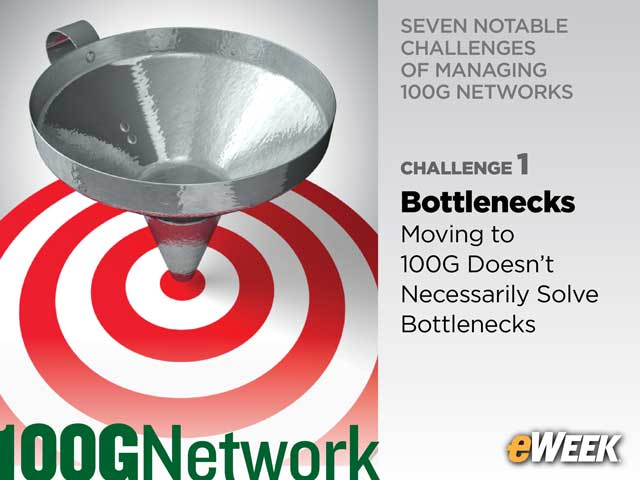
It’s a misconception that having more bandwidth will solve most of the problems that we experience in networks. Doubling bandwidth doesn’t double network throughput, just as doubling the number of lanes on a freeway doesn’t double vehicle throughput. When traffic is placed on 100G lanes or taken off 100G lanes, congestion occurs and effective speeds drop.
Packet Drops
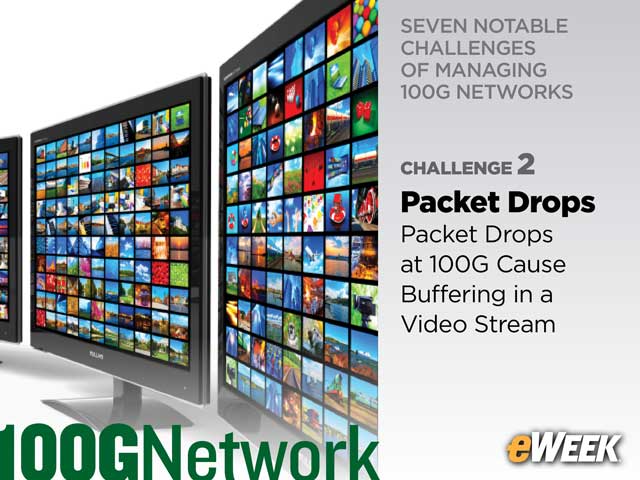
At 100G, the amount of data transported in any period is 10 times the amount as on a 10G network. But packet drops at that speed are much higher, and each has direct consequences: buffering in a video stream or choppiness in an audio stream.
Traffic Build-up
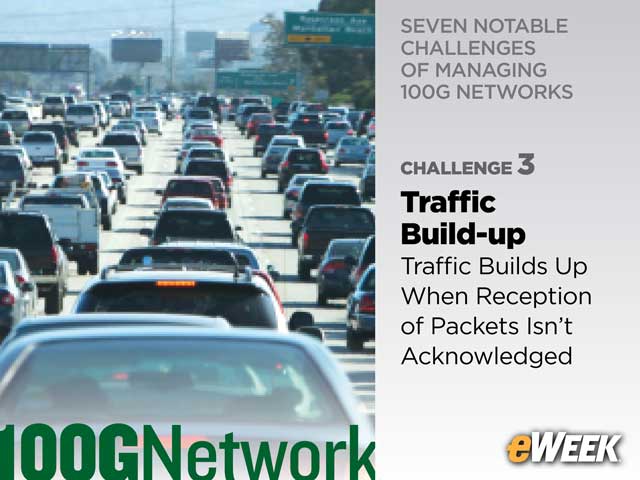
TCP (Transmission Control Protocol), a connection-oriented protocol, requires that, for every sequence of packets sent, the receiver must acknowledge this sequence. If the recipient doesn’t acknowledge, the sender transmits the packet(s) again. Traffic increases, taking a toll on performance.
Packet Analysis
If you can monitor only a certain percentage of network traffic, then the higher the network speed, the smaller that percentage of traffic you can analyze. At 100G, you may see the manifestation of the problem, and this gets worse as speeds increase.
Data Visibility
Monitoring and troubleshooting high-speed networks is a challenge. High-speed networks create more data than 10G networks. Having a distributed architecture combined with smart algorithms can help reduce CapEx and OpEx.
Speed Variations
At current speeds of 10G and 40G, the bursts in the network cause packet loss.As speeds increase to 100G, there is more bandwidth available to accommodate these variations. But is your network up to the challenge?
SLAs at Risk
On 100G networks, unlike 10G, service providers may find it difficult to meet their service-level agreements (SLAs) because they don’t have the network visibility or the tools needed to enforce them. At what point will customers defect? At higher speeds, therefore, service providers may have to select between an uptime SLA and a speed SLA—to the customer’s disadvantage.