






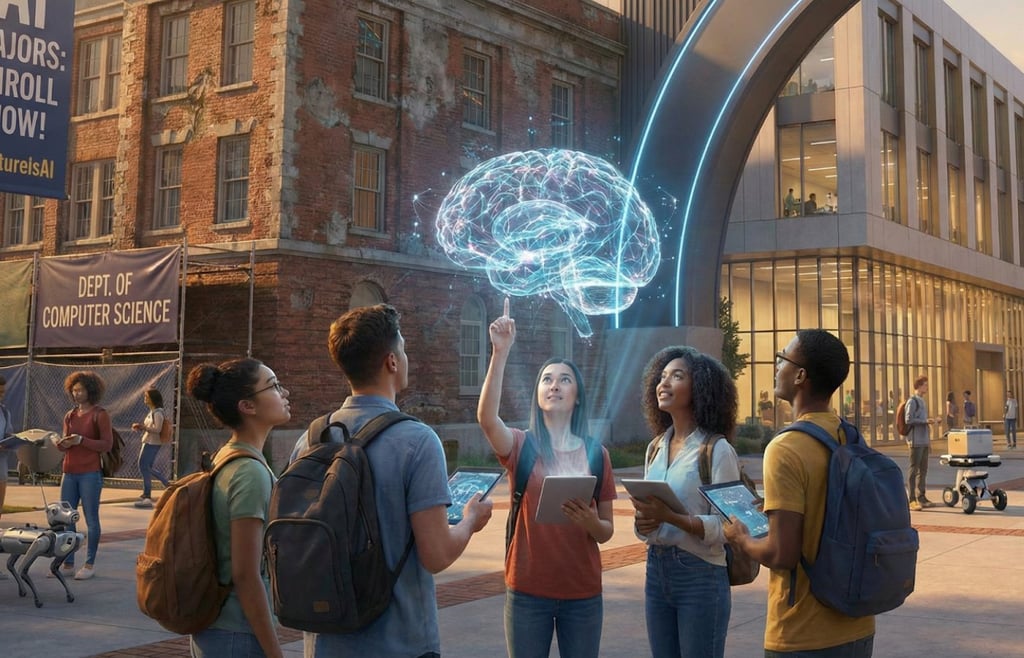


Move over, computer science. AI is the new academic star. Universities across the country are launching AI majors at a rapid pace to meet growing student demand for these programs.
For example, a new college of AI and cybersecurity at the University of South Florida in Tampa saw 3,000 students enroll this semester. And 150 freshmen signed up for a new AI major at the University of California, San Diego. The State University of New York at Buffalo has gone a step further, creating a standalone “department of AI and society” that offers new interdisciplinary degrees in fields such as “AI and policy analysis.”
Further, SUNY Buffalo has seen enrollment in its AI master’s degree program increase 20 times over from 2020 to 2024 — from five to 103 students.
UC San Diego’s AI major resides within the Department of Computer Science and Engineering and is designed for students in this program “to build the next generation of AI systems, improve the foundations of the AI systems currently in use, and familiarize students with the ethical questions surrounding these systems and their impact on society.”
As of 2025, there are 193 bachelor’s degree programs in AI and 310 different AI master’s programs in the US. Those numbers are expected to continue to rise as AI skills are in high demand in the workplace.
AI’s role in the classroom
It comes as no surprise that AI degree programs are becoming increasingly popular. Even as educators debate the effects of AI, both college students and faculty are more frequently relying on tools like ChatGPT for help with writing and grading.
Last spring, Anthropic introduced Claude for Education, an initiative for integrating generative AI into higher education. At the same time, the company also announced partnerships with Northeastern University, the London School of Economics and Political Science, and Champlain College.
The impact of the technology is being felt at all levels of schooling — for example, last spring, President Trump signed the Executive Order on Advancing Artificial Intelligence Education for American Youth.
Why students are drawn to AI degrees
Some college students feel that having a degree in AI will give them a leg up with job opportunities. While many students are interested in AI, those “who prefer to work with data to address problems find themselves more drawn to an AI major,’’ Asu Ozdaglar, deputy dean of academics at the Massachusetts Institute of Technology’s Schwarzman College of Computing, told The New York Times.
MIT offers a Bachelor of Science degree program called “AI and decision-making” that teaches students how to “develop techniques for the analysis and synthesis of systems that interact with an external world via perception, communication, and action; while also learning, making decisions and adapting to a changing environment.”
This year, the program has almost 330 students enrolled, making it the second biggest major at MIT after computer science.
Yet citing concerns about employment, more students are opting for AI degrees. This fall, 62% of traditional computer science programs reported declines in undergraduate enrollment, according to an October report from the Computing Research Association.
A recent analysis of AI reshaping entry-level jobs looks at how automation is closing off traditional first roles for graduates.