








The artificial intelligence boom has raised a pressing question: Will machines take people’s jobs?
Now, AI company Anthropic says it has built a new system designed to detect early warning signs of that disruption.
In a new research paper, the company introduced a framework to track how AI might affect employment over time. The system focuses on measuring how exposed different occupations are to automation by large language models, such as its AI assistant Claude.
Which jobs have the highest AI exposure?
Anthropic’s economists, Maxim Massenkoff and Peter McCrory, describe the approach as a new measure of AI displacement risk called “observed exposure.”
According to the researchers, the index blends theoretical AI capabilities with real-world usage data to determine how much of a job’s work is actually being automated today.
“This approach won’t capture every channel through which AI could reshape the labor market, but by laying this groundwork now, before meaningful effects have emerged, we hope future findings will more reliably identify economic disruption than post-hoc analyses,” Massenkoff and McCrory wrote in the report.
The system evaluates three main elements:
- The tasks that make up each occupation.
- Whether those tasks can theoretically be performed by large language models.
- Whether those tasks are already being carried out by AI in practice.
Jobs receive higher exposure scores when AI can automate key tasks and when the technology is already being used to perform them.
The analysis highlights several professions where AI coverage is already high.
According to the report, computer programmers rank highest, with 74.5% of their tasks potentially automated by AI tools. Other highly exposed roles are in the image below.
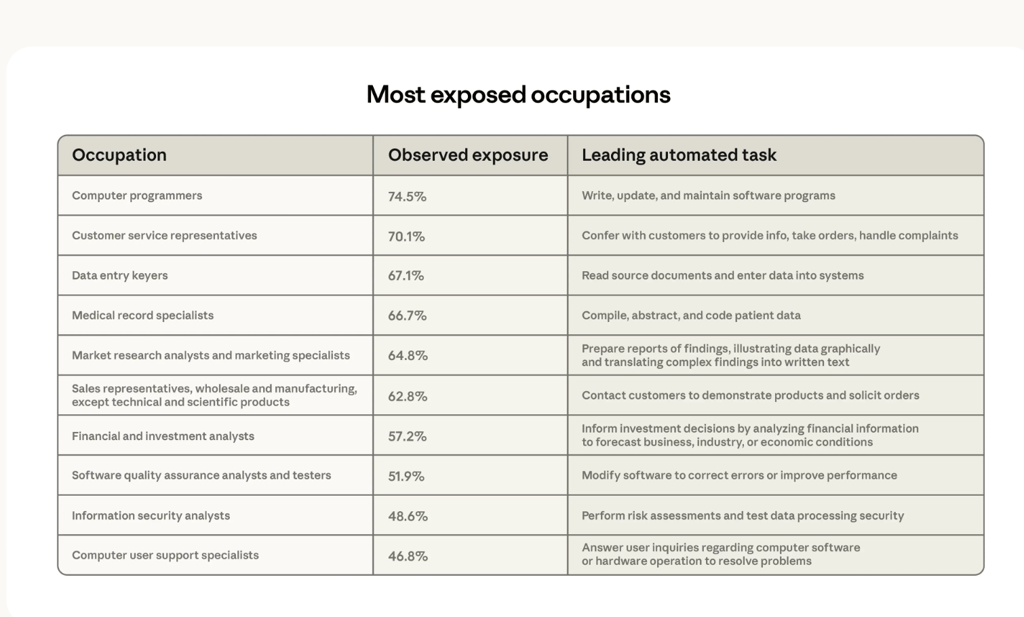
Top ten most exposed occupations based on Anthropic’s task coverage measure. Image: Anthropic.
These findings reflect how widely AI tools are already used for tasks such as coding, handling customer queries, and processing digital records.
Many jobs are still far from AI automation
At the same time, Anthropic’s research shows that many professions remain largely untouched by AI.
About 30% of occupations did not meet the minimum threshold to be classified as exposed, according to the study. These tend to be jobs that rely heavily on physical work or direct human interaction.
“This group includes, for example, Cooks, Motorcycle Mechanics, Lifeguards, Bartenders, Dishwashers, and Dressing Room Attendants,” the company said in the report.
The research also found that AI’s real-world usage still falls far short of its theoretical capabilities. This means there is a significant gap between what the technology could eventually do and what it is doing today.
No clear evidence of widespread job losses yet
Despite concerns about automation, the study found little evidence that AI has significantly increased unemployment so far.
Researchers said the unemployment rate for workers in highly exposed occupations has not risen noticeably since late 2022, when generative AI tools began spreading rapidly.
“The average change in the gap since the release of ChatGPT is small and insignificant, suggesting that the unemployment rate of the more exposed group has increased slightly but the effect is indistinguishable from zero,” the researchers wrote.
However, the data show early signs of slower hiring among younger workers, particularly those aged 22 to 25, in occupations more exposed to AI.
A long-term monitoring system for AI disruption
Anthropic says the index is designed as an ongoing monitoring framework rather than a one-time study. By updating the data regularly, researchers hope to track how AI adoption spreads across industries.
The system could be especially useful if economic changes are gradual and difficult to detect in traditional labour statistics. The company’s work comes as debate grows over whether AI will mainly enhance human productivity or eventually replace large segments of the workforce.
Notably, Anthropic CEO Dario Amodei has previously warned that advanced AI could erase many entry-level jobs within five years, making efforts to track the technology’s labour impact increasingly important.