







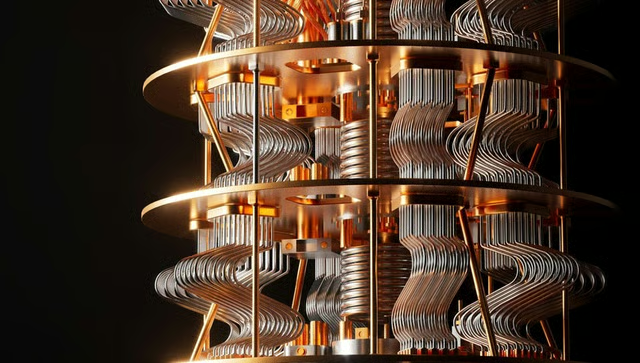
A strange form of liquid helium chilled close to absolute zero could offer quantum computers another way to protect information from electrical noise.
Researchers from the University of Surrey and Northwestern University have proposed a micromechanical qubit architecture called the Superfluid Helium Oscillator Quantum, or SHOQ, device.
In a study published in npj Quantum Information, the team modeled how superfluid helium-3 could be used to encode quantum information without relying on the electrically charged components found in conventional superconducting qubits.
By swapping electrical currents for neutral fluid flow, the researchers estimate that the approach could reduce quantum calculation errors by around 100 times compared to conventional superconducting circuits.
Neutral atoms over sensitive electronics
Today’s leading platforms, including processors built by IBM and Google, rely heavily on superconducting circuits like transmons.
While powerful, their charged components act like antennas for electromagnetic noise and dielectric defects, resembling static cling on a balloon. Those errors are one reason fault-tolerant quantum computers are expected to require many physical qubits to create each reliable logical qubit.
The SHOQ architecture avoids electrical charges altogether by using superfluid helium-3. Because the atoms carry zero net charge, they do not interact with stray electric fields. Encased inside a microfluidic cavity with an oscillating plate and a nanometer-scale weak link, the helium flows without friction and encodes data into quantized mechanical vibrations.
"The maths tells us that it should work," said Dr. Priya Sharma, research fellow at the University of Surrey and lead author of the study. "We have taken what we already know about superfluid helium and quantum technologies and turned that into an educated design, with the parameters and specifications needed to build one. The next step is to make a prototype and put those predictions to the test."
Co-author Dr. Eran Ginossar noted that the device does not need to replace existing setups entirely. "Combining different quantum technologies could allow us to take advantage of the strengths of each," he said.
Bridging fast gates and resilient memory
Commercial quantum processors struggle with a fundamental speed-versus-stability dilemma: superconducting qubits can support fast gate operations, but maintaining coherence remains a major challenge.
The Surrey design points toward a modular computing model similar to classical computer architecture. Rather than forcing a single qubit type to perform both rapid operations and long-term data storage, SHOQ devices could act as quantum memory registers while transmon circuits handle rapid logic gates.
What eWeek found: The cryogenic infrastructure hurdle
The same physics that could make a superfluid helium qubit resistant to electrical noise also creates a major engineering challenge: extreme cooling.
Helium-3 becomes superfluid at temperatures of just a few millikelvin, while conditions modeled in the study extend into the sub-millikelvin range — colder than the typical operating temperatures of many superconducting quantum processors.
Reaching those temperatures can require cryogenic techniques beyond standard dilution refrigeration, adding complexity to the supporting hardware. That tradeoff could be worthwhile if SHOQ qubits prove substantially more resistant to noise and reduce the overhead required for quantum error correction.
For now, however, SHOQ remains a proposed architecture. Researchers still need to build a prototype and demonstrate that its predicted coherence, control, and coupling advantages hold up in real hardware.
Other news: French supercomputer maker Bull has doubled production at its Angers plant as Europe expands regional AI and high-performance computing capacity and pushes to reduce reliance on foreign infrastructure.