






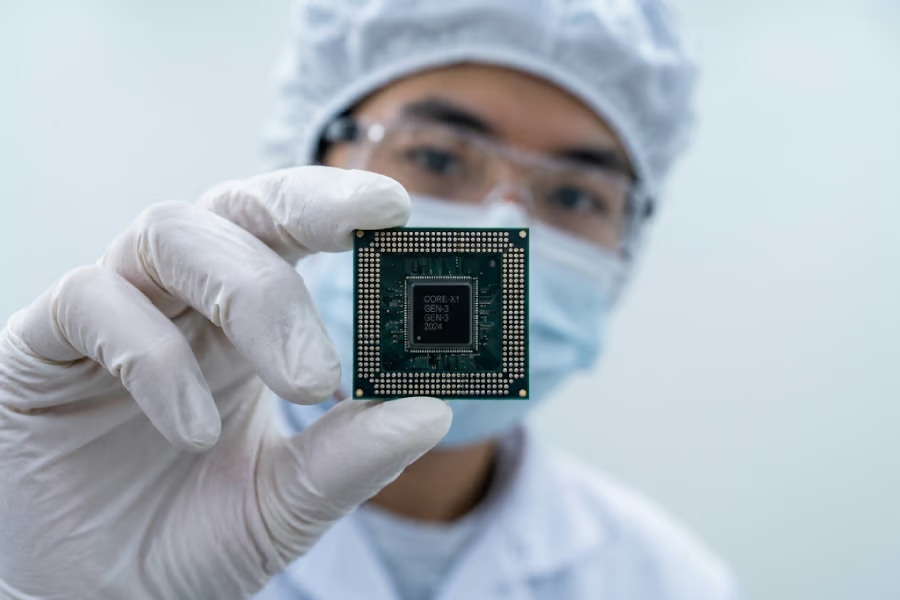


Vietnam has become one of the world's major electronics manufacturing hubs. Now it wants to design and develop more of the technology coming off its production lines.
Vietnamese officials and technology leaders on Sept. 10 outlined a push to further advance the country's semiconductor design, artificial intelligence, industrial robotics, and other higher-value technologies. The effort comes as Vietnam's electronics exports surge, but its manufacturers remain heavily dependent on imported chips and components.
The stakes extend beyond Vietnam. As governments and technology companies rethink where chips, AI hardware, and electronics are designed and manufactured, Vietnam is trying to turn its existing production base into a more sophisticated technology ecosystem rather than remain primarily an assembly hub.
Vietnam's electronics boom exposes a $60 billion gap
The scale of Vietnam's electronics industry gives it a substantial foundation.
Exports of computers, electronic products, phones, and components reached an estimated $101 billion during the first eight months of 2026, up 51% from a year earlier, according to Vietnam News.
But there is a catch.
Vietnam imported approximately $161 billion in computers, electronic products, and components during the same period, resulting in a roughly $60 billion trade deficit for the sector. Most of those imports were production inputs, including integrated circuits, memory chips, processors, displays, and circuit boards.
That dependence helps explain Vietnam's latest technology push.
At the Sept. 10 technology forum in Hanoi, government officials, researchers, and businesses focused on the convergence of semiconductors, AI, optoelectronics, the Internet of Things, and industrial robotics. Vietnam's National Innovation Centre said the country needs stronger technological capabilities, specialized workers, research infrastructure, and domestic companies capable of competing in higher-value parts of global supply chains.
The strategy is increasingly about more than attracting foreign factories. Vietnam wants more of the engineering, research, intellectual property, and domestic suppliers surrounding them.
Vietnam wants to design more of its own chips
Semiconductors may provide the clearest test of whether Vietnam can make that transition.
Vietnam's semiconductor industry generated more than $21 billion in revenue in 2025 and attracted more than $14 billion in foreign investment across more than 240 projects, according to figures from Vietnam's Ministry of Science and Technology, as reported by Vietnam News.
The country also has about 60 integrated circuit design companies and more than 7,000 design engineers. What it does not yet have is a complete domestic semiconductor ecosystem.
Vietnam still lacks industrial-scale chip fabrication and has limited domestic infrastructure for research and pilot production. Domestic chip developers often have to rely on overseas foundries to turn designs into physical prototypes, adding cost and time to the path toward commercialization.
The government is trying to attack that bottleneck.
Vietnam launched its first national center supporting semiconductor chip prototyping in June, providing shared infrastructure intended to help domestic researchers and companies move chip designs toward physical production more quickly and at lower cost. The center also connects Vietnamese designers with international foundries and other technology partners.
Officials are targeting specialized chips for applications including AI, edge computing, next-generation telecommunications, sensors, IoT, power electronics, and hardware security, according to VietnamPlus.
Qualcomm, meanwhile, opened a Hanoi R&D center in May, initially focused on AI and system-on-chip development. The company has also said it is expanding its R&D operations in Vietnam at the intersection of AI, semiconductors, software, and systems engineering.
Vietnamese conglomerate Geleximco is advancing plans for a chip manufacturing plant in Hung Yen province, with construction expected to begin in November and commercial production targeted for early 2028.
In the near term, officials are emphasizing capabilities such as system architecture, chip design, verification, testing, pilot production, and specialized chip development, while Vietnam works toward a broader semiconductor ecosystem.
That approach also recognizes the global nature of chipmaking. Industry participants at the Sept. 10 workshop noted that no country can achieve complete self-reliance across the semiconductor value chain. The goal for Vietnam is to control more critical capabilities while retaining the ability to work with international partners.
AI and robots could turn chip ambitions into products
Vietnam's semiconductor strategy becomes more significant when viewed alongside its ambitions in AI and robotics.
Specialized chips are increasingly required inside AI systems, robots, connected devices, telecommunications equipment, and smart factories. Building those technologies alongside one another could also give Vietnamese chip developers more opportunities to test locally designed components in real products.
Geleximco offers one example. The company has pledged to prioritize testing and integrating control chips, sensors, and power chips designed by Vietnamese engineers into its electric vehicles and broader industrial ecosystem, potentially helping domestic developers overcome the challenge of finding a first customer.
Vietnam's robotics industry is also beginning to move in that direction.
As eWeek recently examined, AMC Robotics is preparing a facility in Bac Ninh to manufacture its NovaArm industrial robotic arm, while Vietnamese companies including VinDynamics and VinRobotics are developing homegrown humanoid platforms.
The shift reflects a broader transformation underway across Asia. eWeek's examination of the APAC humanoid robotics market found that competition increasingly depends on integrating AI with processors, sensors, batteries, motors, and other hardware rather than developing AI models alone.
Vietnam already manufactures enormous volumes of electronics. Developing more of the chips, AI systems, and machines using those components could allow domestic companies to capture more of the value created by that manufacturing base.
But building those capabilities will take more than investment.
Vietnam is projected to need at least 50,000 university graduates and higher-level semiconductor workers by 2030, while its current workforce meets only about 20% of demand, according to VietnamPlus.
That talent shortage could become one of the biggest constraints on Vietnam's attempt to move further up the technology value chain.
What eWeek found: Vietnam has the scale, but key gaps remain
Vietnam is not trying to build a technology industry from scratch. That may be its greatest advantage.
eWeek's review of Vietnam's latest semiconductor and technology initiatives shows a country with a substantial electronics manufacturing base, billions of dollars in chip investment, and growing ambitions in AI and robotics. But the numbers also expose the gap between manufacturing advanced technology and developing more of the intellectual property, engineering, and components that underpin it.
Where Vietnam stands | What eWeek found |
| $101 billion in electronics exports | Vietnam shipped an enormous volume of computers, electronics, phones, and components during the first eight months of 2026. |
| About $161 billion in electronics imports | Imports exceeded exports in the sector by roughly $60 billion, highlighting Vietnam's continued reliance on foreign chips and other production inputs. |
| $14 billion+ in semiconductor investment | Foreign investment provides Vietnam with a substantial foundation, but building domestic technological capabilities requires more than just attracting capital and factories. |
| 60 chip design companies and 7,000+ engineers | Vietnam already has domestic design capabilities, but the lack of industrial-scale fabrication and limited pilot-production infrastructure complicate the path from chip design to commercial production. |
| 50,000 semiconductor workers needed by 2030 | Talent could become one of the biggest constraints as Vietnam tries to expand into more technically demanding parts of the semiconductor supply chain. |
The opportunity is to connect those pieces.
Vietnam's new chip prototyping infrastructure could shorten the path from domestic chip design to physical products. Its emerging robotics and industrial technology companies could provide real-world applications for locally developed components. Foreign investment could become more valuable if it produces R&D operations, engineering expertise, technology transfer, and stronger Vietnamese suppliers alongside manufacturing capacity.
There is also a wider consequence for the technology industry. Companies looking to diversify Asian electronics and semiconductor supply chains are increasingly weighing locations that combine manufacturing capacity, engineering talent, government support, and access to established regional technology ecosystems.
Vietnam already has a substantial manufacturing base, but its ambitions now extend further up the technology stack.
Its next test is whether it can turn that scale into stronger domestic capabilities in chip design, AI, robotics, and other technologies increasingly shaping the products its factories manufacture.
Also read: The Philippines could reach a record $54 billion in electronics exports as the AI hardware boom reshapes Southeast Asia’s semiconductor industry.