






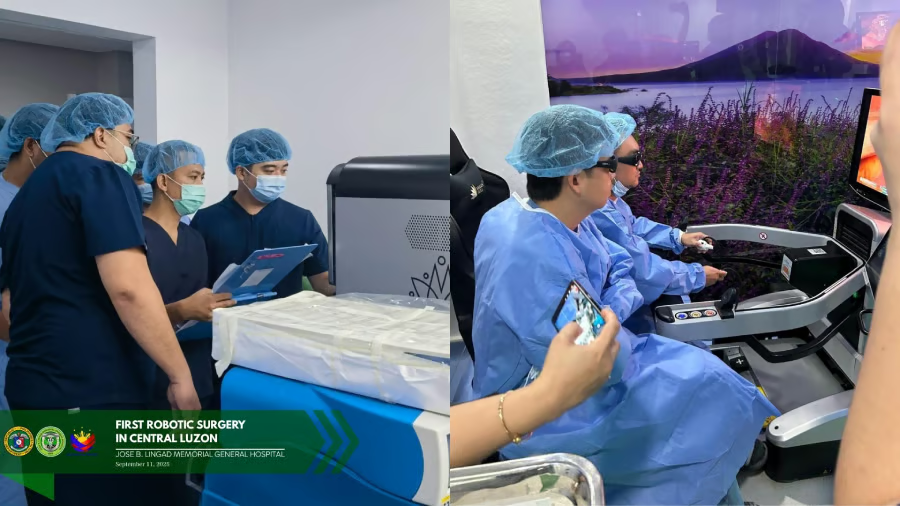


A surgeon in the Philippines just operated on a patient roughly 1,380 kilometers away, according to Philippine health officials.
Doctors in Pampanga and Cotabato City completed what the Philippine Department of Health described as the country's first cross-country robotic telesurgeries on Sept. 5, using a robotic system to perform gallbladder operations while the surgeons and patients were in different parts of the country. The milestone offers a glimpse at how robotics could eventually bring specialized surgery to patients far beyond the operating rooms where expert surgeons are based.
The technology is impressive. The bigger question is whether the Philippines, an archipelago of more than 7,000 islands, could become an unusually compelling proving ground for remote surgery.
Two hospitals, two remote surgeries
The procedures connected Jose B. Lingad Memorial General Hospital in Pampanga with Cotabato Regional and Medical Center in Cotabato City. The Philippine Department of Health said the hospitals were 1,380 kilometers apart.
Dr. Ryan Quiambao, working from the Pampanga hospital, remotely performed a robotic cholecystectomy, or gallbladder removal, on a patient in Cotabato City. Surgeons Dr. Al-Jazzer Angas and Dr. Louis Gerard Agustin then reversed the setup, operating remotely from Cotabato City on a patient in Pampanga.
Both procedures were completed safely in less than an hour with minimal blood loss, according to health officials. Local reporting said the surgeries were also performed at no cost to the patients under the Department of Health's Zero Balance Billing policy.
There is a discrepancy over the precise distance. Philippine health authorities and multiple local reports put the hospitals 1,380 kilometers apart, while SS Innovations, maker of the robotic system used in the procedures, later described the distance as approximately 1,710 kilometers.
The surgeries used the India-developed SSI Mantra Robotic Surgery System. SS Innovations founder and CEO Sudhir Srivastava, who developed the system, traveled from New Delhi to observe the procedures and provide technical assistance alongside company staff.
Reliable connectivity was also central to the demonstration. Technical teams helped support the internet connection used for the procedures, according to local reporting on the surgeries.
The Philippine milestone arrives as medical robotics begins to push beyond the traditional model of a surgeon sitting only a few feet away from a patient. Researchers and medical technology companies are also pursuing greater levels of automation and remote intervention.
Philips, for example, recently received up to $33.7 million to develop AI-enabled autonomous robots for stroke treatment. That project remains preclinical, but it combines robotics, medical imaging, AI navigation, and remote intervention to bring specialized stroke procedures closer to patients who cannot easily reach major treatment centers.
Other technologies are changing how surgeons interact with information inside the operating room. At Duke Health, for example, a surgeon recently used Apple Vision Pro during a hip procedure to keep imaging and surgical-planning information in view while operating.
And the development fits into a much broader robotics push across Asia, where governments and companies are increasingly testing machines outside controlled labs. Singapore, for instance, is turning its Punggol Digital District into a real-world testbed for physical AI and robots.
What eWeek found: The robot is only part of the breakthrough
The distance involved makes the demonstration eye-catching, but the bigger story is what had to work around the robot. The procedures point to four factors that could determine whether telesurgery moves from milestone to mainstream medicine:
- Distance is becoming less of a barrier to surgical expertise. The surgeon in Pampanga controlled robotic instruments operating on a patient in Cotabato City, and surgeons in Cotabato then reversed the setup. For an archipelago of more than 7,000 islands, that could eventually allow specialists concentrated in major medical centers to reach patients without requiring them to travel.
- Connectivity becomes part of the operating room. Remote robotic surgery depends on reliable, low-latency communication to carry information and control signals between the surgeon and the robot. That turns network reliability from an ordinary IT consideration into part of the infrastructure supporting the procedure.
- Remote does not mean autonomous. Surgeons remained in control of the SSI Mantra system, while medical teams were physically present with the patients. Telesurgery may extend a surgeon's reach, but it does not eliminate the need for trained clinicians, nurses, biomedical technicians, and contingency plans at the patient's location.
- The real test comes after the demonstration. Both operations were completed safely in less than an hour, according to health officials, but routine telesurgery would require hospitals to reproduce that performance without extraordinary support. Reliable networks, cybersecurity, equipment costs, training, regulation, and procedures for handling a connection failure could ultimately matter as much as the robot itself.
The Philippines has now demonstrated that surgeons can perform remote surgery on patients hundreds of kilometers away. The next question is harder: whether hospitals can build the infrastructure around that capability well enough to make remote surgery routine rather than remarkable.
Also read: See how the da Vinci 5 robotic system is changing heart surgery while keeping surgeons firmly in control.