







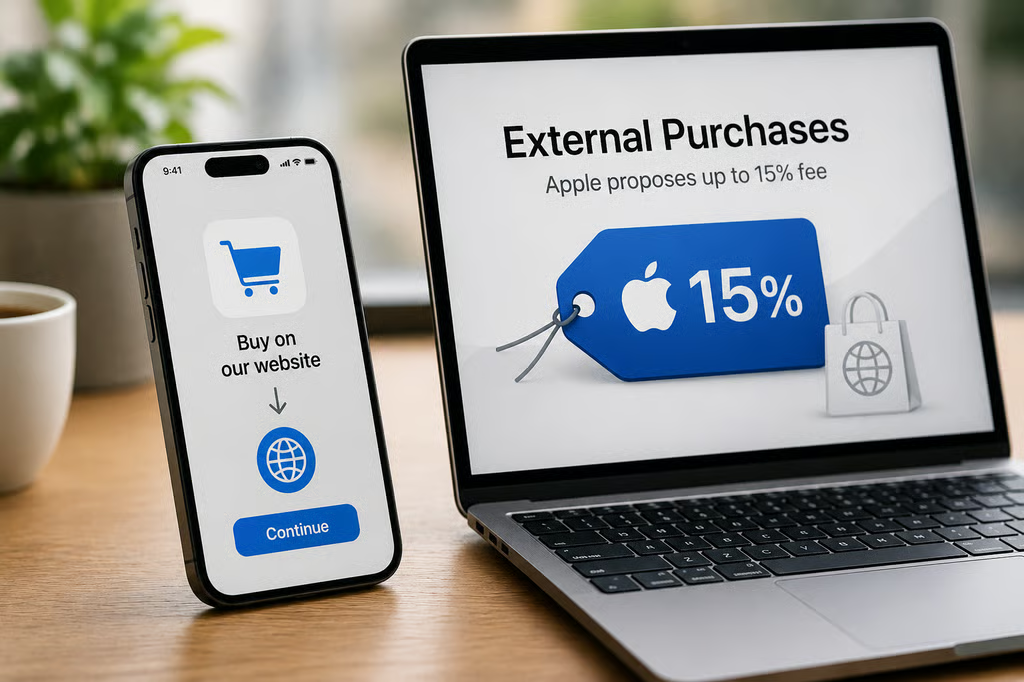
Apple wants permission to charge US developers up to 15% when an iPhone user follows an in-app link and completes a digital purchase on the web. The proposal would replace the current zero-commission rule for US link-outs, but only if Judge Yvonne Gonzalez Rogers approves a fee.
For developers, 15% is not automatically a bargain compared with Apple’s usual App Store rates.
Web checkout adds processing and operating costs, so the savings depend on the Apple tier, transaction size, and cost of running the external payment flow.
Apple wants 5% to 15% of link-out sales
Apple’s August proposal calls for 15% on linked-out purchases for standard apps and 5% for Small Business Program apps. 9to5Mac reported that certain partner-program apps and subscription renewals would be charged 10%.
Apple says its “necessary costs” for enabling external purchases under the Ninth Circuit’s definition would be essentially zero, while arguing that its broader developer tools and services still warrant compensation.
The Ninth Circuit upheld Apple’s April 2025 contempt finding but rejected a permanent blanket ban on link-out commissions. It said any fee should reflect costs genuinely necessary to coordinate external links, with some allowance for intellectual property directly used in those transactions.
Apple cannot collect a link-out commission until the district court approves one.
US App Store rules currently allow buttons and external links to other purchasing mechanisms without a special entitlement. Apple’s standard App Store commission is 30%, while Small Business Program developers and qualifying subscriptions can pay 15%.
The Supreme Court is separately reviewing part of Apple’s contempt appeal. It granted review on June 30, limited to one question about the civil-contempt standard. Apple’s merits brief is due September 14, with Epic’s response due November 13.
When does web checkout actually save money?
Take a hypothetical $10 digital purchase. Under Apple’s standard 30% in-app commission, the developer keeps $7. If Apple’s proposed 15% link-out fee applied and the developer used Stripe’s standard US domestic-card price of 2.9% plus 30 cents, about $7.91 would remain, 91 cents more before other checkout costs.
For a Small Business Program developer, Apple’s current 15% commission leaves $8.50 from that $10 purchase. A proposed 5% Apple fee plus the same Stripe charge leaves about $8.91, a 41-cent difference.
Subscription renewals can flip the math. A $10 qualifying renewal at Apple’s 15% in-app rate leaves $8.50. A proposed 10% link-out fee plus the same Stripe charge leaves about $8.41. On those assumptions, the external route overtakes the 15% in-app rate only above roughly $14.29, before engineering, fraud, refunds, taxes, support, or other commerce costs.
Teams considering an App Store launch or external payment gateway can model their own break-even point now, but the proposed rates are not final. Apple’s China fee changes also show that App Store economics can vary by jurisdiction.
Until the district court approves a fee, zero remains the operative US link-out commission.
Also read: Apple is reportedly considering multiyear agreements that could pay news publishers based on how Siri AI uses their content.