







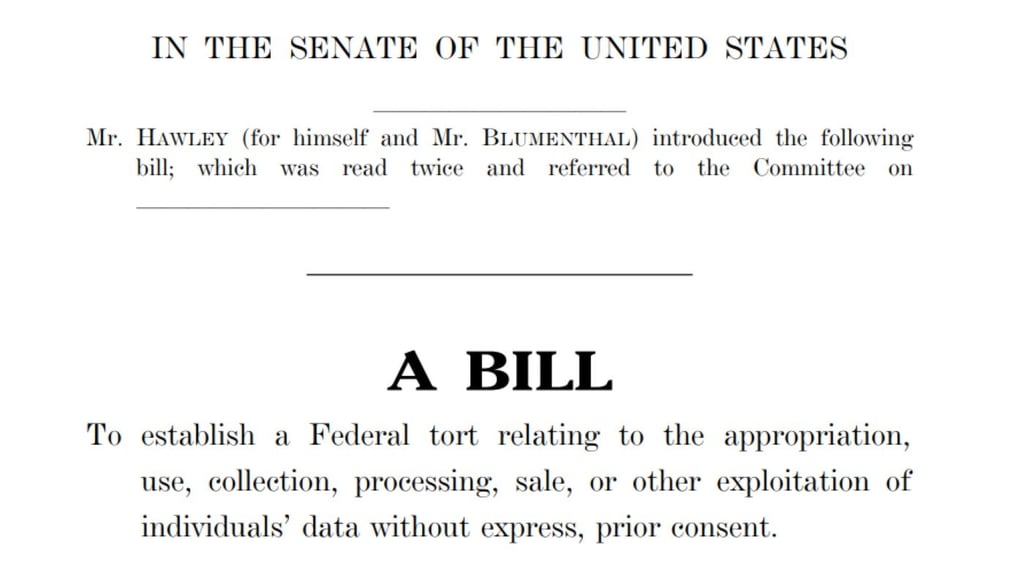
Senators Josh Hawley (R-MO) and Richard Blumenthal (D-CT) introduced a bill Monday that would give individuals the right to sue AI companies that use their personal data or creative works without consent.
They introduced the AI Accountability and Personal Data Protection Act following a Senate Judiciary subcommittee hearing in which Hawley accused OpenAI, Meta, and other companies of mass copyright infringement. In a statement, the senator called it “the largest intellectual property theft in American history.”
Holding tech companies accountable and liable
Several high-profile authors, including John Grisham and George R.R. Martin, have filed lawsuits asserting that AI companies used their work without authorization. Other AI developers, such as Meta Platforms and Stability AI, also face litigation over the datasets used to train other large language models. OpenAI, however, has defended its use of copyrighted data for AI training under the fair use doctrine.
“AI companies are robbing the American people blind while leaving artists, writers, and other creators with zero recourse,’’ Hawley said in a statement. “It’s time for Congress to give the American worker their day in court to protect their personal data and creative works.”
In a separate statement, Blumenthal said, “Tech companies must be held accountable — and liable legally — when they breach consumer privacy, collecting, monetizing or sharing personal information without express consent. Consumers must be given rights and remedies — and legal tools to make them real — not relying on government enforcement alone.”
Provisions of the bill
The proposed bill would:
- Prohibit AI firms from using copyrighted content for training without permission.
- Grant individuals the right to sue if their personal data or creative work is used or distributed without consent.
- Require companies to clearly disclose which third parties will receive data if access is granted.
- Impose significant financial penalties for violations.
This is not the first time Hawley and Blumenthal have teamed up on issues related to Big Tech. During the last Congress, the senators introduced a bipartisan framework to apply guardrails around AI to protect consumers.
Curious how California plans to lead the U.S. in AI oversight? Explore our deep dive into the state’s bold new AI policy blueprint and what it means for Big Tech.