







Buying more GPUs is becoming the easy part of the AI infrastructure race. Keeping them fed, cooled, connected, secured, and useful is where things get complicated.
Cisco expanded its Secure AI Factory with Nvidia on Aug. 25 through a new partnership with Supermicro, adding high-density rack-scale computing and liquid- and air-cooled systems to an architecture that already spans networking, security, software, and AI infrastructure.
The move reflects a larger shift in enterprise AI: the race is moving beyond individual accelerators and toward complete systems that can support increasingly demanding training and inference workloads. For enterprise infrastructure teams, that means AI deployment decisions increasingly involve power, cooling, networking, security, and lifecycle management alongside GPU capacity.
Supermicro brings the compute and cooling muscle
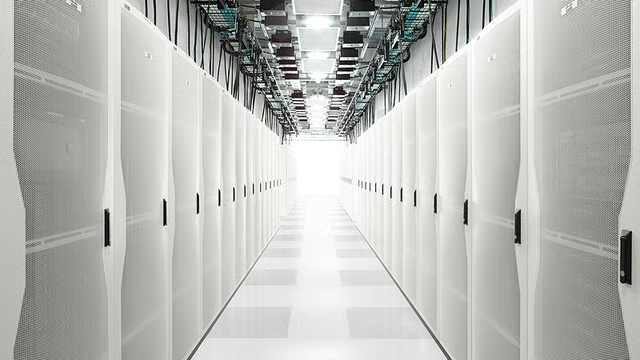
Under the expanded partnership, Cisco will offer Supermicro's high-density GPU systems as part of its Secure AI Factory portfolio, including both liquid- and air-cooled configurations.
The companies are also combining Cisco's liquid-cooled networking equipment with Supermicro's liquid-cooled servers to create what Cisco describes as rack-to-fabric liquid cooling.
That matters because increasingly dense AI infrastructure brings power and thermal problems along with its performance gains. Supermicro already markets its AI Factory systems with Nvidia around rack-level integration, testing, networking, storage, and cooling rather than treating the GPU server as an isolated component.
Cisco said the expanded architecture will support systems including Nvidia Vera Rubin NVL72 and HGX Rubin NVL8, with use cases ranging from training trillion-parameter models to high-throughput inference.
The expansion arrives as Nvidia increasingly pitches itself as more than a chip company. At GTC 2026, eWeek reported that Jensen Huang framed Nvidia around the "full AI stack", spanning chips, infrastructure, models, agents, and physical AI.
What eWeek found: Cisco is adding a deeper rack-scale layer to its AI factory
The new announcement is more than another partner joining Cisco's existing architecture.
When Cisco expanded the Secure AI Factory in March, its architecture already supported large AI factories and Nvidia Cloud Partner-compliant deployments. That announcement, however, put significant emphasis on extending AI from central data centers to local and edge environments while adding security capabilities through technologies such as Cisco AI Defense and Hybrid Mesh Firewall.
Five months later, Cisco is adding another layer to that strategy.
The August expansion brings dense rack-scale Supermicro compute, rack-to-fabric liquid cooling, newer Nvidia Rubin infrastructure, and an expanded Nvidia Cloud Partner-compliant architecture aimed in part at neocloud and sovereign cloud providers.
Cisco is also combining its Silicon One-based front-end networking with Spectrum-X-based back-end networking under Cisco Nexus One. Cisco claims it is the only Nvidia technology partner using its own networking switches and network operating system in an Nvidia Cloud Partner-compliant solution.
The comparison shows how Cisco's AI infrastructure strategy is broadening. Security and distributed inference remain part of the architecture, while the Supermicro partnership gives customers another option to address the compute density and cooling demands of increasingly large AI clusters.
AI factories are becoming an infrastructure business
Nvidia has been pushing that same idea from several directions.
The company has described AI factories as infrastructure that converts computing capacity into AI output, and its ambitions increasingly encompass the physical systems surrounding the GPU. Nvidia recently argued that AI factories require not only chips and networking but also access to land, power, and suitable data center facilities.
Capital is following that thesis. Earlier this year, Nvidia made a $2 billion investment in CoreWeave as the companies pursued a plan to build more than 5 gigawatts of AI factory capacity by 2030.
The concept is also expanding beyond traditional data centers. Nvidia and LG, for example, are working on an AI factory spanning manufacturing, robotics, simulation, and autonomous systems.
Cisco's latest expansion places it squarely in the layer connecting those workloads to physical infrastructure.
What enterprises should watch
The attraction for enterprise buyers is straightforward: validated reference architectures could reduce some of the work involved in assembling high-density AI infrastructure from separate compute, networking, security, cooling, and management components.
Cisco is adding new Validated Infrastructure Services aligned with Nvidia Infrastructure Services to certify that deployed infrastructure matches its intended reference architecture. Cisco also said it is building a dedicated large-scale AI lab to develop tools and test software around that validation process.
But validated architecture does not make the economics disappear. Organizations still have to determine whether they need rack-scale AI infrastructure, how heavily it will be utilized, what power and cooling upgrades are required, and whether the resulting performance justifies the capital and operating costs.
That may become the more consequential AI infrastructure question. As GPU systems become larger and more interconnected, the competitive advantage may increasingly come from how efficiently companies can operate the machinery surrounding the accelerators rather than simply how many GPUs they can acquire.
Cisco plans to begin offering Supermicro compute systems through its Secure AI Factory with Nvidia in October 2026.
Also read: AI Data Center Power Demand Is Testing the Grid for a closer look at how surging AI infrastructure demand is putting pressure on power availability and the electrical grid.