







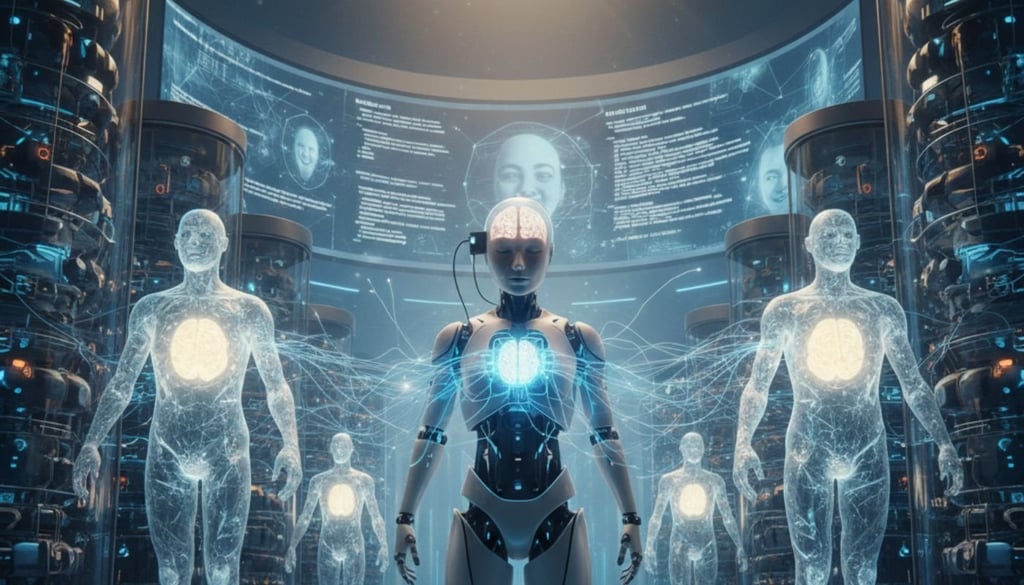
With the confidence of a trillionaire, Elon Musk predicts Tesla’s Optimus robots could be the forever home of human consciousness within 20 years.
Delivered during the Q&A at Tesla’s 2025 Annual Shareholder meeting, Musk’s comments set a grandiose path for robot self-awareness right through Neuralink, his brain interface company. In his vision, humans will be able to download their consciousness, back it up, and possibly reinstall it into a robot body that does not need sleep, snacks, or healthcare.
“It’s not immediate,” Musk said, in answer to an audience question about Optimus’s future capabilities. “But if you say, down the road, would you be able to, say, with a Neuralink, have a snapshot of what is an approximate snapshot of somebody’s mind and then upload that approximate snapshot to an Optimus body? I think that at some point, that technology becomes possible, and it’s probably less than 20 years.”
Musk went on to clarify that such a Frankenstein-esque human-robot mash up will likely not be a one-to-one replica, but “pretty close.” It is an idea that the self-proclaimed futurist has floated before, but his most recent comments land differently now that Optimus has moved from an awkward lab prototype to a more fluid and capable machine.
Winning organic minds and hearts
Musk’s “Black Mirror” dreams come on the heels of his securing his trillion-dollar compensation package. This historic payout has turbocharged his confidence and positioned him once again as the loudest technofuturist on the planet. We are all familiar by now with Musk’s oscillations between engineering breakthroughs and wild leaps into science fiction.
His timeline for robot consciousness is aggressive and is perhaps propped up by recent Neuralink human trials. The company has been candid about its long-term ambition to create high-bandwidth interfaces that allow humans to communicate with machines using thought alone. Pair this with Tesla’s expanding robotics program, and you get a scenario that Musk claims could one day blur the line between organic and synthetic minds.
Musk’s optimistic outlook for a human-robot mind-meld could use a dose of reality, however. Robots with advanced autonomy could, and in some instances have, begun to transform manufacturing, logistics, healthcare, and home assistance. But a robot that can think like a person introduces ethical and moral questions around safety, human rights, and societal accountability.
If Optimus ever reaches the levels of Musk’s imaginings, society will have to wrestle with everything from workplace laws to digital personhood.
Proof of concept
Beyond the geopolitical implications of human-infused robot consciousness, there is also the question of who controls the data.
The head-spinning race to build out AI’s infrastructure currently dominates the world’s financial markets. A near-future where humans can back up their consciousness sounds intriguing until you realize that it has to be stored, secured, and safeguarded from being sold as part of a targeted advertising bundle.
The future Musk describes is a fun thought experiment. Still, the many ways it can go wrong are sobering when you consider the frightening consequences of conscious machines built by private companies operating at a planetary scale.
Musk has a decade and $1 trillion in incentives to deliver a proof of concept. Whether he delivers on any of it is anyone’s guess, but Musk clearly intends to drag the rest of us along for the ride, willingly or not.
Catch up on Elon Musk’s bold forecast of an “AI tsunami” that he says could wipe out desk jobs and usher in a new era of universal high income.