







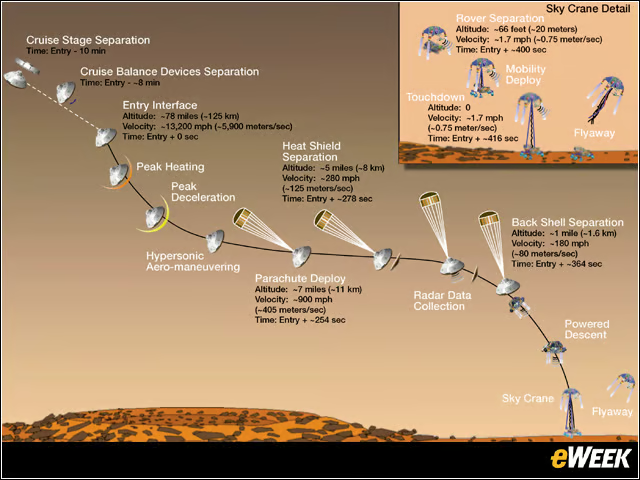
- Landing Stages
- Robot and Chemist
- Curiosity at Work on Mars
- Daybreak at Gale Center
- Curiosity Launch Vehicle
- Mars Science Laboratory Spacecraft During Cruise
- Curiosity Approaching Mars
- Curiosity Inside Aeroshell
- Mars Science Laboratory Guided Entry at Mars
- Deceleration of Mars Science Laboratory in Martian Atmosphere
- Mars Science Laboratory Parachute
- Mars Science Laboratory Parachute
- Curiosity and Descent Stage
- Curiositys Sky Crane Maneuver
- Curiosity Touching Down
- A Moment After Curiositys Touchdown
- Curiosity: The Next Mars Rover
- Mars Rover Curiosity in Artists Concept, Close-Up
- Mars Rover Curiosity in Artists Concept, Wide
- Integrated Payload
- Tucked in for Flight
- Cruise Stage in Place
- Back Shell in Place
Landing Stages

Here’s a look at the various stages of the Curiosity landing process.
Robot and Chemist

This artist’s concept features NASA’s Mars Science Laboratory Curiosity rover, a mobile robot for investigating Mars’ past or present ability to sustain microbial life. In this picture, the rover examines a rock on Mars with a set of tools at the end of the rover’s arm, which extends about 7 feet (2 meters). Two instruments on the arm can study rocks up close. A drill can collect sample material from inside rocks and a scoop can pick up samples of soil. The arm can sieve the samples and deliver fine powder to instruments inside the rover for thorough analysis.
Curiosity at Work on Mars

This artist’s concept depicts the rover Curiosity, of NASA’s Mars Science Laboratory mission, as it uses its Chemistry and Camera (ChemCam) instrument to investigate the composition of a rock surface. ChemCam fires laser pulses at a target and views the resulting spark with a telescope and spectrometers to identify chemical elements. The laser is actually in an invisible infrared wavelength, but is shown here as visible red light for purposes of illustration.
Daybreak at Gale Center

This computer-generated view depicts part of Mars at the boundary between darkness and daylight, with an area including Gale Crater beginning to catch morning light. Gale Crater looms in the distance, distinguished from adjacent craters by its central mountain of strata. Gale Crater straddles the dichotomy boundary of Mars, which separates the broad, flat and young northern plains from the much older and rougher southern highlands. There is evidence that water may have flowed across this topographic boundary, from highland to lowland, perhaps pooling locally within Gale Crater and forming the lowermost strata that fill the crater.
Curiosity Launch Vehicle

This is an artist concept of the Atlas V541 launch vehicle that will carry NASA’s Curiosity rover on its way to Mars. The Atlas V 541 vehicle was selected for the Mars Science Laboratory mission because it has the right liftoff capability for the heavy weight requirements of the rover and its spacecraft. The launch vehicle will provide the velocity needed by the spacecraft to escape Earth’s gravity and set it on its course for Mars. Atlas V rockets are expendable launch vehicles (ELVs), which means they are only used once.
Mars Science Laboratory Spacecraft During Cruise

This is an artist’s concept of NASA’s Mars Science Laboratory spacecraft during its cruise phase between launch and final approach to Mars. The spacecraft includes a disk-shaped cruise stage (on the left) attached to the “aeroshell.” The spacecraft’s rover (Curiosity) and descent stage are tucked inside the aeroshell.
Curiosity Approaching Mars

This is an artist’s concept of NASA’s Mars Science Laboratory spacecraft approaching Mars.
Curiosity Inside Aeroshell

This is an artist’s concept of NASA’s Mars Science Laboratory aeroshell capsule as it enters the Martian atmosphere. The Curiosity rover and the spacecraft’s descent stage are safely tucked inside the aeroshell at this point.
Mars Science Laboratory Guided Entry at Mars

This artist’s concept shows thrusters firing during the entry, descent and landing phase for NASA’s Mars Science Laboratory mission to Mars.
Deceleration of Mars Science Laboratory in Martian Atmosphere

This artist’s concept depicts the interaction of NASA’s Mars Science Laboratory spacecraft with the upper atmosphere of Mars during the entry, descent and landing of the Curiosity rover onto the Martian surface.
Mars Science Laboratory Parachute

This is an artist’s concept of the Mars Science Laboratory Curiosity rover parachute system.
Mars Science Laboratory Parachute

This is an artist’s concept of the Mars Science Laboratory Curiosity rover parachute system.
Curiosity and Descent Stage

This is an artist’s concept of the rover and descent stage for NASA’s Mars Science Laboratory spacecraft during the final minute before the rover Curiosity touches down on the surface of Mars.
Curiositys Sky Crane Maneuver

This artist’s concept shows the sky crane maneuver during the descent of NASA’s Curiosity rover to the Martian surface.
Curiosity Touching Down

This artist’s concept depicts the moment that NASA’s Curiosity rover touches down onto the Martian surface.
A Moment After Curiositys Touchdown

This artist’s concept depicts the moment immediately after NASA’s Curiosity rover touches down onto the Martian surface.
Curiosity: The Next Mars Rover

This artist concept features NASA’s Mars Science Laboratory Curiosity rover, a mobile robot for investigating Mars’ past or present ability to sustain microbial life. Curiosity is being tested in preparation for launch in the fall of 2011. In this picture, the rover examines a rock on Mars with a set of tools at the end of the rover’s arm.
Mars Rover Curiosity in Artists Concept, Close-Up

This artist concept features NASA’s Mars Science Laboratory Curiosity rover, a mobile robot for investigating Mars’ past or present ability to sustain microbial life. Curiosity is being tested in preparation for launch in the fall of 2011.
Mars Rover Curiosity in Artists Concept, Wide

This artist concept features NASA’s Mars Science Laboratory Curiosity rover, a mobile robot for investigating Mars’ past or present ability to sustain microbial life.
Integrated Payload

In the Payload Hazardous Servicing Facility at NASA’s Kennedy Space Center in Florida, all spacecraft elements of the Mars Science Laboratory mission have come together. The top portion is the cruise stage; next, the aeroshell (containing the compact car-sized rover, Curiosity); and on the bottom, the heat shield.
Tucked in for Flight

An overhead crane is attached to the heat shield for the Mars Science Laboratory mission in preparation for integration with the aeroshell, containing the rover Curiosity. Earlier, the aeroshell was mated to the cruise stage, which provides solar power, thrusters for navigation, and heat exchangers to the rover during its flight from Earth to Mars.
Cruise Stage in Place

NASA’s Mars Science Laboratory (MSL) mission cruise stage has been mated to the aeroshell, which contains the compact car-sized rover Curiosity. The cruise stage provides solar power, thrusters for navigation and heat exchangers to the rover during its flight from Earth to Mars.
Back Shell in Place

The back shell, a protective cover that carries the parachute and several components used during later stages of entry, descent and landing, has been lowered into place over NASA’s Mars Science Laboratory rover Curiosity.