









Meta is officially back in the AI ring.
The company just launched Muse Spark, the first major model from its new Meta Superintelligence Labs, and its first big AI release since Mark Zuckerberg reshuffled the org and brought in Alexandr Wang to help get things back on track.
The pitch is pretty straightforward: Muse Spark now powers the Meta AI app and Meta.ai, with rollout coming to WhatsApp, Instagram, Facebook, Messenger, and Meta’s AI glasses in the coming weeks. Meta says it’s multimodal, built for speed, and offers both an Instant mode for quick answers and a Thinking mode for harder questions.
That’s important because Meta isn’t trying to win the AI race the same way OpenAI and Anthropic are. It’s trying to shove AI into every app you already open 40 times a day. Your messages, your feed, your glasses, and, eventually, your very questionable vacation planning.And this model is no slouch, scoring a 53 to debut at 4 on the Artificial Analysis Intelligence Index behind only Gemini 3.1 Pro, GPT-5.4, and Claude Opus 4.6. That’s a powerful comeback from a company whose most recent model, Llama 4 Maverick, scored only an 18.
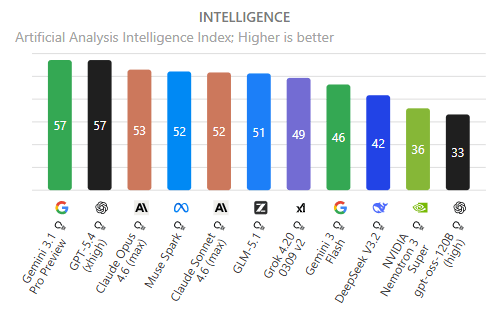
Image: Artificial Analysis
Meta finding its way back into serious AI conversation is no small feat. Countless people in the AI space had all but written them off. And to be clear, this didn’t tap the top spot, and that’s still a hefty climb for Zuck & Co.
But it’s a whole lot closer than it was yesterday. There are a few catches, though:
- Meta may open-source some future models, while keeping its strongest systems proprietary.
- Public access still looks limited for now, with the biggest push happening through Meta’s products rather than a wide-open standalone release.
- And in a funny little sign that things are getting tense internally, journalist Jyoti Mann reported that Meta shut down its internal AI token leaderboard, dubbed Claudeonomics, after data from the dashboard leaked externally. Tough day for the office scoreboard.
Why this matters
Meta may not need the best model if it has the best distribution. If Muse Spark is good enough and lands inside apps used by billions, that could matter more than winning benchmark bragging rights for a week.
Our take
This feels less like a knockout punch and more like Meta proving it can still throw one. But the bigger story is the strategy shift: Meta seems to be moving from “open for everyone” to “open where useful, closed where it counts.”
Smart? Maybe. A pretty major philosophical turn? Definitely. Either way, Corey is not-so-patiently awaiting its arrival in his Meta Ray-Ban smartglasses, and we’re excited to see what else they’re cooking up.
Editor’s note: This content originally ran in the newsletter of our sister publication, The Neuron. To read more from The Neuron, sign up for its newsletter here.