






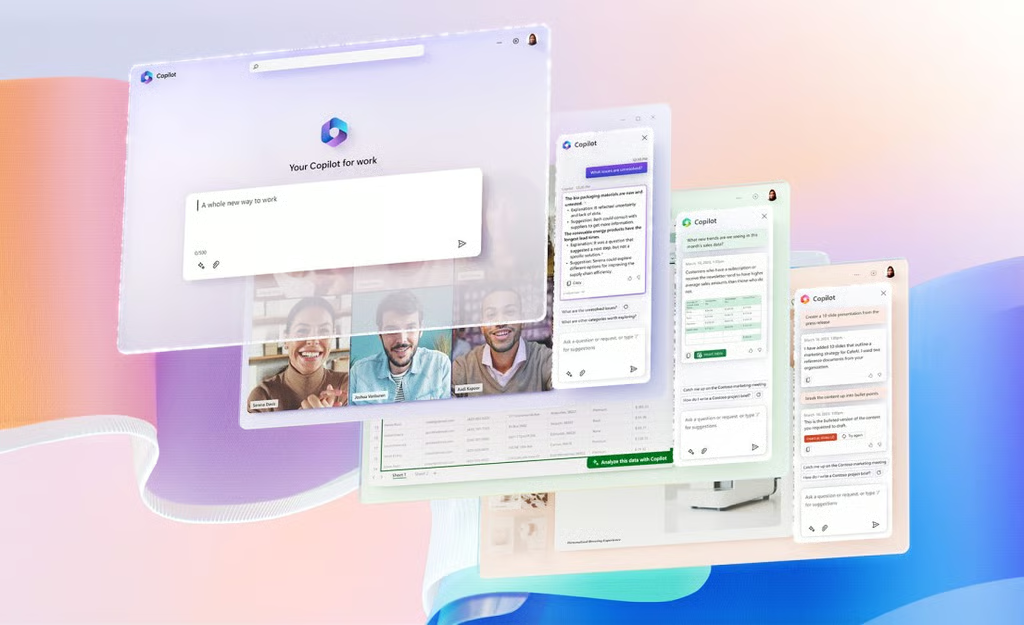


Microsoft has spent the past several years putting Copilot into nearly every corner of its software empire. Now it wants to bring those scattered AI experiences under one roof.
CEO Satya Nadella said during Microsoft’s latest earnings call that the company is combining its chat, collaborative work, coding and autonomous-agent capabilities into a single Copilot “super app.” Microsoft has not disclosed the app’s complete feature set, pricing or exact release date.
The announcement came during Microsoft’s earnings call, where Nadella said the new app will support both individual users and businesses when it launches later this year.
“Copilot is evolving rapidly from chat to Cowork to Autopilots,” Nadella said, per The Verge. “This quarter, we are bringing these Copilot experiences together, including code, in one super app… This is a major step forward, and I look forward to sharing more soon.”
The app will bring together several parts of Microsoft’s growing AI lineup, including GitHub Copilot for developers, Copilot Cowork for collaborative tasks, and Autopilots, Microsoft’s name for AI agents designed to complete longer workflows with less human input.
Microsoft’s answer to AI app overload
The move comes as AI companies race to create a single destination where users can chat, create content, write code and delegate tasks.
OpenAI recently introduced ChatGPT Work, which combines ChatGPT with its Codex coding assistant, while Anthropic has expanded Claude with workplace-focused capabilities. The broader industry shift suggests companies believe the next stage of AI adoption will depend less on individual tools and more on a central assistant that users return to every day.
The challenge for Microsoft is not just adding more AI features; it is making its existing collection of Copilots feel like one product instead of a collection of separate services.
Microsoft has already built Copilot into many parts of its ecosystem, from Windows and Microsoft 365 to GitHub. A unified app could make those capabilities easier to discover and use, especially for businesses that want employees to adopt AI tools without managing multiple platforms.
The announcement arrives as Microsoft’s AI business continues to drive growth. The company reported $90 billion in quarterly revenue, with AI and cloud services contributing significantly to the increase.
Microsoft says Copilot adoption is also increasing, with executives noting that user conversations have nearly doubled year over year and weekly engagement has reached levels comparable with products such as Outlook and Teams. A successful Copilot super app could strengthen Microsoft’s position in enterprise AI by giving companies a single interface for productivity, software development and automation.
It could also help Microsoft compete with rivals trying to become the default AI assistant for both work and personal tasks.
The risk: putting everything in one place
Combining many AI tools into one application could simplify the user experience, but it also creates new challenges.
A single app handling conversations, code and autonomous actions would need strong controls around accuracy, security and permissions. Mistakes from an AI chatbot are already a concern; mistakes from an agent that can perform tasks on a user’s behalf could have bigger consequences.
Microsoft also faces a usability challenge. The company has previously pushed Copilot into many parts of Windows and its software ecosystem, but some users have criticized the aggressive AI rollout. A larger, more powerful Copilot experience will need to prove it adds value rather than simply adding complexity.
Microsoft has not yet explained whether the super app will replace existing Copilot applications or simply act as a new front door to them. Pricing, licensing, administrative controls and availability also remain unclear.
Those details will determine whether the app becomes a genuinely simpler way to use Microsoft’s AI tools or merely another layer sitting on top of them. Bringing every Copilot together is the easy pitch. Making them behave like one trustworthy product will be the harder job.
Also read: Microsoft's AI ambitions extend beyond productivity, as the company is also testing a free, ad-supported version of Xbox Cloud Gaming to broaden access to its gaming platform.