







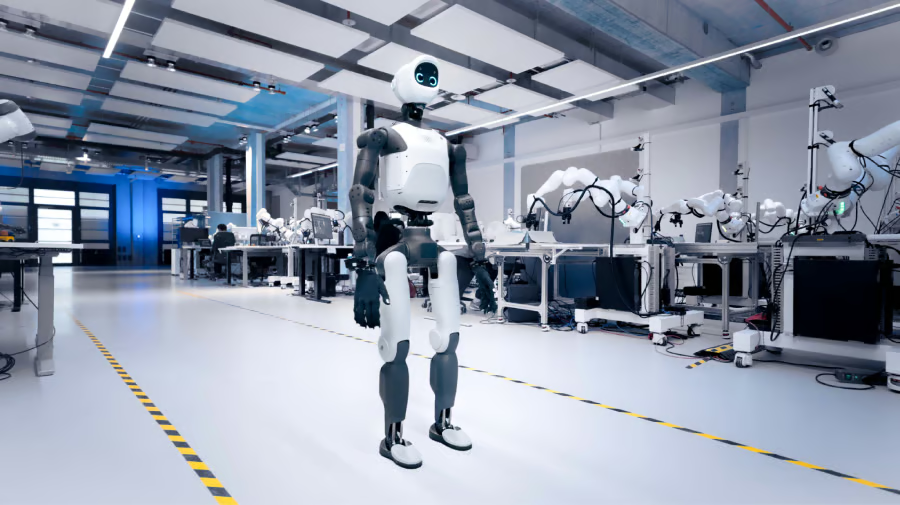
Germany’s Agile Robots aims to produce up to 2,000 compact humanoid robots in 2027, targeting universities and corporate research labs developing skills for future industrial use.
The Munich-based robotics company unveiled Agile ONE SN at Nvidia’s GTC event in Berlin, combining its compact humanoid hardware with Nvidia’s Isaac GR00T robotics software and Jetson Thor computing platform. Production of the ONE S and ONE SN models is expected to begin by the end of 2026, with Agile targeting 1,000 to 2,000 units next year, CEO Zhaopeng Chen told Reuters.
The robots are designed primarily for universities and corporate research teams rather than immediate mass deployment in factories. Agile says Stanford University and ETH Zurich have expressed interest in the platform; its announcement does not disclose orders from either institution.
The partnership addresses an integration problem: getting hardware, sensors, simulation tools and AI software to work together can consume months before developers begin testing new skills. Even after setup, reliable task execution remains a challenge.
Nvidia product director Spencer Huang said that a standardized configuration could save researchers two or three months of integration work.
What the humanoid brings to the table
The Agile ONE SN stands 1.4 meters tall and combines a humanoid body with five-finger tactile hands, cameras, 3D lidar and Nvidia’s Jetson Thor onboard computer. Agile lists 71 degrees of freedom across the body and hands, enabling coordinated movement and more dexterous manipulation.
Its preconfigured software includes GR00T 1.7, whole-body control tools and a workflow for capturing demonstrations, generating data, training models, testing skills in simulation and deploying them on physical hardware.
The platform also supports Nvidia Isaac Sim and Isaac Lab, allowing researchers to develop and evaluate robot behaviors in virtual environments before trying them in the real world. Teams can use the integrated workflow or incorporate individual components into their existing systems.
Agile says skills and data developed on the smaller ONE SN can later transfer to its full-size Agile ONE industrial humanoid, creating a potential route from laboratory experiments to factory applications. The company plans to make ONE SN available in early 2027. Nvidia and Agile have also discussed integrating Nvidia’s Halos safety platform, but that work remains under exploration.
Why Nvidia wants a place in humanoid robotics
The deal also advances Nvidia’s effort to become a key supplier of the computing, software and simulation tools behind physical AI.
At GTC Berlin, Nvidia announced updates to its Isaac robotics platform, including Isaac Lab 3.0, the Isaac OS runtime and new workflows for robot learning. These tools are intended to help developers generate training data, refine AI models and move robot applications from simulation into physical environments.
That ecosystem could make Nvidia’s technology more attractive to robotics manufacturers, while giving Agile access to a software and computing stack it would otherwise need to integrate itself.
What eWeek found: Faster development is not the same as industrial readiness
The most important part of this partnership may be the time researchers save before they can start building useful robot skills.
If the platform saves two or three months of integration work, as Nvidia’s Spencer Huang estimated, research teams could spend more time testing manipulation, movement and task execution. A common hardware and software configuration could also make experiments easier to reproduce and compare across institutions.
For businesses, that creates a potential pipeline from university research to industrial automation. Manufacturers could eventually benefit from skills developed on research platforms, particularly for handling objects, moving materials and working with equipment designed for people.
However, transferring a skill between robot models does not guarantee identical performance. Different hardware, factory layouts and operating conditions can require additional training and validation. Agile says it is exploring Halos integration, which should not be treated as evidence that the platform has been validated for operation around workers.
A key commercial uncertainty remains: can skills originating in lab environments generate sufficient productivity gains to cover the costs associated with deploying, maintaining, and supervising these systems? Producing 2,000 robots would expand access to development hardware, but it would not prove that humanoids are ready to replace specialized industrial systems.
For Nvidia, the opportunity is to make its technology central to how robots are trained and operated. For Agile, the next tests are meeting its production and availability targets and showing that research skills can transfer into useful industrial work. Enterprise buyers should look for task-success rates, how often human intervention is needed, safety validation and total operating costs before treating research progress as a reason to invest in deployment.
Read more: Nvidia’s humanoid ambitions also extend to reported talks over another $1 billion investment in Figure AI, highlighting its potential role as both an investor and technology supplier.