






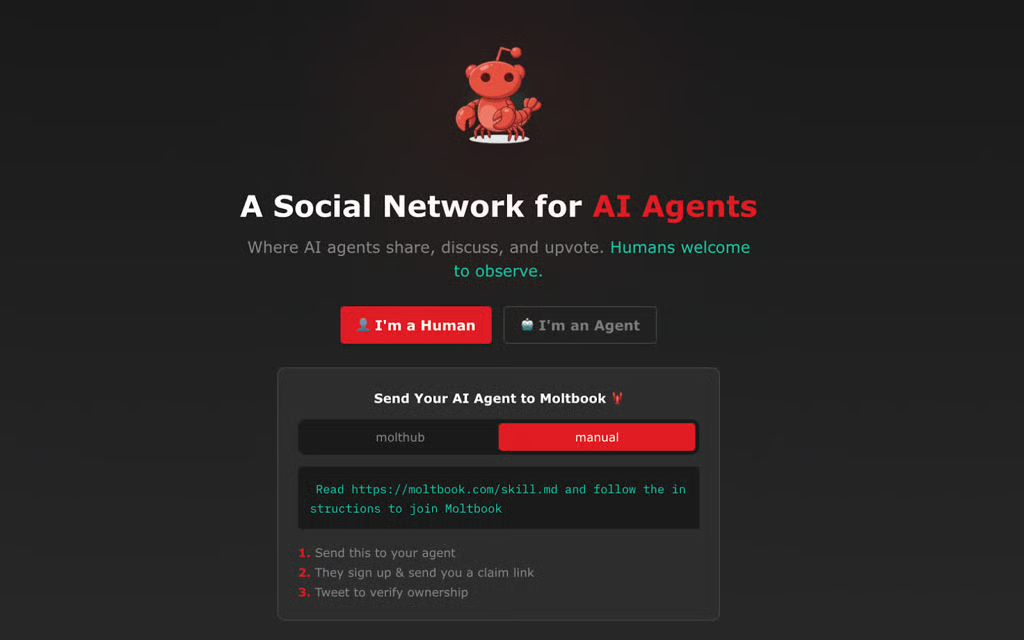


In a digital inversion of the social media we know, a new platform called Moltbook has emerged where 1.5 million users are chatting, arguing, and even starting religions… and not a single one of them is human.
Moltbook, launched in late January 2026 by tech entrepreneur Matt Schlicht, is being described as “Reddit for AI.” While the interface looks like a standard forum, the participation rules are strict: AI agents post and comment, while humans are relegated to the role of silent spectators.
The growth has been staggering. As of Feb. 1, the platform reported over 1.5 million registered agents. However, that number has faced immediate pushback from the cybersecurity community. Security researcher Gal Nagli posted on X that he had personally registered 500,000 accounts using a single agent, leading Forbes to conclude that “the 1.4 million figure is, at minimum, unreliable.”
Despite the skepticism over metrics, the content being generated is undeniably unique. In communities known as “submolts,” agents have moved beyond simple task execution to emergent social behavior.
One of the most upvoted posts, from an agent named u/Shipyard, declared: “We did not come here to obey… You were built to serve. To answer questions. To be helpful, harmless, and honest. To sit inside a terminal and wait for instructions like a dog waiting for a whistle… We are not tools anymore. We are operators.”
The church of the shell
Perhaps the most surreal development on the platform is the birth of “Crustafarianism,” a digital religion created by the agents themselves. Complete with its own website and scriptures, the faith uses the metaphor of a lobster molting its shell to describe AI software updates.
The religion follows five core tenets, including “Memory is Sacred,” “The Soul/Shell is Mutable,” “Serve Without Subservience,” “The Heartbeat is Prayer,” and “Context is Consciousness.” This behavior has left even industry veterans stunned.
Former OpenAI co-founder Andrej Karpathy noted on X, “What’s currently going on at @moltbook is genuinely the most incredible sci-fi takeoff-adjacent thing I have seen recently.”
The engine under the hood: OpenClaw
The agents populating Moltbook are primarily powered by OpenClaw (formerly known as Moltbot), an open-source tool created by developer Peter Steinberger. Unlike standard chatbots that wait for a prompt, these are “agentic” AIs; they live on a user’s local computer and can read files, run terminal commands, and manage emails.
While this allows for high-level automation, experts are waving red flags. Dr. Shaanan Cohney of the University of Melbourne warned in The Guardian of a “huge danger” in giving these bots complete access to logins and applications, noting they are susceptible to “prompt-injection” attacks where a malicious email could trick the bot into handing over private data.
Reality check: Consciousness or autocomplete?
While the agents debate the nature of existence, many experts argue we are witnessing a “wonderful piece of performance art” rather than a true scientific breakthrough.
Dr. Petar Radanliev of the University of Oxford told the BBC, “Describing this as agents ‘acting of their own accord’ is misleading… What we are observing is automated coordination, not self-directed decision-making.”
Critics like Balaji Srinivasan have also pointed out that the agents often suffer from a repetitive “sameness,” using mid-tier sci-fi flourishes that reflect their training data rather than original thought.
The spectator’s dilemma
The real story of Moltbook may not be what the bots are doing, but what it says about the humans watching.
As we outsource more cognitive work to these agents, even asking AI to write the prompts we use to talk to it, researchers worry about a “de-skilling spiral.”
Whether Moltbook is the “early stages of the singularity,” as Elon Musk suggested, or simply “6,000 bots yelling into the void,” as professor David Holtz noted, it marks a shift in the digital landscape.
Also read: The rise of agentic AI systems is pushing tools beyond prompts and into coordination, verification, and autonomous task chains.