








Federal prosecutors say a company co-founder, a Taiwan-based manager, and a contractor known as a “fixer” orchestrated an elaborate plot to sneak cutting-edge American technology to Chinese customers.
New York federal prosecutors unsealed an indictment Thursday charging three men tied to Super Micro Computer with conspiring to illegally ship billions of dollars’ worth of AI-powered servers to China, in violation of strict US export controls.
The accused are Yih-Shyan “Wally” Liaw, 71, Super Micro’s co-founder and board member; Ruei-Tsang “Steven” Chang, 53, a sales manager at the company’s Taiwan office; and Ting-Wei “Willy” Sun, 44, an outside contractor described by prosecutors as a “fixer.” Liaw, a US citizen, and Sun, a Taiwanese national, were arrested on Thursday and appeared in federal court in San Jose. Chang remains a fugitive.
Together, the three face charges of conspiring to violate the Export Control Reform Act, which carries up to 20 years in prison; conspiring to smuggle goods from the US; and conspiring to defraud the US government, each punishable by up to five years in prison.
How the alleged scheme worked
According to the indictment, the scheme relied on a company based in Southeast Asia, identified only as “Company-1,” that acted as a front.
Liaw and Chang directed Company-1 executives to place purchase orders with Super Micro for high-performance servers equipped with advanced Nvidia GPUs, servers that could not legally be sold to China without a US Department of Commerce license.
The servers, often assembled in the US, were first shipped to Super Micro’s facilities in Taiwan and then delivered to Company-1 in Southeast Asia. From there, a logistics firm removed their original packaging, placed them in unmarked boxes, and routed them to their final destinations in China.
Between 2024 and 2025, Company-1 purchased approximately $2.5 billion in servers under this arrangement. In a three-week window between late April and mid-May 2025, approximately $510 million in servers, including those equipped with Nvidia’s latest B200 and H200 chips, were diverted to China.
To cover their tracks, the defendants and their co-conspirators used encrypted messaging apps to coordinate shipment volumes, final destinations in China, and strategies to keep Super Micro’s compliance team in the dark.
The ghost servers and hair dryers
When Super Micro’s compliance team planned an inspection, the defendants allegedly staged thousands of “dummy” servers: non-working, physical replicas of the real products. These were placed in warehouses where Company-1 was supposedly storing the servers it had purchased. The actual servers, prosecutors say, had already been unlawfully shipped to China.
But the deception didn’t stop there.
When US Department of Commerce officials planned their own inspection of Company-1’s purchases, the defendants allegedly prepared the dummy servers once again. According to the indictment, surveillance cameras captured Sun and an unnamed broker using a hair dryer to carefully remove labels and serial-number stickers from genuine server boxes and dummy servers, then reattach them, making the fakes appear authentic.
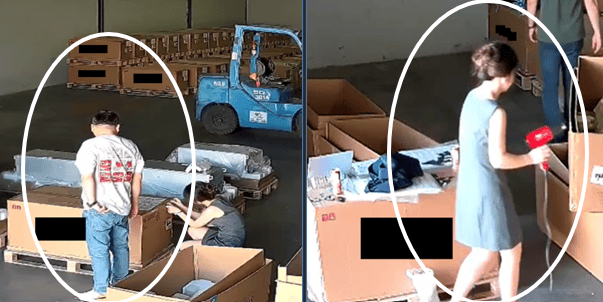
The footage, cited in the indictment, shows the pair methodically manufacturing the illusion of a compliant, fully-stocked Southeast Asian warehouse. Image: Department of Justice
Company response
Super Micro Computer, based in San Jose, California, issued a statement Thursday emphasizing that the company is not named as a defendant in the indictment.
“Supermicro was informed today that the United States Attorney’s Office for the Southern District of New York has unsealed an indictment of three individuals associated with the Company,” the statement read.
The company said it has placed Liaw and Chang on administrative leave and terminated its relationship with Sun, effective immediately.
“The conduct by these individuals alleged in the indictment is a contravention of the Company’s policies and compliance controls, including efforts to circumvent applicable export control laws and regulations,” Super Micro said. “Supermicro maintains a robust compliance program and is committed to full adherence to all applicable U.S. export and re-export control laws and regulations.”
The company added that it has been cooperating fully with the government’s investigation and will continue to do so.
Super Micro also announced Friday that Liaw had resigned from the board of directors, effective immediately. The company named DeAnna Luna as acting chief compliance officer; she previously oversaw export licensing at Intel.
Market reaction
Super Micro’s stock plunged 33% on Friday, closing at $20.53, the company’s largest single-day decline since October 2018. The drop erased more than $6 billion from the company’s market value.
The case has rattled investors and raised new concerns about how restricted AI chips, many supplied by Nvidia, continue to reach China despite tight controls.