






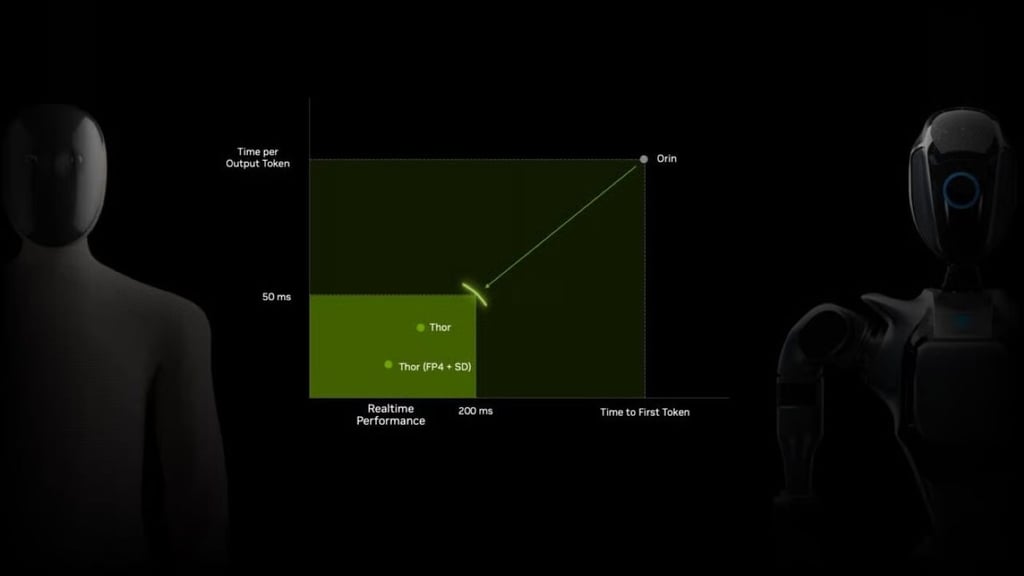


Nvidia dropped its new Jetson Thor robotics computer last week, and it’s basically giving robots a massive brain upgrade. We’re talking about 7.5x more AI processing power than the previous generation, which means robots can finally think and react in real-time instead of stuttering through tasks like they’re buffering a YouTube video from 2009.
Here’s what makes Jetson Thor a big deal
- It delivers 2,070 teraflops of computing power (that’s a lot of math, very fast) while fitting inside a robot’s body.
- More importantly, it can process data from multiple sensors simultaneously — cameras, radar, touch sensors — and make split-second decisions without needing to phone home to the cloud.
- You would use this “brain” with a reasoning model like Cosmos-Reason1, which you can download (GitHub, Hugging Face) or try here.
Who’s already jumping on this?
- Agility Robotics is putting Thor into its warehouse robot Digit’s next generation, making it better at stacking boxes and not accidentally creating modern art installations.
- Boston Dynamics is integrating it into Atlas (yes, the backflipping humanoid), giving it “formerly server-level compute” in a mobile package.
- Research labs at Stanford, Carnegie Mellon, and University of Zurich are using it for everything from medical triage robots to search-and-rescue missions.
This isn’t some niche tech experiment either. Over 2 million developers are already building on Nvidia’s robotics platform. That’s roughly the population of Houston all working to make robots less… robotic.
What is the catch?
This brain boost doesn’t come cheap. The developer kit starts at $3,499, and production modules cost $2,999 each if you’re buying 1,000+ units. That’s more than most people’s laptops, but apparently that’s what it costs to make a robot smart enough to not, you know, walk into walls.
The real question: What will this brain boost mean for Jake the Rizz Bot and his ability to gas you up (or ice you out)?
Why this matters
We’re hitting the point where robots can actually handle complex, unpredictable real-world situations instead of just following pre-programmed routines. Think surgical assistants that can adapt mid-operation, delivery robots that navigate chaotic city streets, or warehouse bots that don’t need humans to tell them how to handle every single box shape.
For example, take Figure AI, which just demoed its humanoid robots’ ability to navigate junk heaps and fold towels (the classic three Ds of robots doing “dirty, dangerous, and dull” tasks). You better believe Figure uses Jetson!
What are robots missing for true intelligence?
Even with all this hardware muscle, robots are missing some crucial ingredients for true intelligence. Matt Berman had a fantastic guest lineup on a recent edition of his Forward Future live show, featuring three AI creators working on exactly those missing pieces.
- Greg Kamradt, who explained how to test for “true AGI” using their ARC-AGI-3 benchmark with a focus on action efficiency, or the amount of steps needed to accomplish a task.
- Charles Packer from Letta, who shared what he and his team are doing to create open source “memories” that AI can carry between systems.
- Allan from Skywork AI, who demonstrated Matrix Game 2.0, where AI creates consistent game worlds on the fly via a generative “world model.”
Why are these important? Because robots needs all three of these elements to handle situations they’ve never seen before, remember their human employer’s preferences (even when switches bodies or companies), and understand physical spaces and predict what happens when they move stuff around without breaking a bunch of stuff in the process.
So, robots with Thor’s processing power + continuous, action-efficient reasoning + persistent memory + world modeling = machines that actually understand their environment. We’re seeing glimpses of that in the robot demos coming out these days… so smarter on device computing is an important next step to getting there.
Editor’s note: This content originally ran in the newsletter of our sister publication, The Neuron. To read more from The Neuron, sign up for its newsletter here.