







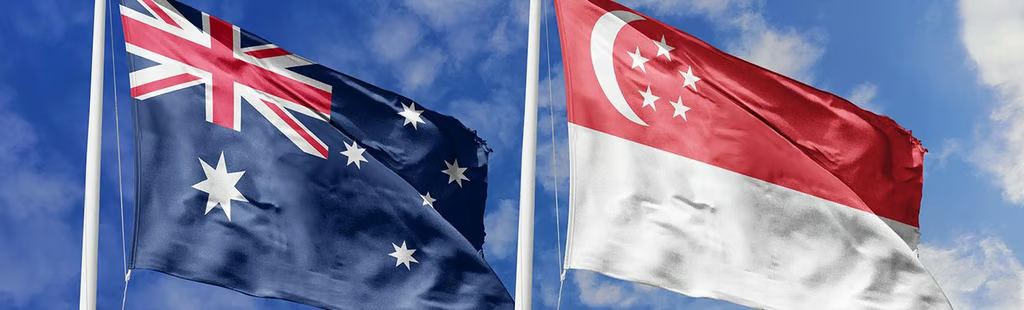
Australia and Singapore have put AI safety, cybersecurity and subsea-cable resilience on the same bilateral agenda, using their first Cyber and Digital Senior Officials Dialogue to deepen cooperation on digital security and infrastructure. Australia’s Department of Industry published the outcome Aug. 11, following the July 30 meeting.
The countries agreed to work more closely on AI adoption, safety, assurance and governance, digital infrastructure, investment and cyber resilience. The announcement sets out no new private-sector requirements, but the dialogue gives both governments a standing channel to pursue joint work under existing AI and cybersecurity agreements.
AI safety and infrastructure share the agenda
At the July 30 dialogue, officials agreed to deepen collaboration on AI adoption, digital infrastructure, investment and innovation, while adding subsea-cable resilience to the agenda. The Australian government also said the countries would share information on AI safety, assurance and governance and expand regional cybersecurity cooperation.
The assurance push comes as companies struggle to keep controls aligned with AI deployment. A July DigiCert survey covered in eWeek found gaps in enterprise AI visibility and governance even as more AI systems moved into production.
The meeting was already in motion before July 30. At a July 27 ministerial meeting, Australia and Singapore called for deeper cooperation on AI and subsea cables and said the senior-officials dialogue would pursue objectives in their existing AI MoU.
Submarine cables are part of the same digital-infrastructure push. The July communiqué highlighted a June 23-24 Singapore workshop on undersea-cable management for ASEAN member states, while Australian enterprises are also confronting infrastructure constraints as AI workloads expand.
Existing agreements set the next steps
Australia and Singapore renewed their AI cooperation MoU on Dec. 16, 2024, replacing a 2020 agreement. It covers civil AI applications, responsible governance, access to technology and talent, commercialization, joint projects, testing and possible alignment of governance approaches.
Their cybersecurity MoU was renewed on Feb. 24, 2026. The agreement covers information-sharing, exercises, training, policy coordination, innovation and regional capacity-building.
Singapore is also advancing AI assurance outside the bilateral relationship. On April 20, it proposed the ISO/IEC 42119-8 standard, focused on standardized GenAI benchmarking and red-teaming methods; separately, OpenAI’s S$300 million Singapore commitment is expanding the country’s applied-AI ecosystem.
Neither initiative has been identified as an Australia-Singapore workstream. The next concrete signals would be named joint projects, shared testing or assurance methods, implementation guidance, funding commitments or formal timelines.
Read more: The EU is also pushing AI model evaluation into cybersecurity planning, showing how government assurance initiatives can develop into more concrete enterprise risk requirements.