









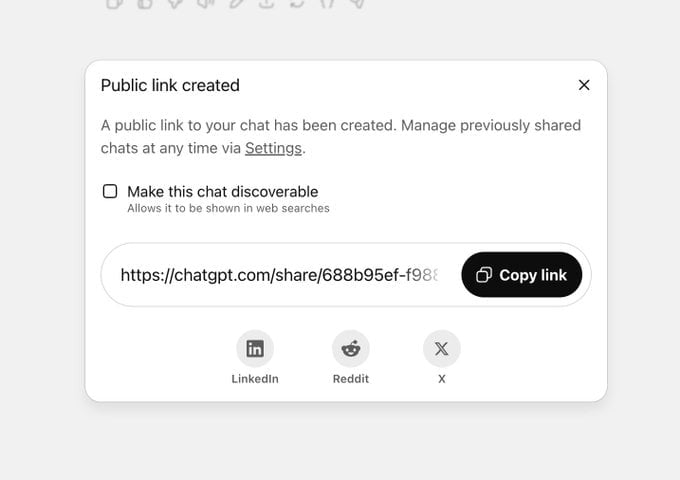
Source: OpenAI
OpenAI has removed a ChatGPT sharing feature after it was revealed that search engines like Google had been indexing user-shared conversations, potentially exposing sensitive and private information.
While the tool was meant to let users share interesting AI responses, it unintentionally made some of those conversations visible through search engines. This meant that private discussions, including personal details, business strategies, and even therapy-like exchanges, could be found through a simple Google search.
How ChatGPT conversations got indexed
The issue surfaced when users discovered that Google searches like site:chatgpt.com/share could pull up thousands of ChatGPT conversations shared via OpenAI’s built-in Share feature.
Although ChatGPT does not make conversations public by default, users could choose to share a conversation by clicking a dedicated Share button and then selecting Create Link. From there, a small toggle allowed the chat to be “discoverable” by search engines.
However, many users were likely unaware that making a chat public also made it discoverable via search, creating the potential for unintended exposure.
Swift response by OpenAI
After widespread concern, OpenAI responded quickly. On July 31, just hours after the story gained traction, OpenAI’s Chief Information Security Officer Dane Stuckey announced the feature’s removal.
“We just removed a feature from @ChatGPTapp that allowed users to make their conversations discoverable by search engines, such as Google,” wrote Stuckey in a post on X.
He called it “a short-lived experiment” and added, “Ultimately we think this feature introduced too many opportunities for folks to accidentally share things they didn’t intend to, so we’re removing the option.”.
Google: We don’t control what becomes public
A Google spokesperson clarified that it is not the search engine, but the website’s settings, that determine what gets indexed.
“Neither Google nor any other search engine controls what pages are made public on the web,” the spokesperson told TechCrunch. “Publishers of these pages have full control over whether they are indexed by search engines.”
Broader concerns around AI privacy
In 2023, Google faced a similar issue when conversations with Bard (now Gemini) were found indexed. Meta also faced criticism when some chats with its AI assistant ended up in public feeds despite disclaimers.
While OpenAI intended to help users share useful conversations, the backlash highlights the fine line between convenience and privacy. The incident underscores the need for stronger safeguards and clearer warnings in AI tools, especially as they become integrated into business and everyday life.
OpenAI, Google, and 60+ other companies are working with the US government to use AI to try to make electronic healthcare records easier to access and share.