






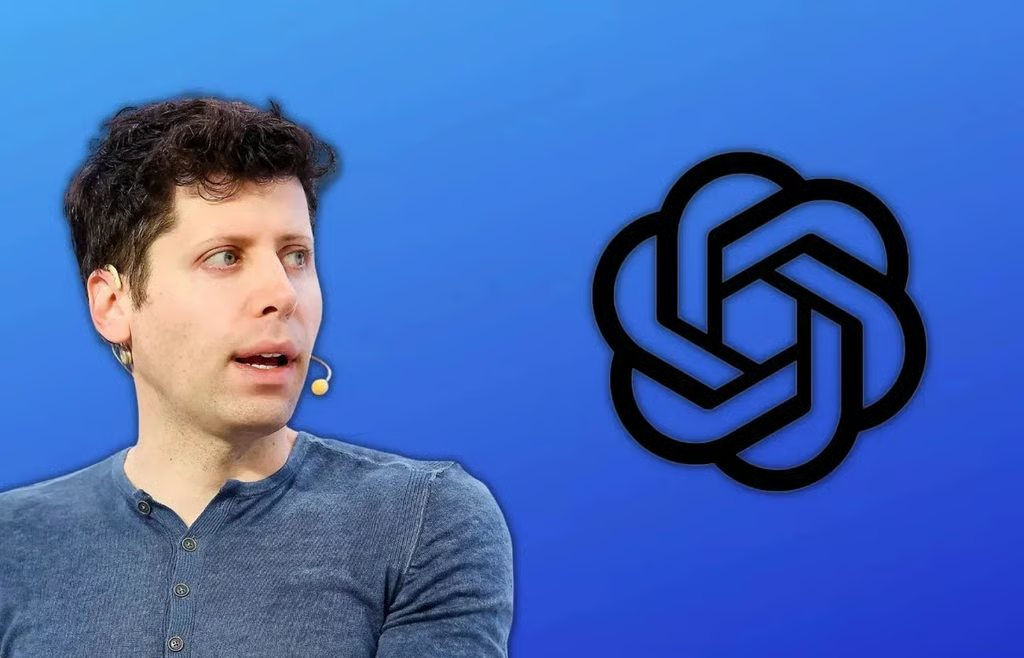


Sam Altman thinks that Meta poaching at least nine OpenAI employees for Meta’s new superintelligence division is “somewhat distasteful.” Mark Zuckerberg has reportedly been offering $100 million signing bonuses to engineers at Altman’s company and elsewhere to entice them to jump ship.
After Zuckerberg revealed who he has hired for Meta Superintelligence Labs, which will work on both the Llama models and frontier versions that could surpass human capabilities, the OpenAI CEO sent a company-wide Slack message, as seen by Wired.
Altman conceded that a “few great people” had joined Meta, but Facebook’s parent company “didn’t get their top people and had to go quite far down their list” of prospects at OpenAI. This echoes what he said on his brother’s podcast last month, that “none of (OpenAI’s) best people” took an offer from Meta.
“They have been trying to recruit people for a super long time, and I’ve lost track of how many people from here they’ve tried to get to be their Chief Scientist,” Altman wrote in the Slack message.
The person who ended up with this title and now leads the Superintelligence Labs is Alexandr Wang, the 28-year-old co-founder of Scale AI. Meta invested $14.3 billion for a 49% stake in Wang’s data-labelling startup earlier this month, and he joined the company as part of the deal.
“I am proud of how mission-oriented our industry is as a whole; of course, there will always be some mercenaries,” Altman went on, saying that “missionaries will beat mercenaries.”
OpenAI maintains that its mission is to ensure AI benefits humanity. However, some recent decisions, such as its shift towards a for-profit business model and deals with the US Department of Defense, do suggest the same conventional corporate ambitions as Meta.
When Meta dangles cash, it’s mercenary; when OpenAI does, it’s mission
While Altman sniffs at Meta’s attempts at dangling cash in front of OpenAI’s engineers, saying it will “lead to very deep cultural problems,” his memo isn’t totally void of similar tactics. He noted that OpenAI was reassessing compensation for the entire organisation, something which its chief scientist, Mark Chen, mentioned recently.
Altman also said, “There is much, much more upside to OpenAI stock than Meta stock,” as Zuckerberg’s company is not as dedicated to AI as his own. “Long after Meta has moved on to their next flavor of the week, or defending their social moat, we will be here, day after day, year after year, figuring out how to do what we do better than anyone else,” he wrote.
Nevertheless, OpenAI will be upping compensation “fairly and not just for people who Meta happened to target,” according to the CEO.
OpenAI vs Meta: The race to superintelligence
Altman’s insinuation that Meta isn’t as focused on AI as his company could have some legs. Zuckerberg’s company, after all, started life as Facebook and retains an almost too strong grip on the social media landscape. It also cemented a commitment to virtual reality in 2021 when it rebranded to Meta, and continues to invest in this area.
Although it has been pursuing AI since approximately 2013, Meta has not seen much success in the post-ChatGPT era, struggling to keep pace with the likes of OpenAI and Google. Missteps include open-sourcing its models, which allows DeepSeek to use them to create more advanced and cost-effective derivatives.
Its latest Llama models have underperformed, its AI chatbots have earned a seedy reputation, and top engineers have been leaving the company.
However, in his memo announcing who made it in to Meta Superintelligence Labs, Zuckerberg said that Meta is “uniquely positioned” to deliver superintelligence, as it has enough cash to acquire the significant compute resources required, a track record of delivering products to billions of people, experience in AI hardware such as smart glasses, and a company structure that allows it to take big swings.
Meanwhile, OpenAI, which has been solely focused on advancing artificial general intelligence since its founding in 2015, announced in January that its primary goal for the year would be the development of superintelligence. Then, last month, Altman said his company had “recently built systems that are smarter than people in many ways.
Editor’s note: This content was originally published on our sister site TechRepublic on July 2, 2025.