






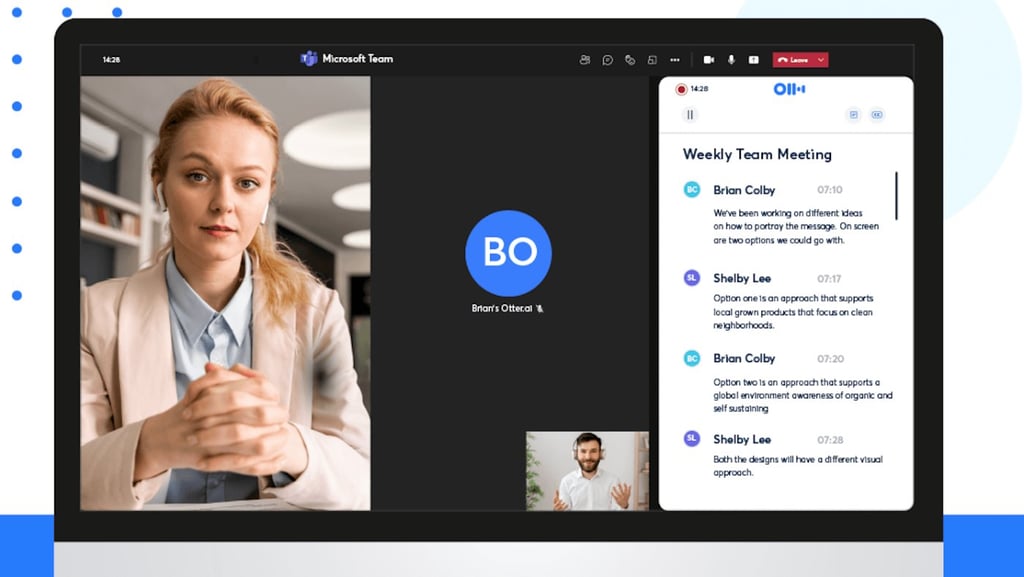


Otter.ai is being sued for using meeting recordings to train its artificial intelligence models that power its transcription service, without informing all participants. While the AI transcription service discloses this practice in its Privacy Policy, the issue arises from the fact that it is possible for the Notetaker to automatically join a meeting without anyone being aware.
“Otter completely fails to disclose…that their conversations are being used to train Otter Notetaker’s automatic speech recognition (‘ASR’) and machine learning models, and in turn, to financially benefit Otter’s business,” the suit reads.
How Otter.ai keeps meeting participants in the dark about its AI training
Otter.ai has a feature called Notetaker, which joins virtual meetings as a separate participant to record and transcribe the discussion. When Notetaker joins a meeting, it may ask the host for permission to join and record, but only if the host isn’t already an Otter.ai account holder.
Notetaker never requests permission from other meeting participants for such access, and if the host is an Otter.ai user who has integrated Zoom, Teams, or Google Meet with their account, the Notetaker can join without explicit consent, the suit states.
Otter.ai users can request that participants of a scheduled meeting be sent an email ahead of time informing them that Notetaker will be joining, but this feature is not enabled by default. Therefore, according to the suit, it is entirely possible for a meeting participant to not be aware that their conversation is being recorded and transcribed.
Even if a participant was aware the meeting was being recorded, they would then have to read through Otter.ai’s Privacy Policy to discover that the recording and transcription could be used for training Otter.ai’s AI models. The complainant, Justin Brewer, joined a Zoom meeting with Notetaker in February 2025 and was unaware that Otter.ai would store and use his communications.
Otter.ai puts the onus on its users to ensure everyone is happy with certain AI training
Otter.ai does state in its Privacy Policy that it obtains “explicit permission…for manual review of specific audio recordings to further refine our model training data” by asking users to check a box after a meeting has finished, but that it is the responsibility of the user to get the “necessary permissions” from meeting participants before doing so.
The company also claims that the audio recordings are “de-identified,” but does not explain how this works. “Scientific research into de-identification of information used to train machine learning models has revealed that even sophisticated de-identification procedures are unreliable,” the suit, which Brewer filed last Friday, reads.
Furthermore, Brewer, an individual from California, has found that rival services allow all meeting participants, regardless of whether they are paying users, to end the recording and transcription during the meeting. “The failure of Otter to include such functionality for its own transcription services is thus indicative of its intent to record conversations in the absence of participants’ informed consent,” the suit says.
Brewer claims that Otter.ai’s practices amount to unlawful wiretapping, computer fraud, invasion of privacy, and unfair business practices.
Privacy issues are rife within AI transcription services
Otter.ai has been facing backlash for its handling of meeting recordings for some time. In October 2024, a significant investment deal collapsed after its transcription tool accidentally sent sensitive post-meeting conversations, including dialogue that occurred after the call ended, to an unintended recipient, according to The Washington Post.
However, it’s not the only tech company facing a privacy scandal over how it handles data to train AI products.
Earlier this month, it was revealed that contractors for Meta who evaluate the performance of its AI chatbots have been privy to the “explicit photos” that users have sent in conversations. Other “unredacted personal data” they have stumbled across includes names, phone numbers, email addresses, gender, hobbies, locations, social media handles, job titles, and selfies.
Because of such issues, the European Union has banned the use of AI-powered virtual assistants during online meetings.