








One drone accident can be dismissed as bad luck. Two is harder to ignore.
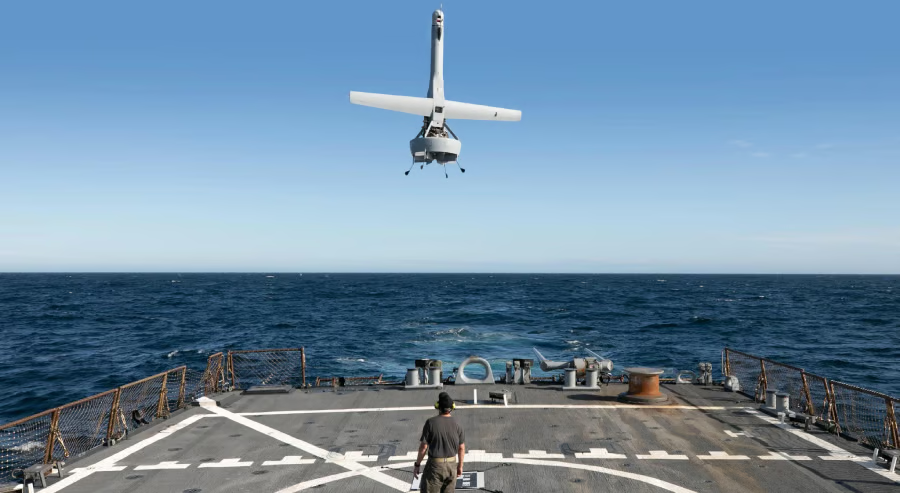
Recent reporting by Forbes and other outlets has placed Shield AI under renewed scrutiny after a V-BAT drone injured a Romanian Navy officer, adding to earlier incidents and internal concerns. The reports are also raising questions about how autonomous military systems are tested and deployed.
The incident stands out because Shield AI has become a prominent name in military AI, with a multibillion-dollar valuation and growing interest from defense customers.
The reports arrive as investors and defense customers pour money into autonomous military systems. For Shield AI, the question is no longer only whether its drones can perform complex missions, but whether they can do so safely enough to earn trust in real-world operations.
Two accidents, one safety question
A year ago, Shield AI was valued at $5 billion. In March, the company announced a $12.7 billion valuation, a clear indication of rapid growth for the 11-year-old company.
However, that growth has not been without issues that could undermine its success.
According to a May 2025 Forbes report, concerns about drone safety and reliability accompanied the company’s expansion. The issue came into sharper focus in April 2024, when one of its V-BAT drones was involved in an accident that partially severed the fingers of a US service member.
At the time, the company framed it as a rare accident, with its president and co-founder, Brandon Tseng, saying that “safety improvements have been made to the V-BAT.” Also quoting Tseng in that report, Forbes writes: “Today, V-BAT retains a perfect record of no injuries when following trained procedures.”
Reuters has now reported that its million-dollar V-BAT drone on May 12 severed two fingers of a Romanian Navy officer, while fracturing a third.
While these may appear to be two isolated incidents, further reporting suggests a broader pattern that may have persisted for some time.
A series of complaints amid rapid company growth
According to Forbes, a former quality assurance manager at the company filed a lawsuit in 2022, citing “a safety issue involving danger of propeller strike/injury to personnel due to unsafe blower handling.”
Reuters reported that over the past 18 months, the V-BAT crashed more than 50 times and that several employees who raised concerns were either ignored or fired.
The publication’s reporting drew on interviews with 21 former staff members, industry executives, and investors, as well as a whistleblower complaint, a hostile work environment lawsuit, and the company’s presentations. It suggests that the company has struggled with years of safety and technical issues, yet obscured them while pushing its drone for military use.
Despite the difficulties, the company has maintained steady financial growth. That includes its $30 million contract with the Romanian government, undisclosed amounts from Pentagon contracts, and a couple of funding rounds, according to reports by Forbes and Reuters. This growth reflects the high demand for companies like Shield AI and products like V-BAT.
However, the challenge for Shield AI may no longer be proving that autonomous technologies can perform complex missions, but showing that they can do so safely and reliably.
For defense customers, the stakes go beyond a single aircraft or a single company. If autonomous systems are going to move deeper into military operations, reliability and operator safety will need to become selling points, not footnotes.
Also read: Foundation is testing humanoid robots for defense work as military robotics moves deeper into logistics, inspection, and other hazardous tasks.