






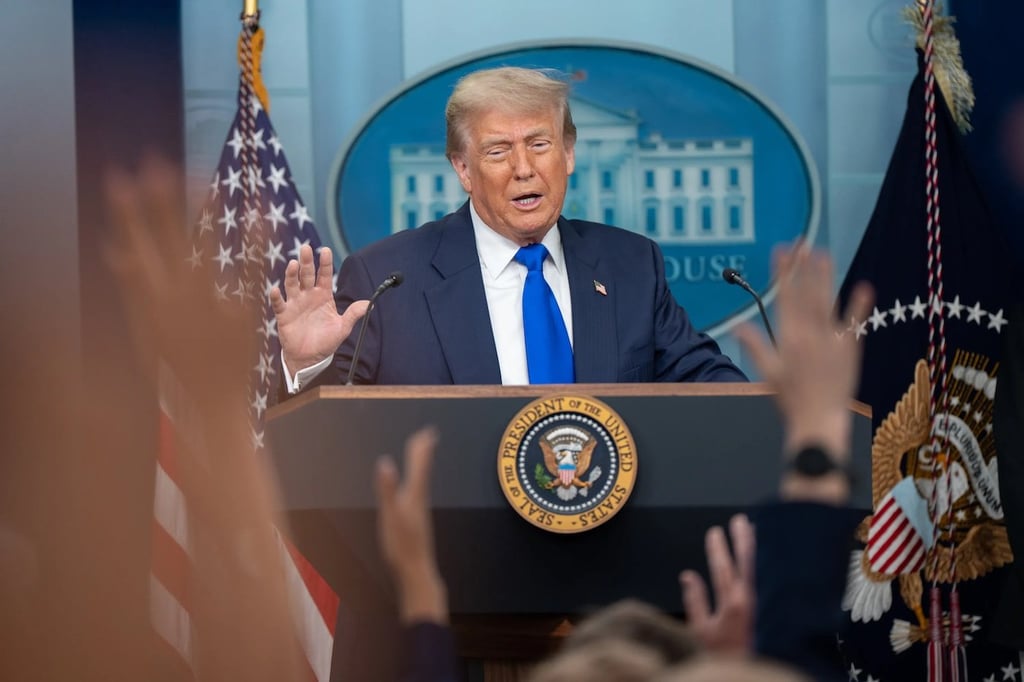


President Donald Trump is asking Congress to hit the brakes on state-by-state AI regulations, arguing that a patchwork of local laws could crush American innovation before it even gets off the ground.
In a four-page policy framework released Friday, the White House laid out its legislative wishlist for artificial intelligence. The document, National Policy Framework for Artificial Intelligence, calls on Congress to establish a single federal standard that would override state AI laws deemed unduly burdensome.
The administration is asking Congress to step in and override state-level AI rules it believes are getting in the way. According to the framework, “Congress should preempt state AI laws that impose undue burdens to ensure a minimally burdensome national standard consistent with these recommendations, not fifty discordant ones”.
This move comes after months of tension between Washington and local lawmakers.
Trump previously highlighted the difficulty of dealing with varying state rules, saying, “We are beating ALL COUNTRIES at this point in the race, but that won’t last long if we are going to have 50 States, many of them bad actors, involved in RULES and the APPROVAL PROCESS. THERE CAN BE NO DOUBT ABOUT THIS! AI WILL BE DESTROYED IN ITS INFANCY!”
While the plan seeks to limit state power over how AI is built, it does allow states to retain their “traditional police powers” to handle issues like fraud and local zoning for data centers.
Safety first for kids and parents
A major chunk of the proposal focuses on making the internet safer for the next generation. The White House is pushing for “ageassurance” tools and better privacy settings that parents can actually control.
The framework states that “AI services and platforms must take measures to protect children, while empowering parents to control their children’s digital environment and upbringing”. It also calls on Congress to build on the “Take It Down Act,” an initiative supported by First Lady Melania Trump to fight back against deepfake abuse.
Who pays for the power?
As AI models get bigger, they need massive amounts of electricity. The administration wants to ensure that regular people don’t see their utility bills spike due to new data centers.
Under what they call the “Ratepayer Protection Pledge,” the White House says “Congress should ensure that residential ratepayers do not experience increased electricity costs as a result of new AI data center construction and operation”. To balance this out, they want to make it easier for tech companies to build their own power sources on-site.
The copyright controversy
One of the thorniest issues in tech right now is whether AI companies should pay artists and writers for using their work to train models. The administration is taking a firm stance here, suggesting that training isn’t a crime, but they’re leaving the final word to the judges.
The report notes that “the Administration believes that training of AI models on copyrighted material does not violate copyright laws,” though it acknowledges that many people disagree. For now, the White House says Congress should let the courts hash it out.
However, they do want a federal law to stop people from using AI to create “digital replicas” of someone’s voice or likeness without permission, unless it’s for something like a parody or a news report.
No new AI police
Instead of creating a brand-new government agency to watch over AI, the White House wants existing agencies to handle it. The goal is to avoid “ambiguous standards” and “excessive litigation.”
The framework explicitly states that “Congress should not create any new federal rulemaking body to regulate AI,” and should instead rely on “sector-specific” experts who already understand their own industries.
For more on the growing AI power struggle in Washington, see our coverage of OpenAI’s Pentagon deal and the Anthropic ban.