








- How IT Can Improve Security in the Coming Year
- Better Predictive-Threat Intel Required
- IT Should Rely More on Machine-Learning Security
- ‘Guilt-by-Association’ Approach Needed
- Apple Pay Gets Early Plaudits
- CIOs, CISOs Need to Educate Their Boards
- Finding All System Weaknesses Is Mandatory
- Mobile Apps Eventually Will Meet Security Needs
- Proactive Security Responses Will Reduce Damage
- Virtualization Admins Will Own Servers and Storage
- Data Science Will Become Mainstream Career Choice
- Enterprises Will Move Beyond Traditional Customer Service
- Location-aware, Contextual Marketing Will Merge
- APIs for IoT Connections Will Be Key to Profits
How IT Can Improve Security in the Coming Year

by Chris Preimesberger
Better Predictive-Threat Intel Required
Companies should stop reacting and start predicting—or start insuring. Cyber-attacks have become increasingly more sophisticated, so in 2015 companies should use an advance predictive-threat intelligence approach to security to better protect businesses against even previously unknown threats. —Webroot EVP of Products and Strategy Mike Malloy
IT Should Rely More on Machine-Learning Security
IT should respond to increasingly sophisticated cyber-attacks by relinquishing manual control and relying on machine learning/threat intelligence technology. —Mike Malloy, Webroot
‘Guilt-by-Association’ Approach Needed
Predictive threat intelligence finally takes a “guilt-by-association” approach by making better industry connections to share information about bad actors, and thus better protecting businesses against even previously unknown threats. —Mike Malloy, Webroot
Apple Pay Gets Early Plaudits

Companies should begin embracing Apple Pay, which would significantly change the credit card breach landscape and would provide a significant reduction in breaches for companies that are part of the Apple Pay ecosystem. —Contrast Security CTO Jeff Williams
CIOs, CISOs Need to Educate Their Boards

What has largely been the focus of the IT and security folks (CISO/CSO) will become a broader executive leadership within an enterprise. Further, company CEOs/CIOs and CISOs will play a greater role in educating the board and reporting progress of an organization’s posture relative to the market expectation. —Vormetric CEO Alan Kessler
Finding All System Weaknesses Is Mandatory
Organizations must assess where inside their “porous” perimeters they are vulnerable and put protections in place around that data. Encryption and access controls are first stops. The operational implications of encrypting much more data in more places cause organizations to focus on operationalizing encryption and key management in ways not previously considered. —Alan Kessler, Vormetric
Mobile Apps Eventually Will Meet Security Needs

Companies must start buckling down with mobile messaging solutions that meet their security needs—particularly in heavily regulated industries such as health care, government and financial services. —TigerText CEO Brad Brooks
Proactive Security Responses Will Reduce Damage

Proactive responses significantly reduce damages that organizations face. The selection of third-party vendors that provide more secure development through Product Security Incident Response Teams (PSIRTs), as well as deep threat research, will limit breach scenarios before they happen. Two-factor strong authentication will increase in 2015 as one simple and cost-effective proactive measure, while vendor incident response services will grow to help clients when they are under attack. –Ken Xie, Founder, Chairman of the Board and CEO of Fortinet
Virtualization Admins Will Own Servers and Storage
The people who are closest to the technology will need to become experts in securing it. Virtualization admins, system engineers and software developers will start to take ownership of their server, virtualization and storage requirements. In turn, that elevates the storage admin to working on projects with more strategic value than carving up LUNs and volumes. — Kieran Harty, Tintri
Data Science Will Become Mainstream Career Choice
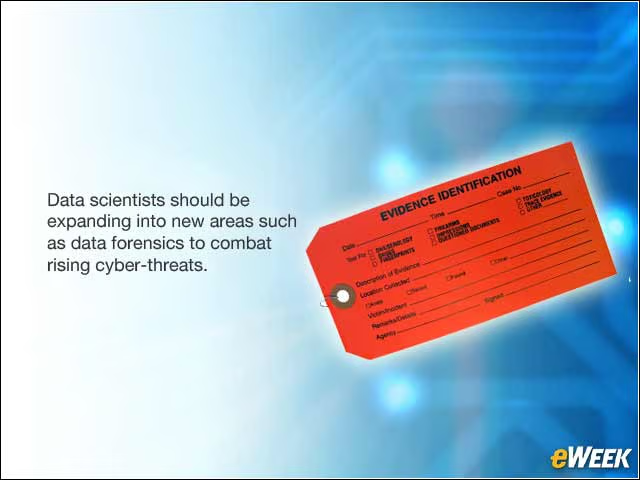
Data scientists will become a mainstream career choice. Most universities are already offering courseware in data science in preparation of the dramatic rise of this new profession. Nearly every enterprise will have data scientists doing more than just studying customer behavior, which is something that was a focus in 2014. Instead, they will expand into new areas such as data forensics to combat rising cyber-threats, and the creation of new types of businesses based on data services. —EXASOL CEO Aaron Auld
Enterprises Will Move Beyond Traditional Customer Service

Companies should move beyond traditional customer service. In the era of big data, agents are provided with copious amounts of customer information. This year, contact centers will start to better understand what to do with it. Big data is key in identifying behavioral patterns. Using tools like Hadoop and advance search, both live agents and self-service applications will be able to proactively offer customers the information they need. Natural language processing will also allow companies to determine customers’ sentiment in order to match them up with agents who have the appropriate skills. —Five9 Director of Product Marketing Mayur Anadkat
Location-aware, Contextual Marketing Will Merge

We will begin to see a convergence between location-aware marketing and contextual marketing that takes into account behaviors in a location in addition to content that’s been consumed/viewed up to the point of marking a location. It’s not enough to know where a consumer is. You have to know what they’ve been doing and match that against previous or similar behaviors, then layer on the location to derive the ideal message for the ideal time, based on the ideal locations, serving up the ideal content—which isn’t always an offer, but something to underscore the value a brand can bring to the daily routine that we all have. —Message Systems Director of Industry Relations Len Shneyder
APIs for IoT Connections Will Be Key to Profits

The Internet of APIs (IoA) expresses the idea that for enterprises, the Internet of things (IoT)’s success centers less on the latest shiny, connected gadget; it’s about what value a company can extract once things are connected, where “things” are physical endpoints, such as beacons and sensors, as well as logical systems, such as SaaS services and black-box appliances. To connect and extract value, you need APIs, which become the fundamental building block for IoT. Companies begin to allocate budget for the Internet of APIs. — Raw Engineering CTO Nishant Patel