








- 10 Things Storage Vendors Don’t Want You to Know
- Five-Year Warranties Should Be Standard
- You Should Be Able to Use All the Storage You Buy
- Upgrades Should Not Be Costly or Complex
- Storage Doesn’t Need People
- Quality Matters When It Comes to Drives
- Flash Isn’t Always the Savior of the Universe
- All-Flash Arrays Aren’t Always More Power-Efficient
- Vibration Kills Predictable Performance
- You Don’t Need All Those Bells and Whistles
- Scalable Storage Isn’t All the Same
10 Things Storage Vendors Don’t Want You to Know
by Chris Preimesberger
Five-Year Warranties Should Be Standard
Most storage vendors include a 12-month warranty and will probably extend it to three years if you push them hard. But ask them for a five-year guarantee, and they’ll hike the total price by a huge amount. Why? It’s because they like you to rotate the hardware every three years. Not only should storage last five years, but it should still be performant, so push for fairer treatment.
You Should Be Able to Use All the Storage You Buy
Many storage vendors issue “best practice” guidelines warning customers of dramatic performance loss if they use more than 70 percent storage capacity. It’s possible to deploy a storage array that can run at 100 percent capacity without any performance degradation, so why is it that most storage architectures aren’t designed for this?
Upgrades Should Not Be Costly or Complex
A large-scale upgrade, or changes to parts of the existing infrastructure, can frequently mutate into a complex project that includes downtime, investment in new hardware and a hefty professional services bill. Background migrations are possible and, with true scale-out architectures, forklift upgrades can be a thing of the past.
Storage Doesn’t Need People
The biggest cause of data center failures is actually human error. If you can limit the interaction between humans and IT by making equipment repairable as needed, you restrict the potential for data center failure. Around 70 percent of warranty returned drives either have nothing wrong with them or only require a simple recondition. The solution is to find an array vendor that avoids the need for humans to go near the box for at least five years.
Quality Matters When It Comes to Drives
Whether you’re looking at hard-disk or solid-state drives, the same rule applies: Beware of consumer-grade hardware. There’s a huge difference in the quality of components used, the testing carried out and, most importantly, the annual failure rate of drives in consumer- and enterprise-grade products. Consumer-grade hardware may well be cheaper to purchase, but operational cost and risk are likely to be much higher than for more reliable and robust enterprise-grade products. Make sure you balance capital expenditure, operational cost and risk when looking at any type of drive.
Flash Isn’t Always the Savior of the Universe
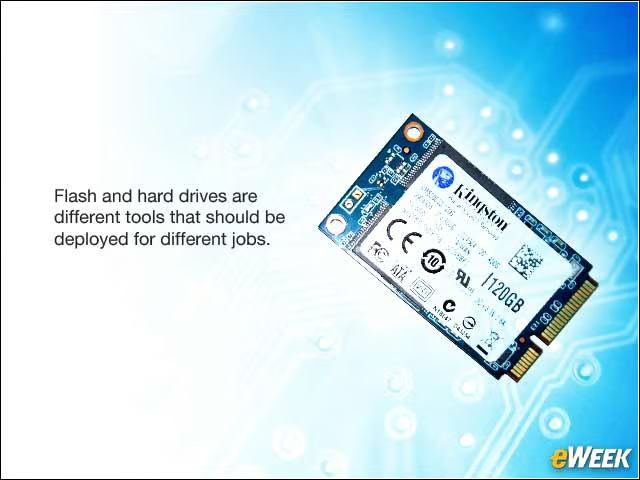
Flash isn’t the answer to every problem. It is a great tool to help the performance of certain workloads, but it has its limitations. When it comes to large sequential writes, for example, hard-disk drives are much more appropriate. Flash and hard disk are different tools that should be deployed for different jobs. To get the right blend of media for their storage requirements, talk to vendors that aren’t restricted to a single type of media.
All-Flash Arrays Aren’t Always More Power-Efficient
Many people have been led to believe all-flash arrays are more power-efficient than hard-disk arrays. When looking at the power requirements of storage, you need to consider the whole array, not just the drive modules, to get the full picture. The truth is, some hard-disk drive arrays use less power than all-flash ones. What matters most is how vendors implement more power-hungry components, such as processors and cache memory.
Vibration Kills Predictable Performance
Excessive vibration can cause reliability issues, but what a lot of people don’t realize is that it can also seriously affect performance. While it is possible to stop vibration and give 100 percent consistent performance, it’s not easy and takes significant investment to design such an array.
You Don’t Need All Those Bells and Whistles
Decisions around enterprise storage have typically been built on feature checklists rather than the reliability and performance of the array itself. With the emergence of software-defined storage (SDS), a significant amount of functionality is shifting from the storage array to hypervisors, OSes and apps. Many enterprise storage array “deals” end up locking customers into proprietary software that only works on one platform. SDS gives businesses the flexibility to choose the platform they want without worrying about the underlying hardware. This improves their bargaining power and frees them to focus on performance and reliability.
Scalable Storage Isn’t All the Same
Many vendors offer scalable storage, but most neglect to explain that it relies on a central legacy storage controller to power performance-hungry software stacks and applications. This can often lead to significant upgrades to scale capacity and performance. However, there is an alternative to the traditional “scale-up” storage model. There are some units that will work seamlessly together in a single storage pool combining increased capacity and performance.