







Container storage vendor ClusterHQ announced on December 22 that it is shutting down the company’s operations, effective immediately. ClusterHQ raised $18 million in venture capital funding to help fuel its efforts to build a commercially supported stateful container storage technology.
In a 2014 interview with eWEEK, ClusterHQ co-founder Luke Marsden explained the core premise of his business and its primary open-source project called Flocker. Simply put, Flocker was built to help solve the challenge stateful storage for containers.
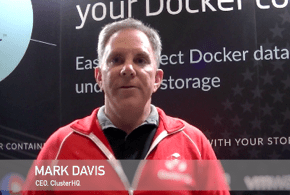
Fast forward to December 2016 and stateful container storage is not a new concept anymore and the innovation lead that ClusterHQ once had, no longer is unique. In a blog post, ClusterHQ CEO Mark Davis (pictured) wrote that today it seems like everyone is talking about stateful containers. Among the recent moves in container storage, Docker Inc. acquired container storage vendor Infinit on December 6.
“For a confluence of reasons, the ClusterHQ board of directors, of which I am chairman, have decided it best to immediately shut down company operations,” Davis wrote. “We are proud of many accomplishments, not least of which is leaving behind an outstanding body of open source software which is actively used by many in the container ecosystem.”
I first met Davis in person back in November, 2015 at the DockerCon EU event in Barcelona, Spain. In a video interview I did with Davis at the time, he impressed me with his keen understanding of the storage market, honed by a career spent in the world of storage virtualization. From 2007 until 2013, Davis was CEO of storage virtualization vendor Virsto, which he sold to VMware.
In my video interview with Davis, I specifically asked him about the money side of his business. At that point in late 2015, it wasn’t entirely clear to me how much money was to be made from a container storage business. Davis however was very optimistic.
“There is lots of money to be made. That’s, of course, why we’re in business,” he said at the time. “We’re happy to be participants in open source. We have lots of people using our software for free, and we love that, but we’re here to build a long-term sustainable business, and we can’t do that if we don’t make money.”
As it turns out, ClusterHQ didn’t make enough money to remain a viable business. I suspect, that operational costs exceeded revenues, while new Venture Capital funding is now drying up, so ClusterHQ was in a bind that it ultimately could not escape.
Sean Michael Kerner is a senior editor at eWEEK and InternetNews.com. Follow him on Twitter @TechJournalist