







More Storage for Less CAPEX
The constant search for ways to reduce capital expenditures, or “CAPEX” as its known to business managers, is the No. 1 reason why IT decision-makers are looking at iSCSI is to save costs. A conventional Fibre Channel SAN port for a director commonly costs $1,200 per port and FC switches can run $800 a port. Each FC host bus adaptor (HBA) costs about $1,500; then there is the cost of high-end storage arrays. FC hardware isnt cheap.
More Flexibility for Virtualization
Because iSCSI requires no dedicated cabling, it can be run over existing switching and IP infrastructure. Virtualized systems may have nodes anywhere in the world; thats where the IP protocol comes in very handy.
Storage Consolidation Savings
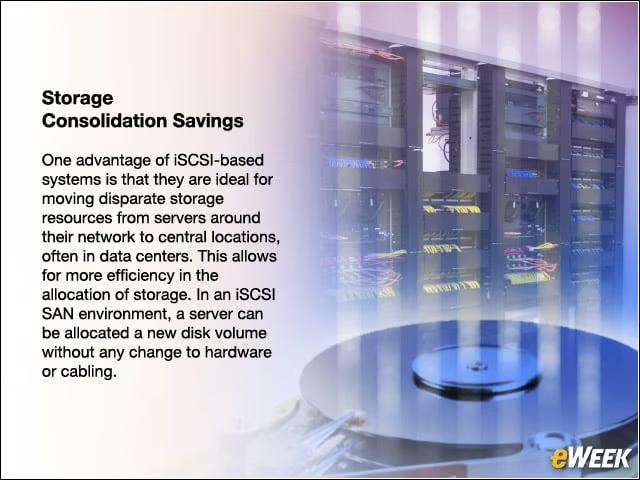
One advantage of iSCSI-based systems is that they are ideal for moving disparate storage resources from servers around their network to central locations, often in data centers. This allows for more efficiency in the allocation of storage. In an iSCSI SAN environment, a server can be allocated a new disk volume without any change to hardware or cabling.
Greener Data Centers
Because iSCSI requires less hardware and no dedicated cabling, it also requires less power and cooling to operate, thus saving energy and reducing the carbon footprint of a data center.
Global Data Protection
The way iSCSI initiators and targets prove their identity to each other is through the Challenge Handshake Authentication Protocol (CHAP), which includes a mechanism to prevent clear text passwords from appearing on the wire. If followed carefully, the rules for using CHAP within iSCSI prevent most dictionary attacks, spoofing or reflection attacks.
Lower Network Management Costs
IT shops that dont have Fibre Channel can readily adopt iSCSI. These data centers can use their existing knowledge (and most legacy hardware) in networking. They don’t have to learn about zones of VSANs, buffer-to-buffer credits and those things that are unique to Fibre Channel. And forget all that cable spaghetti.
Application Acceleration With Solid-State Disks
In the early days of the iSCSI market, a lot of people thought that in order to make iSCSI storage work, iSCSI-attached servers had to be fitted with special hardware accelerators to offload the TCP/IP protocols. More than a decade later, server CPUs have enough cores to handle iSCSI in software. The real bottleneck is that the hard disk storage is the same old speed it was 10 years ago. The future of iSCSI storage is solid-state.
Open Standards-Based
Best of all iSCSI connectivity is based on open standards and open APIs. Fibre Channel is a closed, proprietary, hard-wired system that locks users into a vendor through the hardware.
Cloud and VDI Access Controls
As long as there is network connectivity iSCSI knows no limits in terms of distance. Fibre Channel, strictly a localized approach, requires special-purpose cabling. Cloud systems are IP-based, thus iSCSI is a natural fit with both cloud services and virtual desktops, which are a form of cloud service.
Network Convergence LAN/SAN
The iSCSI protocol unites storage and IP networking, thus enabling the transport of block-level storage traffic over IP networks. It builds on two widely used technologies: SCSI commands for storage and IP protocols for networking. The protocol is used on servers (initiators), storage devices (targets), and protocol transfer gateway devices. iSCSI uses standard Ethernet switches and routers to move the data from server to storage. It also enables IP and Ethernet infrastructure to be used for expanding access to SAN storage and extending SAN connectivity across any distance.