






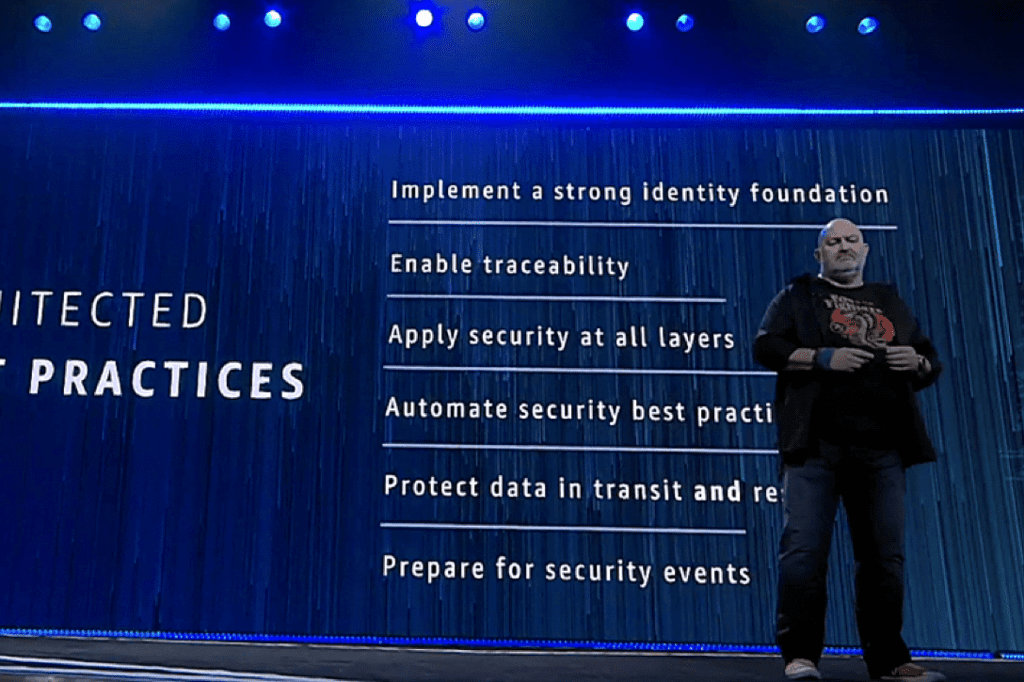

Cloud security is top of mind for many in IT today, including Amazon Web Services (AWS) CTO Werner Vogels. During his keynote address Nov. 30 at the AWS re:Invent conference in Las Vegas, Vogels detailed multiple security best practices that help to enable a well-architected cloud architecture.
“Protecting your customer should be your No. 1 priority; without that you don’t have a business,” Vogels said.
In his opinion, security is more important than any feature development, Vogels said. He noted that at AWS, security will always be his group’s No. 1 investment area.
There are a number of well-architected security best practices that Vogels sees as being important in the cloud and everywhere else. The first principle is to implement a strong identity foundation that implements a policy of least privilege. With least privilege, users only get the access they need to accomplish a specific task. When developers start to build systems, a common practice is to give everyone full root privileges, which is a practice that Vogels said needs to be reduced.
“Basically, you should start taking away IAM [Identity and Access Management] rights until you can no longer do your job,” he said. “Least privilege is a very important principle for keeping your systems secure.”
Vogels also suggested that developers have tracing and auditing tools in place to be able to check for potential risks. In addition, he advocated for the use of automation for security best practices where possible to reduce the risk of human errors and omissions.
“Make sure that you are prepared for things that can go wrong because sometimes they will,” Vogels said.
Encryption
There is also a strong need to protect data both in transit and at rest with data encryption technologies.
“I believe we have not taken encryption seriously enough,” Vogels said. “Encryption is the only tool you have to be absolutely sure that you are the only one that controls access to your data.”
Perhaps five years ago data encryption tools were not easy to use, but that’s no longer true today, he said. Encrypting data both in transit and at rest should be the default behavior for IT, and AWS now provides its users with many easy-to-use options for enabling encryption, Vogels said.
“There is no excuse anymore to not use encryption,” he said. “At minimum, encrypt all the personally identifiable information from your customers and all critical business data.”
While security is often considered to be a separate discipline within IT, Vogels emphasized that security is everyone’s job in IT now. Ranging from development with continuous integration all the way to deployment and operations, security needs to be part of the process, according to Vogels.
“You as developers now have to be security engineers,” he said. “It is all our tasks now to protect our customers.”
The rapid pace of innovation and code deployment in the modern DevOps era is one of the leading reasons why security needs to be a core developer task.
“The pace of innovation has to meet the pace of protection,” Vogels said.
Sean Michael Kerner is a senior editor at eWEEK and InternetNews.com. Follow him on Twitter @TechJournalist.