








- Bringing the New App Economy Into Enterprises: 10 Ways to Do It
- View Your Enterprise Through App Glasses
- Marry Rich Capability With Progressive Disclosure
- Evolve Software Distribution Into ‘Shopping’
- Transform Corporate Bonuses Into Revenue
- Blur Trust Boundaries
- Cultivate Internal, Partner, and Customer ‘Entrepreneurs’
- Budget Small, Fail Fast and Iterate Quickly
- Elevate Web Services Into API Products for Developers
- Solve Authorization Problems at the API Boundary
- Connect People to People
Bringing the New App Economy Into Enterprises: 10 Ways to Do It

by Chris Preimesberger
View Your Enterprise Through App Glasses

IT managers should start looking at how their back-end systems might become more modular and “app-like.”The days of hardware and software vendor lock-in, immobile functionality and proprietary licensing limitations are rapidly going the way of the dinosaurs.
Marry Rich Capability With Progressive Disclosure
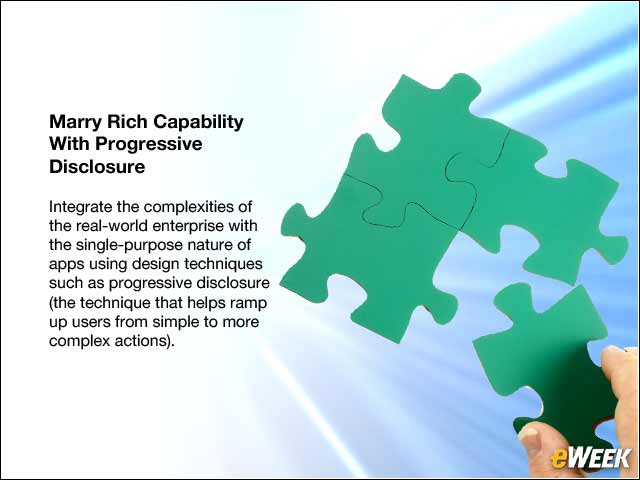
Integrate the complexities of the real-world enterprise with the single-purpose nature of apps using design techniques such as progressive disclosure (the technique that helps ramp up users from simple to more complex actions).
Evolve Software Distribution Into ‘Shopping’
An app store is a good and well-understood experience; the IT help desk can be the opposite. The same can go for software provisioning in an enterprise. If you focus on the end-user experience, the rest will follow.
Transform Corporate Bonuses Into Revenue

This is a way to foster entrepreneurship in-house, by linking bonuses to the revenue produced by apps. This might be in the “far-out-there” category, but it’s an important idea to keep in mind for the future.
Blur Trust Boundaries
You cannot erase the lines or “trust boundaries” between the enterprise and the external world (customers and partners), but you can make it easier and more porous for information to flow in and out. A well-constructed data access and security system that fits your company or industry is a must, but keeping the user in mind has to be priority No. 1.
Cultivate Internal, Partner, and Customer ‘Entrepreneurs’
Well-designed and promoted APIs can be a valuable link among organizations working together toward a common goal. Partners—especially small partners or vendors selling to a bigger company—often are eager to help push innovation into an enterprise through an API.
Budget Small, Fail Fast and Iterate Quickly
Opt for slower, more agile development over waterfall (all-at-once) development. This enables a smaller, iterative budget and the ability to learn lessons quickly. Failures often can be better spotted in an iterative environment.
Elevate Web Services Into API Products for Developers
This is about taking the old back end of 75 SOAP (Simple Object Access Protocol) services trying to talk to each other and creating a product that developers can actually use. Mediate between SOAP and REST (representational state transfer) to try and get the cultures working together.
Solve Authorization Problems at the API Boundary
The smarter, more proactive and more aggressive an organization is when putting in authentication at the API boundary, the more quickly value will be produced on the other side of it.
Connect People to People
People making software the value chain between the app and the API is human. Remember to align with the real world. Once you treat the API as a product—knowing that the developer is the customer—that’s when you’re off to the races.