







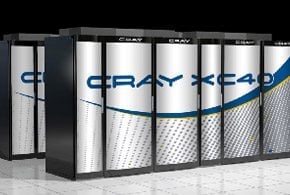
Cray will be furnishing Microsoft’s cloud with supercomputing systems, allowing Azure customers to accelerate their high-performance computing (HPC) workloads, the two companies announced on Oct. 23.
“Microsoft and Cray are working together to bring customers the right combination of extreme performance, scalability, and elasticity,” commented Jason Zander, corporate vice president of Microsoft Azure Team, in a blog post announcing the alliance. “Customers can get a dedicated Cray XC or CS series supercomputer in Azure to run HPC and AI applications alongside their other cloud workloads directly on the Azure network.”
Zander added that the systems will seamlessly slip into the existing Azure cloud service portfolio. Cray’s technology integrates with Azure Virtual Machines on the computing front and Data Lake for storage. In terms of artificial intelligence (AI) workloads, the systems will also support Microsoft’s AI platform and Azure Machine Learning, Zander assured.
According to Peter Ungaro, president and CEO of Cray, the arrival of his company’s high-end systems on Microsoft’s cloud makes supercomputing attainable to more enterprises.
“Our partnership with Microsoft will introduce Cray supercomputers to a whole new class of customers that need the most advanced computing resources to expand their problem-solving capabilities, but want this new capability available to them in the cloud,” said the executive in prepared remarks.
“Dedicated Cray supercomputers in Azure not only give customers all of the breadth of features and services from the leader in enterprise cloud, but also the advantages of running a wide array of workloads on a true supercomputer, Ungaro said in his statement.
The Cray-powered Azure supercomputing-as-a-service offerings will be hosted in select Azure data centers. Resource provisioning on Cray XC and CS, along with the accompanying Cray ClusterStor storage systems, will be done on a per-customer basis, according to the companies.
It’s not the first time Cray has partnered with a cloud provider.
In May, the supercomputer maker announced a partnership with Markley, a Boston-based cloud company. Focusing first on life sciences, the first joint service includes big data analytics services based on Cray’s Urika-GX appliances.
For Microsoft, the move is the latest in its efforts to bulk up its cloud-based HPC ecosystem and lure businesses, scientific research labs and other organizations with resource-intensive workloads to Azure.
In 2015, Microsoft snapped up New Zealand-based cloud HPC specialist GreenButton for an undisclosed amount. GreenButton’s on-demand service, called Cloud Fabric, allowed customers to tap a practically unlimited amount of cloud processing power for their big data and HPC workloads.
In August, Microsoft announced it had acquired HPC software maker Cycle Computing while keeping a lid on the financial details of the transaction. Cycle Computing’s claim to fame, besides being a charter member of the Cloud Native Computing Foundation, is orchestration software that enables so-called Big Compute in the cloud to process workloads that would otherwise require expensive on-premise server clusters or a dedicated supercomputer.