






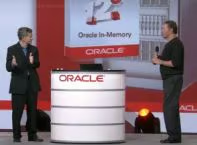


Oracle CEO and co-founder Larry Ellison didn’t have the America’s Cup weighing on his shoulders like he did last September, so he was able to participate Dec. 18 in delivering his company’s fiscal report.
Like the results from the international boat race, Ellison helped deliver a generally good report. Oracle revealed that its fiscal second-quarter earnings grew by 7 percent to beat Wall Street projections and its own guidance from three months ago.
Revenue for the quarter was up 2 percent to $9.3 billion, exceeding analysts’ expectations of $9.2 billion. Net income was up 1 percent to $3.2 billion, so Oracle announced a cash dividend of 12 cents per share, the same as it granted last quarter.
The stock was up 3 percent, or $1.07, to $34.70 at market close on Dec. 18, but it subsequently retreated 70 cents to $34 in after-hours trading.
Perhaps the most important strategic number, however, to come out of the report was 35–meaning the increased percentage of future bookings for the Redwood City, Calif.-based company’s cloud-computing-related services.
“We intend to be a player in all three aspects of cloud: SaaS (software as a service)–cloud applications–platform (as a service), and infrastructure (as a service),” Ellison said on the conference call to analysts and journalists. “We think we’re going to be especially strong in platform. We think our two platform brands–Oracle Database and Java–are stronger than any of our SaaS competitors.
“If you look at Salesforce.com and Force.com and their capabilities versus the Oracle database and Java, we think we have a considerable advantage. Also, in infrastructure (IaaS), we intend to be price-competitive with Amazon and Rackspace.”
Ellison added that in 2014, Oracle will become more competitive in the “commodity infrastructure-as-a-service market, with ‘commodity’ not being a bad word. We also intend to sell our customers not only IaaS, but a highly differentiated platform as a service as well as a highly differentiated suite of applications for the cloud.”
Oracle, like other old-school, all-purpose IT providers IBM, Hewlett-Packard, Cisco Systems, Dell and EMC, is relying more and more on selling cloud-computing software and services for new revenue growth as time moves on.
While its bookings for future cloud enterprise software and services were up 35 percent for the quarter, Oracle’s software and cloud business saw new-subscription revenue slip 1 percent to $2.4 billion.
Co-President Mark Hurd said on the call that “all six of our engineered systems products showed tremendous growth” during the quarter, led by the SPARC Supercluster, Exadata and Exalytics data center systems. Existing revenue from hardware updates and support was up 6 percent at $4.5 billion–much better than in past quarters since Oracle bought its hardware franchise from Sun Microsystems in 2010.