








- 10 Big Data Trends Apt to Influence Enterprises in 2015
- The Rise of the Chief IoT Officer
- Analytics Will Be No. 1 Priority for IoT Initiatives
- IoT Platform-to-IoT Platform Integration Will Drive Relevance
- Industrial/Enterprise IoT Will Take Center Stage
- Data Will Get Bigger and Faster With More Analytics
- More Flexible Stacks Than Purpose-Built Stacks
- More Horizontal Integration
- More Vertical Applications
- Decentralization
- Integration of Advanced Analytics and Machine Learning
10 Big Data Trends Apt to Influence Enterprises in 2015

by Chris Preimesberger
The Rise of the Chief IoT Officer

In the not too distant past, there was an emerging technology trend called e-business. Many CEOs wanted to accelerate the adoption of e-business across various corporate functions, so they appointed a change leader often known as the vice president of e-business, who partnered with functional leaders to help integrate e-business processes and technologies with legacy operations. The Internet of things (IoT) represents a similar transformational opportunity. As CEOs start examining the implications of IoT for their business strategy, there will be a push to drive change and move forward faster. A new leader, called the chief IoT officer, will emerge as an internal champion to help corporate functions identify the possibilities and accelerate adoption of IoT on a wider scale.
Analytics Will Be No. 1 Priority for IoT Initiatives
The top priority in 2015 is translating data to business value; 2014 was about sensors and devices. The initial objective of many IoT projects was about simply placing sensors on critical assets, such as aircraft engines, cell phone towers and cargo containers, as a way to start collecting real-time event data. Early IoT pilots demonstrated the wealth of information made possible by sensors and connections. In 2015, the attention will quickly shift from simply enabling IoT to generating benefits from IoT. Timely analytics is key in gaining actionable insights from data.
IoT Platform-to-IoT Platform Integration Will Drive Relevance
Forrester recently stated: “IoT software platforms will become the rage in 2015.” Indeed, many IoT software companies are thinking platform rather than modules. However, an IoT platform’s real value will be driven by its integration with other IoT platforms. The reality is that there is no single, end-to-end IoT platform that can deliver device management, data aggregation, analytics and visualization for a span of potential IoT use-cases. Therefore, the power and value proposition of an IoT platform will be driven by its connection and integration with other complementary IoT platforms.
Industrial/Enterprise IoT Will Take Center Stage
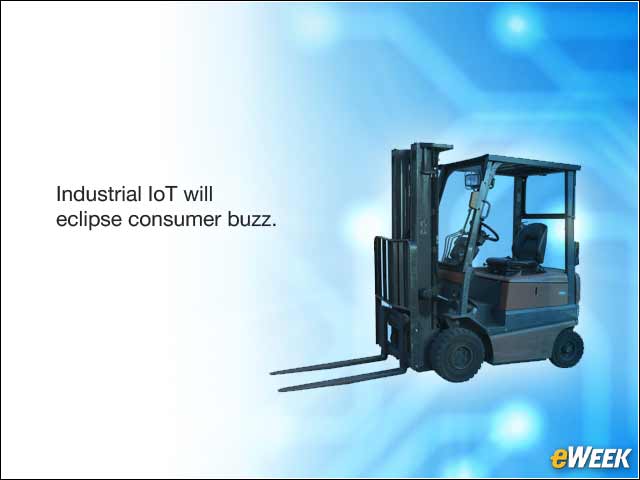
Driven by well-publicized acquisitions (such as Google Nest) and high-profile new products (such as Fitbit and Apple Watch), consumer IoT has received a disproportionate amount of media attention compared with industrial IoT. Although consumer IoT will eventually be a huge market, the hype greatly outweighs the near-term reality with respect to adoption. However, the tide is turning, and industrial IoT will take the spotlight in 2015 as the media starts to more frequently cover the massive opportunity and traction of enterprise IoT in driving efficiency and creating new business models.
Data Will Get Bigger and Faster With More Analytics
We will see greater demand for IoT analytics. Due to increased competitive pressures, organizations need to optimize processes and products; the key to identifying optimization opportunities and tracking improvements is in IoT data. As the cost of sensors and data processing continue to drop, we will see more data, much of which will be analyzed in near-real-time.
More Flexible Stacks Than Purpose-Built Stacks
We still see a lot of purpose-built solution stacks being built—from sensors all the way up to applications. Although purpose-built solutions are able to deliver an ideal solution for one specific use-case, they are expensive, inflexible and lack the ability to easily integrate and share data. In 2015, we will see tremendous change in the speed of response to market changes. Enterprises will embrace more flexible packages that can be updated on the fly, ideally by business people not requiring IT support.
More Horizontal Integration
We will see more horizontal components—tools and components that span different platforms—gain traction in the market. Organizations will use building blocks optimized for certain infrastructural tasks, such as device management, data collection, storage, analytics and application management. Standardization will play a big role in enabling such horizontal platform components to work well with each other.
More Vertical Applications
We also will see more industry- and business-specific (vertical) applications because these are the best way to put data in context and convey an insight to a particular user-group. A vertical application shows the relevant information in a way that the target audience understands easily. Apps that put analytics up-front are good for analytically minded people, but not everybody enjoys surfing data; most people prefer a context- specific presentation (or summary) of only the most relevant data.
Decentralization
The volume of data from disparate devices will continue to grow, and analysis in near-real time will become more important. As time goes on, this also will require more decentralized processes. Think about a ship in the middle of the ocean: Do you really want to transfer all low-value log data from all sensors, machines, routers and switches to a central data analytics installation? The cost of transferring data from all over the world in real time to a central location is too high. Furthermore, network latencies and interruptions prohibit the use of centralized solutions.
Integration of Advanced Analytics and Machine Learning
There is so much talk about advanced analytics (AA), artificial intelligence (AI) and machine learning (ML) that most people have a hard time understanding it. The good news is that the majority of people do not have to understand. They instead should care about their operational processes and products, not about math. AA delivers hints that we human beings might miss due to the sheer volume, speed and complexity of the IoT data available. These hints could be valuable starting points for more detailed analysis.