








20 Things You Might Not Know About COBOL (as the Language Turns 50)

by Darryl Taft
No Title
The name COBOL was decided upon at a meeting of the Short Range Committee of CODASYL (the Conference on Data Systems Languages) held on Sept. 18, 1959.
No Title
COBOL, one of the oldest programming languages, gets its name as an acronym for Common Business-Oriented Language, and is primarily used in business, finance and administrative systems for companies and governments.
No Title
$2 trillion is the total investment in COBOL systems.
No Title
Five billion lines of new COBOL are developed every year.
No Title
More than 80 percent of all daily business transactions are processed in COBOL.
No Title
More than 70 percent of all worldwide business data is stored on a mainframe.
No Title
More than 70 percent of mission-critical applications are in COBOL.
No Title

Even 50 years later, 15 percent of all new application functionality will be written in COBOL.
No Title
More than 310 billion lines of software are in use today and more than 200 billion lines are COBOL (65 percent of the total software).
No Title
COBOL is an anagram of BCOOL!
No Title
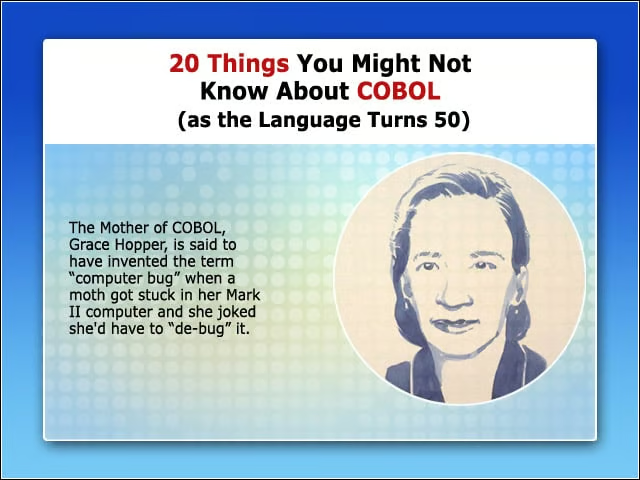
The Mother of COBOL, Grace Hopper, is said to have invented the term “computer bug” when a moth got stuck in her Mark II computer and she joked she’d have to “de-bug” it.
No Title
There are 200 times more COBOL transactions per day than Google searches worldwide.
No Title

COBOL is changing with the times. COBOL is being re-energized as an important component of moving businesses to the Web seamlessly and efficiently.
No Title
An estimated 2 million people are currently working in COBOL in one form or another.
No Title
The COBOL 2002 standard includes support for object-oriented programming and other modern language features.
No Title

Work is progressing on the next full revision of the COBOL Standard. It is expected to be approved and available in the early 2010s.
No Title
Though named in September 1959, the COBOL subcommittee completed the specifications for COBOL in December 1959.
No Title
The first compilers for COBOL were subsequently implemented during the year 1960.
No Title
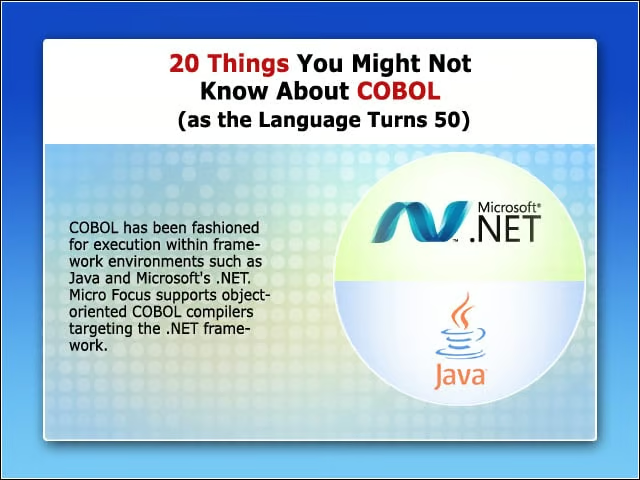
COBOL has been fashioned for execution within framework environments such as Java and Microsoft’s .NET. Micro Focus supports object-oriented COBOL compilers targeting the .NET framework.
No Title
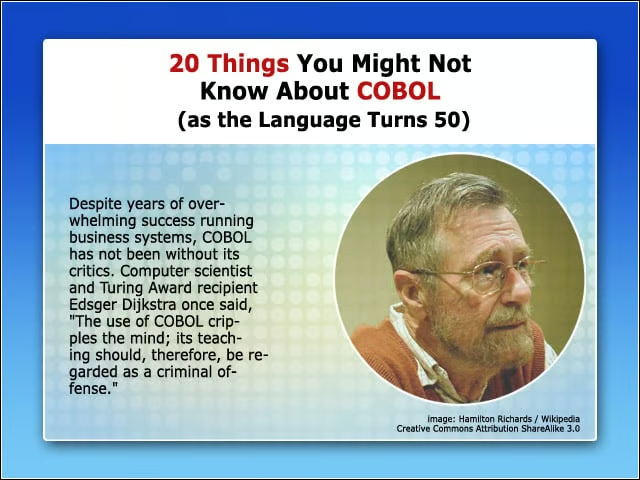
Despite years of overwhelming success running business systems, COBOL has not been without its critics. Computer scientist and Turing Award recipient Edsger Dijkstra once said, “The use of COBOL cripples the mind; its teaching should, therefore, be regarded as a criminal offense.”