








- Data-Retention Trends for 2014: Expect Much More Automation
- Strained IT Will Demand More Operational Simplicity From Vendors
- CIOs Become Cloud Operators
- Internet of Things Accelerates Data Explosion
- Customer Experiences to Be Measured in Milliseconds
- Systems Requiring Planned Downtime Will Be Eliminated
- Continued Growth of Unstructured Data
- New Storage Technologies Will Expand Roles and Gain Ground
- File-Based Storage Solutions Will Remain at Center Stage
- Increased Focus on Data Profiling
- Active Archives Will Become Mainstream in Long-Term Data Storage Environments
Data-Retention Trends for 2014: Expect Much More Automation
by Chris Preimesberger
Strained IT Will Demand More Operational Simplicity From Vendors
While IT budgets will increase in 2014, Gartner says it will be at a slow, steady rate. However, operations teams will need to optimize to handle exponential growth in data and traditional systems simply won’t fit into these budgets. To optimize the operations’ budget—and ensure the team’s sanity and sleep schedules—they will value operational simplicity and cost-effective scaling above all else. The same budget spent on licensing software at tens of thousands per processor core will be leveraged to achieve massive scale by adopting new technologies. —Basho Technologies
CIOs Become Cloud Operators

Modern approaches to service and application delivery, often used by new-gen companies, will continue to take a substantial foothold in the enterprise market. Businesses will demand that CIOs offer a cloud experience on par or superior to Amazon Web Services, both in cost and capability. To do so, they need to follow Amazon’s thinking from 10 years ago and start implementing distributed environments. CIOs will become more involved in vendor-selection criteria, and internal and external customer requirements will result in many organizations deploying a range of public and private cloud solutions. Given budgetary considerations, these will be an amalgam of internal capabilities (where already extant) and flexible solutions from vendors. —Basho Technologies
Internet of Things Accelerates Data Explosion
The Internet of things is no longer just a catchy marketing phrase; it will drive a new explosion in stored, monitored, processed and analyzed data. Commodity storage and scalable software technologies mean companies will change their approach to data retention and create new data rather than updating or deleting historical information. Additionally, we predict only 1 percent of data in the future will require a relational data model. Companies need flexibility to handle all the data generated and need a cost-effective way of scaling their data storage that ensures critical customer data is always available. —Basho Technologies
Customer Experiences to Be Measured in Milliseconds

Latency metrics are changing. It is estimated that Amazon loses $1,100 in direct revenue from just one second of downtime, so differences of milliseconds really matter. Milliseconds are the new standard, and anything longer will damage the customer experience and revenues. The challenge lies in achieving local latencies while growing globally. The only solution is to keep the data close to the users. Mobile gamers in Japan and France, for example, need to be able to play against each other in near-real time, and regardless of a natural disaster in the U.S. Geodata locality will grow to be even more important and companies will look for ways to easily replicate and scale databases across geographic locations ensuring their data is accessible at the edge. —Basho Technologies
Systems Requiring Planned Downtime Will Be Eliminated
Customers’ needs are changing. Downtime is never an option, an omni-channel experience is now the norm, and low-latency experiences are key regardless of where the customer is located. Distributed systems meet the stringent needs of the customer as they are designed to better manage data and prevent downtime. Basho estimates 90 percent of use cases are better solved with distributed systems, and integrating these systems into the overall infrastructure will allow for further innovations. —Basho Technologies
Continued Growth of Unstructured Data
Despite diminishing IT budgets, unstructured data will continue to grow at an exponentially rapid rate. IDC has forecast 80 exabytes of storage will be needed for 2014, where 70 of these exabytes (almost 90 percent), is expected to come from unstructured data. To meet this challenge, active archives and data tape technologies will play an increasing role as organizations seek innovative storage solutions that meet today’s storage demands where older storage technologies come up short. —Active Archive Alliance
New Storage Technologies Will Expand Roles and Gain Ground
In 2013, object storage established itself as the best new storage architecture to address the scalability challenges faced by industries in which storage is a major component of their business model. In 2014, we’ll see expanded software intelligence that makes tape easier to manage, streamlined within the storage environment. New appliances that front-end tape will make it easier for customers to use low-cost tape, delivering the long-term reliability, access and protection promised by an active archive. —Active Archive Alliance
File-Based Storage Solutions Will Remain at Center Stage
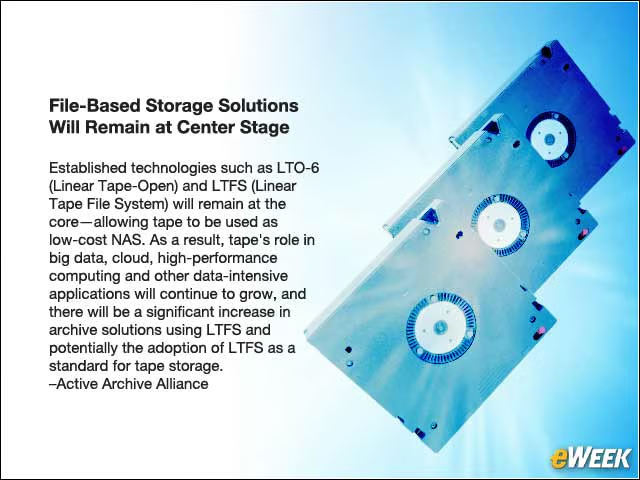
Established technologies such as LTO-6 (Linear Tape-Open) and LTFS (Linear Tape File System) will remain at the core—allowing tape to be used as low-cost NAS. As a result, tape’s role in big data, cloud, high-performance computing and other data-intensive applications will continue to grow, and there will be a significant increase in archive solutions using LTFS and potentially the adoption of LTFS as a standard for tape storage. —Active Archive Alliance
Increased Focus on Data Profiling

The use of rudimentary data profiling will become increasingly important for deploying effective storage management strategies. Understanding baseline file attributes for large data sets will be important for matching performance requirements to storage options. This will allow storage administrators to architect solutions that meet their specific storage requirements and unlocks the inherent benefits of an active archive strategy that results in real, hard dollar ROI. —Active Archive Alliance
Active Archives Will Become Mainstream in Long-Term Data Storage Environments
In 2013, the end-user community gained a solid understanding of the differences between archive and backup and the value archives can bring to their storage strategies. With this foundation set, in 2014, active archives will increasingly become a top strategic purchasing intention of CIOs as they grapple with implementing cost-effective methods to store, retain and retrieve data. —Active Archive Alliance