








- 10 Reasons for Moving to a Converged Data Platform
- Apps Automate Real-Time Adjustments to Improve Business Performance
- Real-Time Analytical Insight
- Lower Total Cost of Ownership
- Faster Application Development
- Reduced Cluster Sprawl
- Consistency in Administration
- Reduced Data Duplication
- Enables Use of New-Gen Tools
- Less Development Effort for Integrating Separate Workloads
- Provides Local Data Access to Enterprisewide Data
10 Reasons for Moving to a Converged Data Platform
From better insights into data to improved administration and security, a converged data platform offers a multitude of benefits.
Apps Automate Real-Time Adjustments to Improve Business Performance
Adapting to changes in systems operations requires capturing event data, assessing that data and responding in real time—all while using deeper historical analysis to create a feedback loop to improve future responses. A good big data analytics function can play a big role here.
Real-Time Analytical Insight
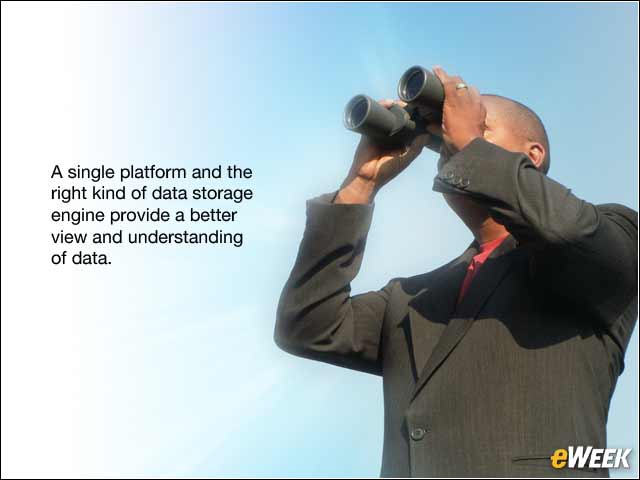
This is used to provide a complete view of data in files, database records and data streams. Data comes from many sources today, and using the right data storage engine in a single platform lets you take advantage of that single view of all data.
Lower Total Cost of Ownership

This emanates from more efficient sharing of resources on a converged platform. Rather than create separate clusters that require separate resource allocation that leads to underutilization across the data center, a converged data platform leads to better utilization and thus fewer hardware expenditures.
Faster Application Development
A converged platform can speed up development of any type of application because it can handle greater volumes of data to add into the development process. Identifying more use cases and more business value from data becomes easier as related—but previously disparate—data sets are correlated in the same platform.
Reduced Cluster Sprawl
This minimizes complexity that can cause errors. With fewer clusters with which to work, a converged data platform reduces the integration processes across those disparate clusters, thus reducing the heavy troubleshooting and resolution work that arises when a problem occurs.
Consistency in Administration

A converged platform generally results in a consistent, unified framework for administration, business continuity, security and data governance. Responsibilities for maintaining data value, including enforcing policies and strategies around business continuity, security and governance, can get overwhelming when you have disparate silos to manage with different administrative controls.
Reduced Data Duplication
This reduces redundancy for the processes and tools required to manage each copy. A converged data platform reduces the data duplication that is necessary in an environment with task-specific silos, which eliminates redundant administration effort for various processes and data management tools.
Enables Use of New-Gen Tools
A broad range of open-source projects are now available for converged platforms that provide a rich diversity of processing options. Big data requires the use of many different technologies, since you’re dealing with many data types and different goals. Having a range of cost-effective tools at your disposal gives you the agility to deliver on important initiatives.
Less Development Effort for Integrating Separate Workloads
New-gen environments often entail real-time and batch processing intersecting with operational and analytical workloads. A converged data platform creates a more seamless handoff between the many workloads you will run to handle big data.
Provides Local Data Access to Enterprisewide Data
A converged data platform can be deployed in many locations around the world, so that distinct user locations can access a cluster in a local data center with high speed and minimized latency. At the same time, each user group can be given access to an enterprisewide view of the data without enduring the latency of accessing geographically remote data centers.